
Five years ago, when I played in the Grenke chess tournament, I said to myself that if I had the chance, I would like to return to play this tournament in Karlsruhe. Years passed, and the Grenke Open was canceled until this year because of COVID-19 and some other reasons. This year, it was announced on short notice that the event would happen again. It is impressive what the organizers managed to do in less than two months!
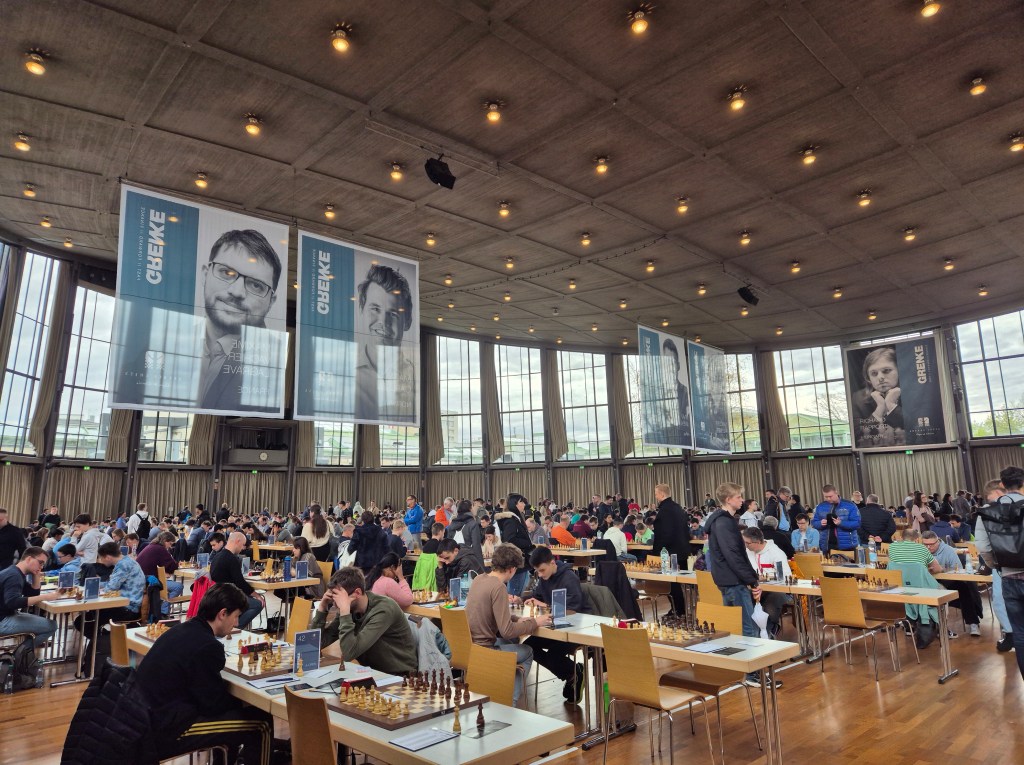
The atmosphere of thousands of people playing chess simultaneously differentiates Grenke Chess Festival from other tournaments worldwide. These people range from the best players to absolute beginners, mainly from Germany and other countries.
At the start of the previous edition of the tournament, there were about 2000 players, but this year, after five years of pause, around 2600 players joined, making Grenke the biggest chess tournament in the world. This happened because the popularity of chess has been rising since the Queen Gambit series.
The festival consists of 4 different tournaments. The classic tournament had only 6 players, among the best in the world. The Open A tournament is open for players with an ELO rating above 2000. The B open is for players below 2000, and the C open is for beginners with less than 1600 ELO FIDE. All the open tournaments were 9 rounds played for 5 days: one round on Thursday, March 28th, and then 2 rounds daily for the next 4 days.
According to some statistics, were 935 players in the A-open, 1177 in the B-open, and 500 in the C-open. One interesting fact is that if the number of rounds is smaller than log2(n) -1, where n is the number of participants, you can end up with more than one player having a maximum number of points at the end of the tournament, which makes it hard to establish a winner. For example, in tournament B, log2 (1177) – 1 > 9 (number of rounds), but fortunately, there was just one winner with 8.5 out of 9.
I played the B open with an ELO rating of 1857. I scored 5.5 out of 9 games: 5 wins, 1 draw, and 3 losses. Two of my losses were against players above 1900, including the last winner of the B tournament. The third lost game was against a lower-rated player in a completely won material and positional position. I guess I just relaxed too soon and blundered one piece and the game. I ended up at position 244 from 1177, which was better than my initial ranking of 303. As a result, I lost 3 ELO rating points. For comparison, 5 years ago, I was rated 1874 and made 6 points out of 9, losing 9 rating points and finishing 109 out of 797 players. The overall result was better last time, but the rating performance was better this time. This is possible when you play against people with higher ratings.
Overall, I am happy with my result because I don’t spend time preparing for chess.. Five years ago, I was more serious about training and playing than I am now. You can’t make progress in chess if you don’t work on it.

Some sensation from the tournament was the draw obtained in round 2 by a junior Romanian FIDE master against the 9th player in the world, Arjun Erigaisi ( also the rating favorite of A-open). The winner of the classic chess tournament was Magnus Carlsen, the best player in the world. The winner of the A-open was Hans Moke Niemann, known in the chess world for the trial against Magnus Carlsen.
Some recommendations for people interested in participating in future editions. The playing venue is great, the space and the conditions are perfect. They have wooden boards and pieces for everyone ( they needed more than 1300 boards and pieces this time). The tables are big, the chairs are good, you have enough space during the game. The only downside is the noise. You can’t be silent in an ample open space with more than 1500 simultaneously. This was not a problem for me, but I saw some players wearing earplugs. This recommendation is good for people who can’t focus because of noise. Don’t come to Grenke if this is your first tournament. The reason is that 4 days with double rounds means intensively playing chess for 7-8 hours each day. It may be like running a marathon by an untrained person.

I also have some recommendations for the organizers: Send SMS/WhatsApp messages to players with the pairings for the next round. Make some announcements in English, not only in German.
The chess world has changed a lot in the last five years. Now, all the top tournaments have live coverage on YouTube, with Grandmasters covering the games. Recently, players of different strengths have come to play in tournaments with tools, stream their games online, and have someone else comment live on them. For me, this is useful as I can learn more from the games of a 2000 ELO-rated player (close to my level) than I can learn from 2700+ players.
I would happily return to this tournament because of the unique positive vibe and energy.
 Adrian Matei's blog
You must be logged in to post a comment.