
When registering for the 50th edition of the Roma-Ostia Half-Marathon, I became curious about the history of this race distance. I had always assumed the half-marathon was a more recent creation, but I wanted to learn more.
To understand the history of the half-marathon, we must first explore the origins of its full-distance counterpart: the marathon. The marathon’s roots trace back to the famous legend of Pheidippides, a Greek messenger who reportedly ran around 40 kilometers from Marathon to Athens to deliver news of a military victory. Legend says he collapsed and died from exhaustion after delivering his message.
Interestingly, there were no marathons or long-distance races exceeding 5 kilometers in the ancient Olympic Games. The marathon as we know it today began with the inaugural modern Olympic Games in Athens in 1896. That first race was in fact from Marathon to Athens as in the legend. For the first editions of the Olympiad, the marathon distance varied between 39-42 kilometers. The first Olympic marathons were races full of challenges, with the 1904 St. Louis Marathon being the probably the most strange running race of all times.
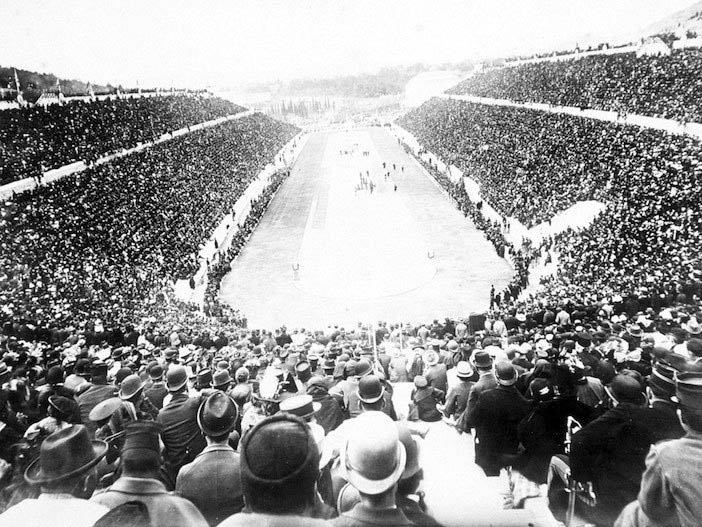
The marathon distance of 42,195 meters (26.2 miles) was officially established during the 1908 London Olympic Games. The race was originally planned to be 26 miles long, but at the request of Queen Alexandra, the starting point was moved to Windsor Castle’s lawn so the royal children could watch the start from the nursery. This adjustment added 352 meters, creating the now-standard distance.
As the marathon gained popularity, races began appearing outside the Olympics. The Boston Marathon, for instance, was first held in 1897, inspired by the Athens Olympics. In the UK, the Polytechnic Marathon was established to train athletes for the Games, while in the continental Europe, the Kosice Peace Marathon, which began in 1924, is the oldest continuously running marathon on the continent.
While the marathon’s history is well-documented, the half-marathon’s origins are more ambiguous. The longest distance ran inside stadium at official competitions was 10 kilometers. There was a big gap between 10k and marathon and this is how appeared the need for an intermediary distance. Why they chose half-marathon instead of 20 kilometers or 15 miles? Because the marathon distance was standardized by mid of last century and meant the same thing everywhere in the world.
Wikipedia mentions as the first race the Route du Vin Half Marathon which started in 1961. But they also say that it was not the exact 21097 meters (13.1 miles) until 1990s. Given this situation other sources mentions the Freckleton half-marathon as the the first race to match this exact distance in 1965. There are also other events that claim to be the first half-marathon. For sure the first half was run in the 1960s. Regardless, the half-marathon emerged roughly 70 years after the marathon.
One reason for this unclear history is that the half-marathon remained relatively unpopular until it became part of the World Athletics Road Running Championships in 1992. This addition helped elevate its profile, making any half-marathon with more than 50 editions, like the Roma-Ostia, a truly special event.
The popularity of the half-marathon has skyrocketed in recent years. In 2019, more than 2 million participants ran half-marathons globally, double the number of marathon runners. Many major half-marathons now sell out months in advance, reflecting their appeal to both seasoned runners and beginners alike.
Social media and the internet have undoubtedly played a significant role in this surge. Seeing friends share their running experiences online has inspired others to try it themselves, discovering that long-distance running is achievable with consistent effort. The half-marathon, in particular, strikes a perfect balance, challenging yet accessible, making it the ideal entry point for many aspiring runners.
Half-marathon has a history of only around 60 years but the best times of this race are still ahead. You can contribute to this history too!

 Adrian Matei's blog
You must be logged in to post a comment.