Helsinki offers three half-marathons over the summer, but the most interesting is the one during City Running Day. The main attraction of this half-marathon is finishing inside the stadium that hosted the 1952 Summer Olympic Games. There are not many races in the world inside an Olympic stadium. Another attraction is that most of the route is on the seaside of Helsinki, in nature, around lakes, and inside forests. It is not a typical city marathon.
Sightseeing from Helsinki route
The event was very well organized and had many positive aspects. Many volunteers were on the route, ensuring things were okay—this was a record number of volunteers for a race. They served water and isotonic every 4-5 km. People started in waves every 10 minutes, so it was not crowded at the start, and you could run faster if you wanted to and were able to.
During the race
I would have preferred that they don’t have hills. Also, about 5 km of the total distance is not on asphalt but on gravel. You will definitely end up with pebbles inside your shoes. These are not good conditions for me, but they might be suitable for other runners. For people who like to run in the mountains, this is much better than running only on asphalt.
The race day was perfect, with temperatures of about 13 degrees Celsius. The only problem was the wind. The Marathon started at 9:30 AM, and the half-marathon was held in the afternoon from 2:20 PM, similar to in Gothenburg.
On the Olympic Stadium
My race went according to plan for the first 3 km until I stopped to drink isotonic water. The hills came, and I went from a race mindset to a mood of enjoying nature and the moment and not focusing on the time to finish the race. I stopped and drank isotonic water at each post. Running on pebbles was also not fun.
Upon entering the stadium, I removed my cap as a sign of respect for the history of this temple of athletics. The finish was lovely, with many spectators encouraging the runners in the Olympic stadium. The organizers made the most of this attraction by charging a 50 euro entry fee for the Half-marathon and a 60 euro price for the pictures.
Prize giving for marathon runners
My friend Bogdan had an interesting number at the start. Compared with me, he is better trained and was able to focus on the race and finish in 1:47. If it wasn’t for the climbing and descending, he would have achieved a personal best at this race.
With Bogdan before the start
My main reason for choosing this race was the finish at the Olympic stadium. It was in this place, at the 1952 Olympic Games, that Emil Zatopek won gold at 5000m, 10000m and Marathon. No other athlete ever done that and very likely no one else will ever be able to achieve the triple win at an Olympics Game. I consider Zatopek the most remarkable human in athletics, not only for his results but also for the courage to always do what is right. In Czechia, they recently made a movie about his sports career.
Five years ago, when I played in the Grenke chess tournament, I said to myself that if I had the chance, I would like to return to play this tournament in Karlsruhe. Years passed, and the Grenke Open was canceled until this year because of COVID-19 and some other reasons. This year, it was announced on short notice that the event would happen again. It is impressive what the organizers managed to do in less than two months!
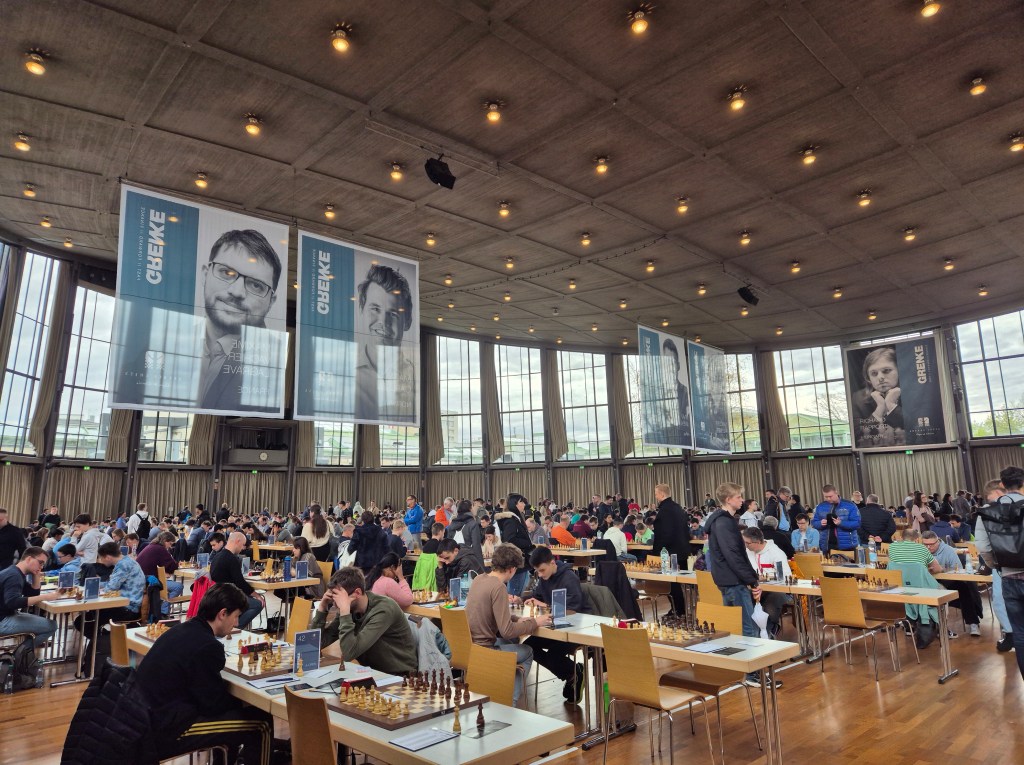
The atmosphere of thousands of people playing chess simultaneously differentiates Grenke Chess Festival from other tournaments worldwide. These people range from the best players to absolute beginners, mainly from Germany and other countries.
At the start of the previous edition of the tournament, there were about 2000 players, but this year, after five years of pause, around 2600 players joined, making Grenke the biggest chess tournament in the world. This happened because the popularity of chess has been rising since the Queen Gambit series.
The festival consists of 4 different tournaments. The classic tournament had only 6 players, among the best in the world. The Open A tournament is open for players with an ELO rating above 2000. The B open is for players below 2000, and the C open is for beginners with less than 1600 ELO FIDE. All the open tournaments were 9 rounds played for 5 days: one round on Thursday, March 28th, and then 2 rounds daily for the next 4 days.
According to some statistics, were 935 players in the A-open, 1177 in the B-open, and 500 in the C-open. One interesting fact is that if the number of rounds is smaller than log2(n) -1, where n is the number of participants, you can end up with more than one player having a maximum number of points at the end of the tournament, which makes it hard to establish a winner. For example, in tournament B, log2 (1177) – 1 > 9 (number of rounds), but fortunately, there was just one winner with 8.5 out of 9.
The main playing hall
I played the B open with an ELO rating of 1857. I scored 5.5 out of 9 games: 5 wins, 1 draw, and 3 losses. Two of my losses were against players above 1900, including the last winner of the B tournament. The third lost game was against a lower-rated player in a completely won material and positional position. I guess I just relaxed too soon and blundered one piece and the game. I ended up at position 244 from 1177, which was better than my initial ranking of 303. As a result, I lost 3 ELO rating points. For comparison, 5 years ago, I was rated 1874 and made 6 points out of 9, losing 9 rating points and finishing 109 out of 797 players. The overall result was better last time, but the rating performance was better this time. This is possible when you play against people with higher ratings.
Overall, I am happy with my result because I don’t spend time preparing for chess.. Five years ago, I was more serious about training and playing than I am now. You can’t make progress in chess if you don’t work on it.
Part of the tournaments B and C area
Some sensation from the tournament was the draw obtained in round 2 by a junior Romanian FIDE master against the 9th player in the world, Arjun Erigaisi ( also the rating favorite of A-open). The winner of the classic chess tournament was Magnus Carlsen, the best player in the world. The winner of the A-open was Hans Moke Niemann, known in the chess world for the trial against Magnus Carlsen.
Some recommendations for people interested in participating in future editions. The playing venue is great, the space and the conditions are perfect. They have wooden boards and pieces for everyone ( they needed more than 1300 boards and pieces this time). The tables are big, the chairs are good, you have enough space during the game. The only downside is the noise. You can’t be silent in an ample open space with more than 1500 simultaneously. This was not a problem for me, but I saw some players wearing earplugs. This recommendation is good for people who can’t focus because of noise. Don’t come to Grenke if this is your first tournament. The reason is that 4 days with double rounds means intensively playing chess for 7-8 hours each day. It may be like running a marathon by an untrained person.
Excellent conditions to play chess in Karlsruhe
I also have some recommendations for the organizers: Send SMS/WhatsApp messages to players with the pairings for the next round. Make some announcements in English, not only in German.
The chess world has changed a lot in the last five years. Now, all the top tournaments have live coverage on YouTube, with Grandmasters covering the games. Recently, players of different strengths have come to play in tournaments with tools, stream their games online, and have someone else comment live on them. For me, this is useful as I can learn more from the games of a 2000 ELO-rated player (close to my level) than I can learn from 2700+ players.
I would happily return to this tournament because of the unique positive vibe and energy.
As in this article, I compared this edition with the one five years ago and chose to end with a song on this theme.
Usually, at the end of the year, I write about chess tournaments. Unfortunately, the European Rapid and Blitz Chess Championship moved from Katowice to Zagreb this year. I couldn’t find a convenient flight to Zagreb. I looked for a similar tournament somewhere in Europe where I could easily travel. I found a tournament in Cluj, which is part of the Romanian Grand Prix tournaments. I booked the travel details for Cluj in advance, but it proved too much in advance. For some reason, the organizers moved the tournament from Cluj to Sebes. Sebes is 120 km south of Cluj, hard to reach from Cluj if you don’t have a car, and has few attractions. In these circumstances, I could visit Cluj as a tourist in November or lose the money spent traveling there. I chose the first option, and I am happy with that. Cluj has greatly developed in recent years and is a vibrant and modern city.
Instead of playing chess, I write about the game. In my opinion, the most interesting thing that happened in chess was the Polgar experiment.
Laszlo Polgar, a Hungarian educational psychologist, wanted to prove his idea that geniuses are made and not born. He said he would prove this theory using his children. His theory is “that any child has the innate capacity to become a genius in any chosen field, as long as education starts before their third birthday and they begin to specialize at six.”
Together with his wife Klara, they had three daughters and chose to prove the theory by making the girls champions in the chess field. The chess results are very measurable. For example, in the last 40 years, only two players, Kasparov and Carlsen, were number one globally.
Although it was a hardship during communist times in Hungary, and they had to fight with the authorities, they managed to keep the children out of school and teach them at home. The results started when Susan, the eldest daughter, became the highest-rated woman in the world in 1984. Later, in 1988, the Hungarian women’s team, with all three sisters playing, won the Women’s Chess Olympiad. It was a remarkable result and raised a lot of interest about how that was possible.
One should remember that in the 1980s and 1990s, chess was a game played mostly by men. There were few tournaments for women. Conditions were harsh. For example, players smoking at the table during official games was ordinary. A game lasted 6-7 hours in most cases, with intense fighting each day for nine days or more during a tournament. The girls had to fight mentalities and biases to progress in chess.
An example of rough behavior. Sofia Polgar won against former vice-world champion Viktor Korchnoi.
Laszlo Polgar, to prove his theory, aimed for his daughters to become not the best women chess players but the best in the world. For this reason, Susan only played in men’s tournaments for a while. In 1991, Susan became the first woman to obtain the title of chess grandmaster according to the rules and not honorary (as the other two women before her). Later, when it became clear that she couldn’t become the world chess champion, she turned towards women’s tournaments. Susan became the Woman World Champion in 1996.
But the most impressive result was obtained by the youngest daughter, Judit. In 1991, the same year as Susan, Judit became a chess grandmaster at age 15 (the youngest GM in the world at that time). She won many tournaments and aimed to become a world chess champion. In 2005, she played in the candidates’ tournament in Argentina. The winner of that tournament with eight players would become the world champion. Judit did not win the title that time. After that event, she was never close to becoming a champion again. Judit was the highest-rated woman in the world for more than 25 years until she retired from playing official events. Her peak rating was 2735, which made her the 8th highest-rated player in the world. For reference, in chess history, only three women made it to the top 100 players in the world, and only Judit to the top 10. It is hard to put into words how huge this accomplishment was.
Judit Polgar beating Garry Kasparov in a game. At that time, Kasparov was the best player in the world.
To better understand the results, let’s look at some data. The average rating of the top 100 best chess players worldwide was 2692 in December 2023. The average of the top 100 women was 2418. There is a gap of 174 ELO points between the top men’s and women’s players.
Recently, FIDE ( the International Chess Federation) published results on the gender gap in chess. The participation of women in tournaments is under 20 percent in most countries and less than 10 percent in developed Western countries. The reduced number of female players is one reason for the gap between men’s and women’s results in chess. But still, there is a big gap even in 2023 between men’s and women’s results. Based on the above results, Polgar proved his theory is correct. It required a lot of energy and work to achieve these results. Some people condemned Polgar’s experiment, saying he created a “Frankenstein” and put his children to enormous efforts. It is worth mentioning that his children had a successful life outside the chess world. Also, although all are retired these days, their activities are still around chess, and they continue to enjoy the game.
Retired Judit Polgar playing against Magnus Carlsen, the best player in the world, in 2022
Polgar’s idea is that with educated geniuses, humanity can make breakthroughs in science and medicine. I don’t know if anyone is willing these days to make such an effort with children, given that the world has changed so much. The hope for breakthroughs in science and medicine now relies on artificial intelligence.
This experiment had a positive impact in attracting women to play chess and breaking barriers in this game. Despite the statistics above, the number of women in chess has seriously improved. Susan Polgar was the first woman to have a grandmaster title in 1991. Now, there are 41 grandmasters women worldwide. Please keep in mind that the theory works only on children. I witnessed older players trying to improve at chess (including myself), and it is much harder to make progress. If you don’t do it while young, forget about developing later.
I’ve been close to the chess world for 30 years and have witnessed how education works and how children are treated by their parents. Polgar’s experiment is unique. In most other cases, the parents pressure children to obtain results. It is a way for parents to achieve the results they could not get in their own lives through their children. This pressure results in children hating the game and quitting it as soon as possible once they can avoid their parents’ authority. This behavior is happening in all sports or domains where there is competition. Only time will say who was right and who was wrong.
I will end with my favorite chess quote: “In every position, there is a move to be found – but you have to search for it! “– Paul Keres.
Judit Polgar and her sisters organize a chess festival every year in Budapest.




 Adrian Matei's blog
You must be logged in to post a comment.