
In 2024, Prague set a record for participants, with over 13,500 people at the finish. The previous editions had about 10,000 finishers, so there was a significant increase this year. More importantly, 57% of the participants were foreigners. The fact that the race is part of the SuperHalfs helps increase the number of participants.
On April 6th, the day of the race, it was hot in Prague. The temperatures reached 28 Celsius, and the sun was shining. These are not the best conditions for running a long distance.
The race route goes along the Vltava River and crosses five bridges between both sides of Prague. It continues in the old center through Venceslas Square and next to the famous astronomical clock. I am not a big fan of running on cobblestone. I prefer running on asphalt and visiting tourist attractions slowly and not during a run. The finish was in the same place as the start in Bubenské nábř. area.
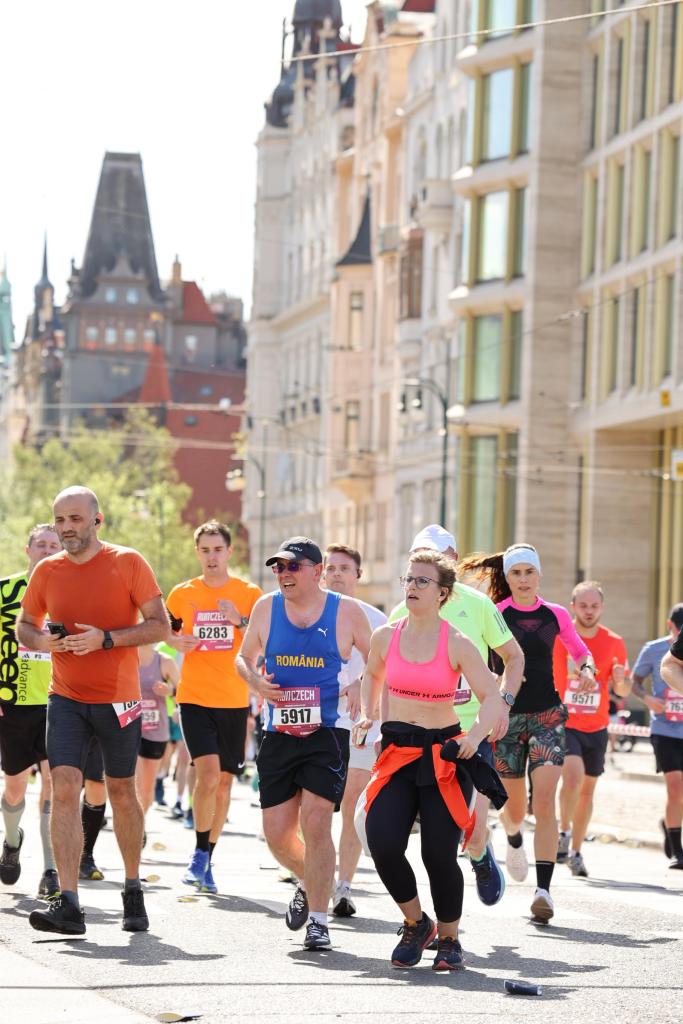
My race went okay in these circumstances, as I know how to run safely in hot weather. If you want to survive a race in hot weather, you need to do a few things: stop and drink water or isotonic at every hydration point, wear a cap, wear a tank top (not a T-shirt), keep the pace in the safe zone, have a couple of gels with you.
I finished at 2:14 without any incident. It was my third-worst time ever, but that did not matter as I checked my third super half race and did not focus on time.
I am very serious about the weather problem while running. In Prague, 102 people fell on the street during the race for different reasons. Of these runners, 36 went to hospital. The authorities declared a trauma plan (a local form of a disaster plan). There was a campaign hospital called Golem at the finish line in a huge tent with air conditioning and ambulances driving people there and into the hospital. I lost the count of fallen runners I saw during this race. It was much worse than in Lisbon. In fact, the sound I heard most during the race was the sound of ambulances. The medical help was very well organized. As a kid in the 80s, I remember watching a Czech serial called “Sanitka” ( The Ambulance) on TV. It was like seeing scenes from those series in Prague that Saturday.
There are many news articles about the problems at the Prague half-marathon, all in the Czech language. I found this post by a Cardiologist, Hanka Štefaničová, who, as a participant, described what happened during the race very well.
What I learned. At the end of the race, there was a problem. The runners who finished had to go on a tight corridor guardrail by fences for 200 meters to get the medals, and then they would get water, bananas, and other refreshments from the organizers. A few volunteers handled medals to racers at the end of these fences. But too many people finished simultaneously, and the queue of racers waiting because of this bottleneck was very long. Imagine the situation: you run under the sun for more than 2 hours, then you have to stop under the sun for 10 minutes or more to wait for the medal. If you get no water, you will collapse.
After getting the medals, some runners understood the gap, took water bottles, and gave them to the people in the queue. I drank 2 such bottles until I got the medal. That saved the other runners and me while waiting in the queue. I know those were ad-hoc volunteers because they all had finishers’ medals on their chests. They were not organizers. At the time, I took the medal and was happy to get the baggage and talk to Bogdan after the race. It didn’t cross my mind to stay and become one of the ad-hoc volunteers to give water to people waiting in the queue. In my mind, I was a participant who finished the race and not an organizer. Sometimes, you need to get out of your role, become human, and do what it takes to help others, even if no one has asked you or is not expecting you to do that.

Some statistics are relevant to what happened. For races with many runners, I look at the time of the runner who finished precisely in the middle of all the runners. If the race has 10k finishers, I look at the time of the runner who finished exactly at 5k at the finish. The table below clearly shows how external factors influence race results.
| City | Date | Finishers | Middle time |
| Warsaw | 18.03.2024 | 13422 | 1:55:20 |
| Lisbon | 18.03.2024 | 13247 | 2:02:40 |
| Prague | 06.04.2024 | 13557 | 2:03:40 |
I have some suggestions for the organizers. For example, they could give runners bottles of water instead of glasses. The volunteers were overwhelmed and did not have enough time to pour water into glasses to give to runners. At the finish, they could have more people to handle medals. Also, if possible, provide water to people once they finish and don’t let them wait under the sun. Set the check time posts in the farthest areas of the route, where people need to turn around. This is a simple mechanism to avoid cheating.
Despite the problems mentioned above, the organizers did a good job overall. A positive note for the area to leave and pick up baggage: it was the best organized I have ever witnessed. The rest of the nice things are expected for major half-marathons: SMS with your result, pictures after the race, refreshments during and after the race.
As for my plans, I traveled by plane four out of five consecutive weekends in March and April for events covered in this blog. It is time to rest and train before my next half-marathon in Helsinki in May.



 Adrian Matei's blog
You must be logged in to post a comment.