This May marks 10 years since I started running. A full decade of runs, finish lines, and the quiet rhythm of feet on pavement. One month earlier I crossed the 12,000 km distance. I’ve written before about other key milestones in this journey, crossing the 6,000 km and later the 10,000 km marks. Both were moments that made me stop, reflect, and appreciate how far I’ve come.
A Tale of Two Cities
The 6,000 km mark was more than just a number, it marked the end of an era. I had spent five years running in Bucharest, where this journey began. Those were the years of building a base, getting to know my limits, and discovering what running meant to me.
Since then, I’ve spent the last five years running in Krakow, a city that’s become just as meaningful. New routes, different seasons, a different pace of life and yet, the same sense of satisfaction after every run.
Racing More Than Ever
After passing the 10,000 km milestone in late 2023, I didn’t slow down. Quite the opposite. I’ve run eight half-marathons and one 10k race in the last 2,000 km alone. This has actually been the most race-filled period of my running life.
What made it even better? Every race was in a different European city. Running became an excuse to travel, a way to combine city breaks with something I love. Explore during the day, race in the morning, and leave with new memories. I’ve shared stories from those races in earlier posts, but they continue to be highlights of the journey.
The Support Behind the Scenes
A big part of what’s kept me going has been the remote coaching and encouragement from Ștefan Oprina. He’s been in my corner all this time, offering structure, insight, and motivation. Having someone experienced guiding me, even from afar, has made a big difference. So thank you, Ștefan!
Setbacks and Slower Paces
Of course, not every step has been smooth. In January 2025, I pulled a hamstring. This likely happened because I pushed too hard on a treadmill session. I was running for 30 minutes at a steady, fast pace. That was a wake-up call. It’s been my only injury, but it reminded me that rest and balance are just as important as discipline.
Lately, my pace has slowed. I haven’t gone under 1:59 in a half-marathon recently. That’s been tough to accept at times, but I’m optimistic that things will pick up again, hopefully starting this autumn.
Looking Ahead
Next up: a race in Tallinn this September. And I’m genuinely looking forward to it. It’s not just about the result. It involves showing up and exploring a new place.
Because at the end of the day, that’s the most important thing: the journey continues.
A traditional duathlon typically combines running and cycling. It’s less well-known than the triathlon, which includes swimming, cycling, and running—in that order. In both formats, the winner is the person who crosses the finish line first.
While I was in Bucharest this May, I experienced a rare coincidence. Two major sporting events were scheduled for the same weekend. One was the Bucharest Half-Marathon, and the other was the Bucharest Chess Grand Prix.
I wanted to participate in both, but unfortunately, the starting times overlapped. Luckily, the running festival included a 10 km race on Saturday morning, which ended before the chess tournament began. That turned out to be the better option. Not only did it fit my schedule, but running 10 kilometers requires significantly less energy than a half-marathon.
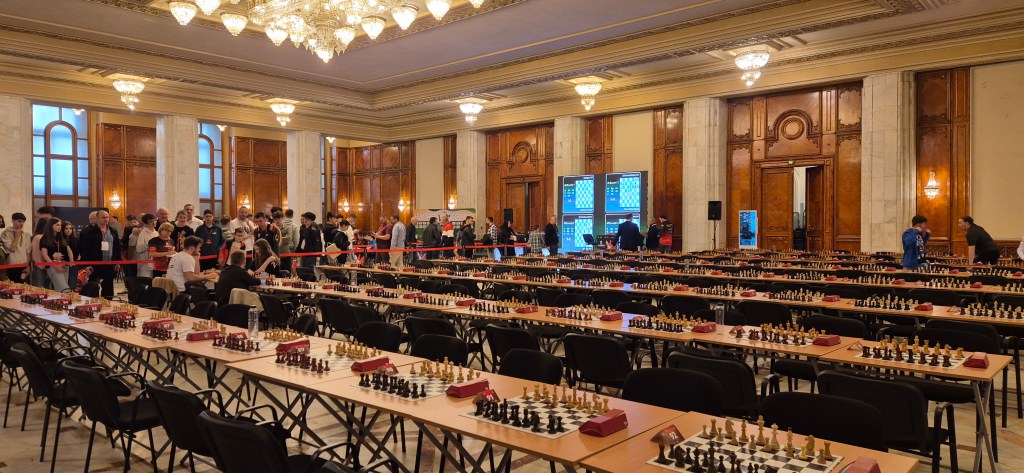
The venue for the chess tournament. Also the finish for the running was in front of the same building
I set myself a simple goal: to finish in the top half of both competitions. For the 10K run, this meant aiming for a time under 58 minutes based on the previous year’s results. For chess, it was more ambitious: scoring at least 5 out of 10 points. My best previous performance had been 4.5 points at the 2022 edition, and I hadn’t done much preparation this time.
The Running Phase
The last kilometer of the race
The day began with the 10K race, an event as well-organized as ever. The weather was perfect for running: cool (6–8°C) with a light drizzle. I started at a pace of about 5:20 per kilometer and maintained it for the first half. I was feeling strong. I sped up for the second half and dropped below 5 minutes per kilometer. I even sprinted the last 200 meters at a pace of 4/km.
I finished with an official time of 52:08, far better than expected. I placed 312th out of 2,957 finishers, putting me in the top 10.5%. However, this statistic is somewhat misleading, as most of the stronger runners competed in the half-marathon on Sunday. So, the field for the 10K wasn’t as competitive.
After the race with colleagues from Trupa lui Fane
A major factor in my performance was the training I did for a month with “Trupa lui Fane” in Bucharest. That preparation made a big difference. For context, I ran the Berlin Half-Marathon in 1:59:32, while the 10K time I just achieved projects to about 1:55:00 for a half-marathon. That gives me hope to break 1:55 at the upcoming Tallinn race.
Many thanks to Ștefan Oprina, who has helped me overcome health challenges and become a better runner over the years!
The Chess Tournament
Later that day at the chess tournament
After the run, I had time to shower and eat before the chess tournament began.
The tournament followed a 10 round Swiss format. That means each player is paired in each round with another player who has the same score. Each game was timed at 15 minutes per player. There was a 5-second increment per move. This is standard practice these days to avoid losses on time in winning positions. The schedule included 4 rounds on Saturday and 6 rounds on Sunday.
I started with 2 points from the first 4 rounds, not great, but acceptable. Sunday started well with a win. Then, I lost against a Candidate Master. I followed up with two more wins (one also against a Candidate Master). That brought me to 5 points from 8 rounds, achieving my goal of finishing in the top half. Unfortunately, I lost the last two rounds against stronger players. In the end, I placed 213th out of 475 players. This result put me in the top 45%. Additionally, I gained 5 ELO points.
A New Type of Duathlon?
This experience made me think: what if we organized duathlons that combined very different events like running and chess?
One idea is to use a simple average of ranks or scores across both disciplines to determine an overall winner. A more refined method could involve using normalization. Each result could be compared to the best and worst performances in each category. This approach allows fair comparisons.
I was thinking of a way to compare results from independent events. In this case a rough formula could be:
Eval = 2×ELO Performance−Race Time (seconds)
The idea is to reward high chess performance. The higher the performance, the better. It also aims to penalize long race times. The lower the race times, the better. I’ll work on refining this formula in a future post.
A Special Chess Anniversary
This year marks the 100 year anniversary of the Romanian Chess Federation. With almost 500 players this was the biggest chess open tournament ever organized in my country. It attracted many strong players and also gave me the chance to reconnect with my chess roots.
I was delighted to see my former coaches again.
I first met Iulian in 1992 when he visited our class during a math lesson. He had just opened a chess club and invited students to join. Our teacher asked who already knew how to play chess, and a few of us raised our hands. He encouraged us to learn more about the game. Shortly afterward, I joined the club, and chess became a lifelong journey. Iulian didn’t play this year, but he was there coaching five juniors. I was part of his first generation of students; since then, many others have followed. Here we are 33 years later still enjoying the game.
With Iulian my first coach
Cristian, a chess master, coached me between 2018 and 2020 before I moved to Poland. He was one of the referees at the tournament and continues to coach young players. During our time working together, I focused a lot on the psychological aspects of chess—understanding how emotions influence decision-making. Chess often goes beyond logic; it’s also about how you manage your internal state.
With Cristian
I’m deeply grateful to both of them for their impact on my life.
Seeing them again, by chance, after several years was one of the weekend’s highlights. We’ve kept in touch, but nothing compares to meeting in person.
There’s a quote I really believe in:
“In life, what matters most is the people you meet and the books you read.”
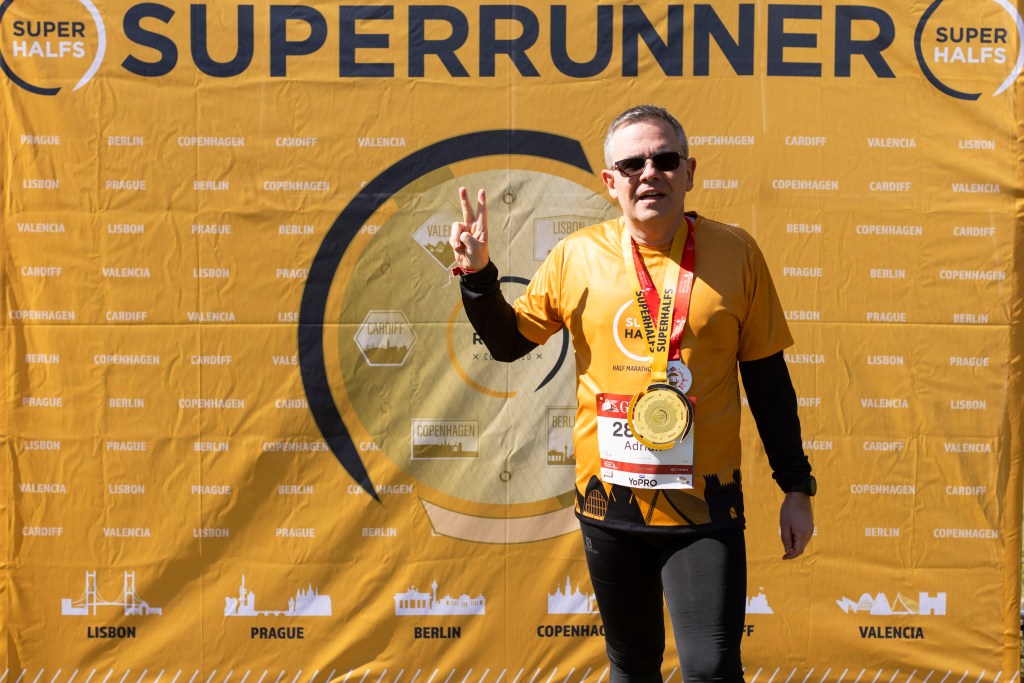
The SuperHalfs program has grown rapidly in popularity. With increasing demand and limited slots available for each race, the organizers have removed the time limit to complete all six events in the series. This move allows more runners to gradually work toward finishing the series over time.
As of May 2025, only 1,113 runners have completed the entire series. This is an impressively small number. Nearly 100,000 people have participated in at least one of the six races. Given these numbers, I thought it might be helpful to share my personal journey and offer some insights for aspiring SuperHalfs finishers.
While you can find the list of finishers on the official SuperHalfs website, gathering deeper data requires some effort. I used ChatGPT to generate code that helped me analyze the number of finishers by country. Here are the results:
Country
Number of finishers
Spain
193
Great Britain
185
Germany
136
Denmark
100
Portugal
92
Italy
74
Czechia
42
France
38
Poland
28
Netherlands
26
Brazil
22
The numbers are interesting. Not a surprise that Spain and Great Britain are on top. In Spain people run fast, they have half-marathons with 2.5 hours time limit to finish, while in the rest of Europe is 3 hours. The UK, meanwhile, has a rich running culture and offers wonderfully organized races. I highly recommend racing in the UK for an unforgettable experience. The first 5 countries from the list are also organizing races from series. Italy is the first country that has many finishers but doesn’t have a race in the program. Interesting Brazil is the only non European country that has many finishers.
Before the Berlin Half-Marathon this spring, only about 480 people had completed the series. Berlin added nearly 700 new finishers in one go, largely because it was newly included in the program just last year.
The SuperHalfs calendar includes three spring races—Lisbon, Prague, and Berlin—and three autumn races—Copenhagen, Cardiff, and Valencia. Since 2025, demand has surged, and most events now use a lottery system to allocate entries.
If you’re not lucky in the lottery, there’s an alternative: official travel agencies offer guaranteed race entries. I used one of these agencies—Germany’s Interair—for the Cardiff Half-Marathon when I joined the event late and couldn’t find an open spot. Their service was excellent.
If you are not lucky winning the lottery, you can use one official travel agency. This agency will guarantee your participation in the race. I had used a travel agency only once during my campaign for the Cardiff half-marathon. I decided to join this race too late and there were no available spots. I used the services of the German travel agency Interair and I was very happy with them.
I’ve written posts about my experiences in each of the six races. Here are a few personal impressions:
Top Picks: For me, the best races are Valencia and Berlin. Both offer outstanding organization and scenic, fast courses—ideal races to conclude your series on a high note.
Cardiff: A very well-organized race with amazing crowd support. However, the course is not flat. It is less ideal if you’re chasing a personal best.
Copenhagen: The course is flat, but I had some concerns when I ran it in 2022. The start was chaotic because there were no wave starts. The course became crowded. Pedestrians were crossing in front of runners, especially in the city center. The finish area was also quite congested. Hopefully, these issues have since improved.
Lisbon: Be mindful of the weather—it can get hot. The course begins with a downhill section, then transitions into rolling terrain before flattening out from kilometer 7 onward.
Prague: My least favorite race. The course includes cobblestone sections in the city center, which can be tough on the legs. Weather can also be unpredictable. A simple way to improve the course would be to extend the riverside sections and avoid the city center altogether. Interestingly, Prague also has the smallest field of runners among the six races.
Here are some highlights of Superhalfs races. Best finish is in Berlin. Valencia has the best atmosphere. It also has the best organization at the start. Cardiff boasts the best public. The best routes are in Valencia and Berlin.
The SuperHalfs program is a fantastic way to combine travel, fitness, and personal achievement. Running a half-marathon isn’t about proving anything to others – it’s a personal journey. And this series makes that journey unforgettable.
If you’re considering joining, act fast. As the series continues to gain traction, getting a spot will only become more challenging.




 Adrian Matei's blog
You must be logged in to post a comment.