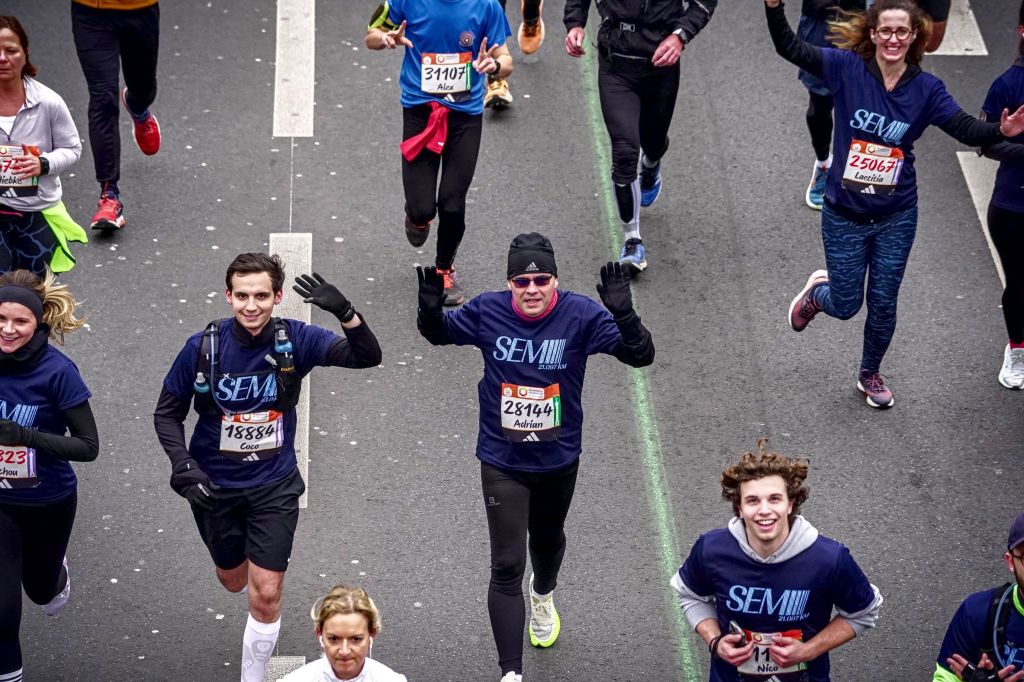
Lisbon half-marathon

My running season this year began with the Lisbon half-marathon. Lisbon is part of Superhalfs, a series of 6 half-marathons you can complete in five years for an extra medal. Together with Bogdan, we registered for this race for a long time.

I returned to Lisbon after ten years and found the city had changed positively. Many buildings were renovated, the cost of living was good compared to central Europe, and people were very relaxed.
On March 17th, we took a morning train to Pragal station and followed the crowds to the start. The first negative surprise was that the organizers blocked the people from getting to the start line for a long time. The problem was that we had no space for warmup before the race. We stayed only in crowds until we went over the start line. This was the worst organization of a start to a half-marathon I have ever witnessed, and you can see I have some experience.
The run starts from Pragal, on the other side of the Tagus River from Lisbon. First, you cross the April 25th bridge. The Lisbon half-marathon is the only way a pedestrian can cross this impressive bridge. If you are afraid of heights, this might be an interesting challenge.

Then, the runners continue off the bridge in Lisbon. The first 5 km are in general descending which is appropriate for speed. From km 7 until the end, the race is flat on the shore of the Tegus River. The finish is next to Belem Tower in front of the spectacular Jeronimos Monastery.

At the start on the other side of the river Tagus from Lisbon

The second negative surprise was the temperature. That day, the weather went up to 27 degrees Celsius, but the main problem was that with a humidity of 80-90%, you feel the temperature is 35 degrees Celsius. If you don’t hydrate well, you risk not finishing the race. On a positive note, the organizers added ad hoc more hydration points towards the end of the race.

During this race, I saw at least 15 people who had fallen and were taken by ambulance or treated on the spot. This is a negative record. I’ve never seen that many people injured in a race. About 250 people abandoned the race.

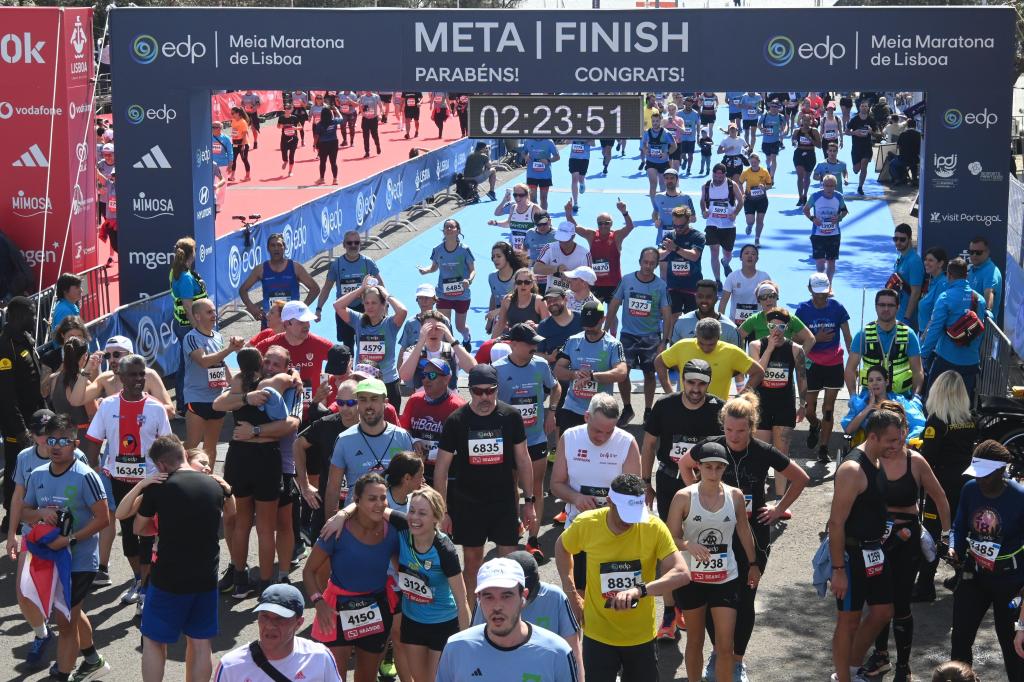
At the finish lane

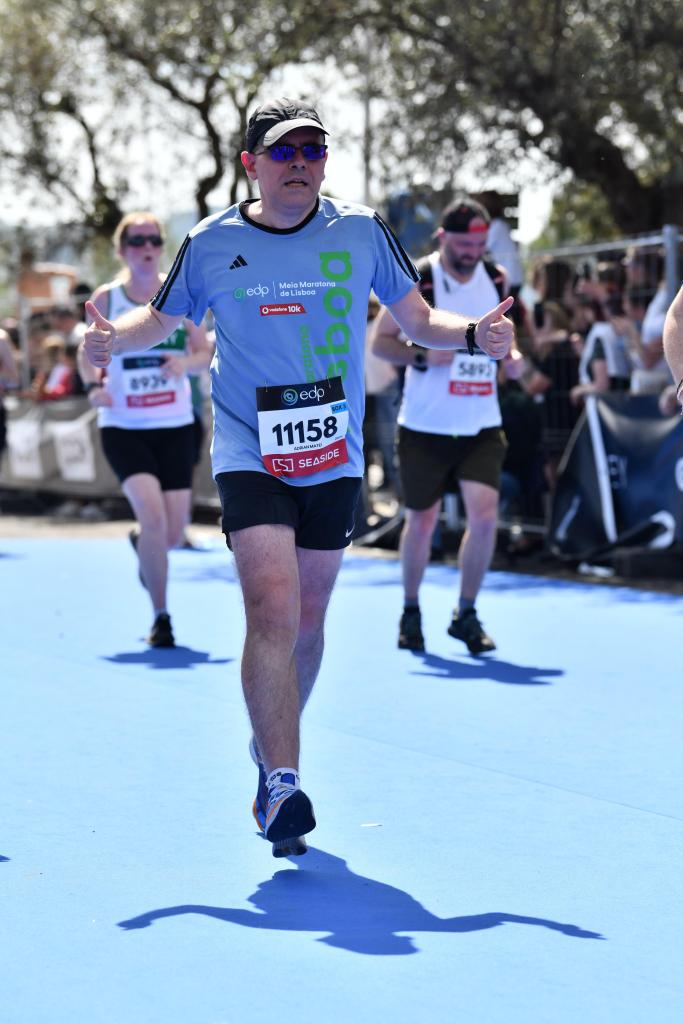
As for me, I wanted to finish in less than 2 hours, and after 9 km, it seemed possible. Unfortunately, at that moment, the third negative surprise happened. As I later found out, I had some food poisoning from the day before, which made me look for a toilet. After solving the problem, I continued the race at around 6’30” pace until the finish line, which I crossed at 2:19. This was my worst time ever in a half-marathon, but I am happy that I finished the race. Even in this challenging situation, I managed to be in the top 10000 from 13200 finishers.

Happy people at the finish

On a positive note, Bogdan had a perfect race in such circumstances, finishing at 1:46:46 ( a time that happens to be my personal best). It was an excellent result for him, being 3062 out of all runners or the top 23%.
All’s well that ends well. Both of us finished the race on time and got medals. Later, I underwent antibiotic treatment, and I was fine.

With Bogdan after the race

Please find some insights for people interested in running this half-marathon in the future. Register at least half a year in advance as the race is quickly sold out. Try to get to the start as early as possible. We arrived at 8:55 ( while the race was scheduled for 10:05), but it needed to be earlier. The organizers created some bottlenecks around the start, and it took a lot of work to get there. The start and finish are not on the same spot, and you can’t bring stuff to leave at the garderobe and pick it back up after the finish. If it is a hot day, please wear a cap. It makes a big difference.

They say that the more challenging the race, the longer you will remember it. This was definitely a race I’ll remember.

Chess story

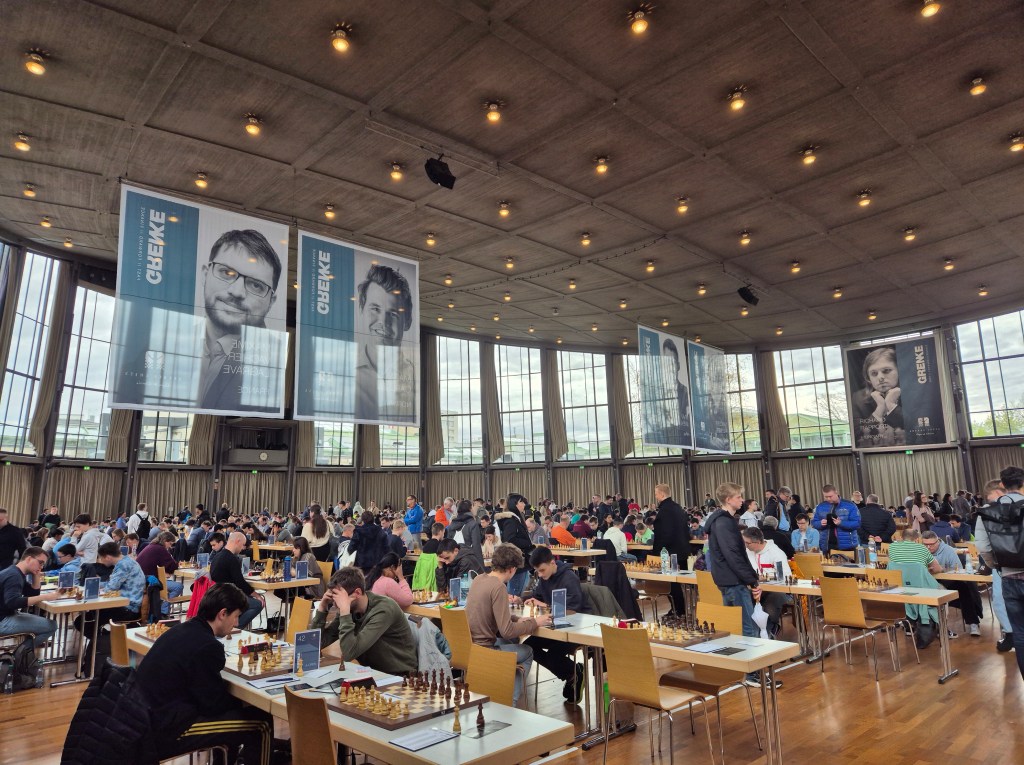
Usually, at the end of the year, I write about chess tournaments. Unfortunately, the European Rapid and Blitz Chess Championship moved from Katowice to Zagreb this year. I couldn’t find a convenient flight to Zagreb. I looked for a similar tournament somewhere in Europe where I could easily travel. I found a tournament in Cluj, which is part of the Romanian Grand Prix tournaments. I booked the travel details for Cluj in advance, but it proved too much in advance. For some reason, the organizers moved the tournament from Cluj to Sebes. Sebes is 120 km south of Cluj, hard to reach from Cluj if you don’t have a car, and has few attractions. In these circumstances, I could visit Cluj as a tourist in November or lose the money spent traveling there. I chose the first option, and I am happy with that. Cluj has greatly developed in recent years and is a vibrant and modern city.

Instead of playing chess, I write about the game. In my opinion, the most interesting thing that happened in chess was the Polgar experiment.

Laszlo Polgar, a Hungarian educational psychologist, wanted to prove his idea that geniuses are made and not born. He said he would prove this theory using his children. His theory is “that any child has the innate capacity to become a genius in any chosen field, as long as education starts before their third birthday and they begin to specialize at six.”

Together with his wife Klara, they had three daughters and chose to prove the theory by making the girls champions in the chess field. The chess results are very measurable. For example, in the last 40 years, only two players, Kasparov and Carlsen, were number one globally.

Although it was a hardship during communist times in Hungary, and they had to fight with the authorities, they managed to keep the children out of school and teach them at home. The results started when Susan, the eldest daughter, became the highest-rated woman in the world in 1984. Later, in 1988, the Hungarian women’s team, with all three sisters playing, won the Women’s Chess Olympiad. It was a remarkable result and raised a lot of interest about how that was possible.

One should remember that in the 1980s and 1990s, chess was a game played mostly by men. There were few tournaments for women. Conditions were harsh. For example, players smoking at the table during official games was ordinary. A game lasted 6-7 hours in most cases, with intense fighting each day for nine days or more during a tournament. The girls had to fight mentalities and biases to progress in chess.

An example of rough behavior. Sofia Polgar won against former vice-world champion Viktor Korchnoi.

Laszlo Polgar, to prove his theory, aimed for his daughters to become not the best women chess players but the best in the world. For this reason, Susan only played in men’s tournaments for a while. In 1991, Susan became the first woman to obtain the title of chess grandmaster according to the rules and not honorary (as the other two women before her). Later, when it became clear that she couldn’t become the world chess champion, she turned towards women’s tournaments. Susan became the Woman World Champion in 1996.

But the most impressive result was obtained by the youngest daughter, Judit. In 1991, the same year as Susan, Judit became a chess grandmaster at age 15 (the youngest GM in the world at that time). She won many tournaments and aimed to become a world chess champion. In 2005, she played in the candidates’ tournament in Argentina. The winner of that tournament with eight players would become the world champion. Judit did not win the title that time. After that event, she was never close to becoming a champion again. Judit was the highest-rated woman in the world for more than 25 years until she retired from playing official events. Her peak rating was 2735, which made her the 8th highest-rated player in the world. For reference, in chess history, only three women made it to the top 100 players in the world, and only Judit to the top 10. It is hard to put into words how huge this accomplishment was.

Judit Polgar beating Garry Kasparov in a game. At that time, Kasparov was the best player in the world.

To better understand the results, let’s look at some data. The average rating of the top 100 best chess players worldwide was 2692 in December 2023. The average of the top 100 women was 2418. There is a gap of 174 ELO points between the top men’s and women’s players.

Recently, FIDE ( the International Chess Federation) published results on the gender gap in chess. The participation of women in tournaments is under 20 percent in most countries and less than 10 percent in developed Western countries. The reduced number of female players is one reason for the gap between men’s and women’s results in chess. But still, there is a big gap even in 2023 between men’s and women’s results.
Based on the above results, Polgar proved his theory is correct. It required a lot of energy and work to achieve these results. Some people condemned Polgar’s experiment, saying he created a “Frankenstein” and put his children to enormous efforts. It is worth mentioning that his children had a successful life outside the chess world. Also, although all are retired these days, their activities are still around chess, and they continue to enjoy the game.

Retired Judit Polgar playing against Magnus Carlsen, the best player in the world, in 2022

Polgar’s idea is that with educated geniuses, humanity can make breakthroughs in science and medicine. I don’t know if anyone is willing these days to make such an effort with children, given that the world has changed so much. The hope for breakthroughs in science and medicine now relies on artificial intelligence.

This experiment had a positive impact in attracting women to play chess and breaking barriers in this game. Despite the statistics above, the number of women in chess has seriously improved. Susan Polgar was the first woman to have a grandmaster title in 1991. Now, there are 41 grandmasters women worldwide.
Please keep in mind that the theory works only on children. I witnessed older players trying to improve at chess (including myself), and it is much harder to make progress. If you don’t do it while young, forget about developing later.

I’ve been close to the chess world for 30 years and have witnessed how education works and how children are treated by their parents. Polgar’s experiment is unique. In most other cases, the parents pressure children to obtain results. It is a way for parents to achieve the results they could not get in their own lives through their children. This pressure results in children hating the game and quitting it as soon as possible once they can avoid their parents’ authority. This behavior is happening in all sports or domains where there is competition. Only time will say who was right and who was wrong.

I will end with my favorite chess quote: “In every position, there is a move to be found – but you have to search for it! “– Paul Keres.

Judit Polgar and her sisters organize a chess festival every year in Budapest.

Revolution songs from the previous century

The XX century was turbulent, with many revolutions and wars. In this post, I will write about some of the songs that encouraged the fighters to combat those bloody events.

The criteria for the songs were to be composed in the XXth century and to cover events from the same century. For this reason, I had to eliminate pieces like “The Internationale,” “Warszawianka,” or “Ay Carmela !” which were composed in the XIXth century. Another criterion was to add only songs I like. It is a subjective list, and I don’t claim to be an exhaustive list. It is essential to mention that I don’t associate myself with the message of all the songs. It would be impossible to sustain both communist and anti-communist causes simultaneously. However, that doesn’t stop me from appreciating beautiful and motivating songs. Conversely, I chose not to write about some events because I failed to find lovely songs with my subjective taste. Some pieces were contemporary with the revolutions they referred to, while others were composed before or later. I chose to cover only revolutions and not World Wars.

From a chronological perspective of the XXth century, the first six decades were dominated by communist or anarchist revolutions. In comparison, the last four decades were democratic revolutions fighting against dictatorship.

The first revolution of the XX century we cover here was the 1905 uprising in Russia. In our times, we remember those events in the movie “Battleship Potemkin” by Serghei Eisenstein from 1925. That movie remains a masterpiece of cinematography and propaganda. It is possible that the song “Potemkine” by Jean Ferrat, composed in 1965, was inspired by that movie.

We continue with the Mexican Revolution from 1910-1920. The most known song from that period, “La Cucaracha,” was from the previous century. Therefore, I chose “La Adelita,” a song about the women “Soldaderas” participating in the revolution.

The next event was the Russian Revolution of 1917. The most known hymn of the “great revolution” is “The Internationale,” which dates from the 1870s. For the same reason as above, I chose “Farewell of Slavianka,” composed in 1912 by Vasily Agapkin and played during the events.

After the Russian Revolution, there were many tries by communists to seize power in different European countries. Most notable would be the revolution in Germany during 1918-1919. A representative piece of that revolution is “Brüder, Ergreift Die Gewehre,” written by Max Barthel, although some things are unclear about this song.

The Spanish Revolution happened in the 1930s. There are many beautiful songs from that time. My first choice would be “Ay Carmela !” but since it was from the previous century, I selected “Si me quieres escribir,” a song of the Left forces composed in the 1920s. It has to be added that “A las barricadas” is, in fact, “Warszawianka” melody with Spanish verses.

The Cuban Revolution started in 1953 and succeeded in 1959. The well-known song “Hasta siempre comandante” was composed in 1965 as a response to a farewell letter from Ernesto Che Guevara to the Cuban people. Che Guevara was an Argentinian anarchist who, after the success of the Cuban revolution, left Cuba to support the uprisings in other countries, in Congo and later in Bolivia, where he was murdered.

We can say that communist and anarchist revolutions died with Che Guevara. The subsequent revolutions covered here are fights for democracy.

In 1956, the first anticommunist uprising in Europe took place in Hungary. There was no official song for that event, but 10 years later, in 1966, an Italian journalist, Pier Francesco Pingitore,  wrote the lyrics commemorating those events. It was called “Avanti ragazzi di Buda” to remember the young students who participated in that rebellion. The Hungarian uprising was crushed the same year by the Soviet Army.

The Spring in Prague happened in 1968. Again, it was a fight for freedom and democracy. The Warsaw Pact countries’ armies occupied Czechoslovakia and crushed the democratic movement. Romania was the only country from the Warsaw Pact without sending troops and condemning the aggression instead. The Prague Spring had a huge impact all over Europe. Many poems and melodies were composed for the revolution in Prague. I had to select four songs: one in Czech, two in French, and one in Italian. Guicini’s song refers to the self-immolation of Jan Palach in Prague in 1969, a moment with broad impact at the time and over the years. His death is covered in other songs, like this one from Salvatore Adamo:

“Y en a qui meurent au printemps
Comme des éclairs, comme des flambeaux
Barrant la route un court instant
Aux chars d’assaut” -Mourir dans tes bras

The following two events are not revolutions in the classical sense. In 1970, Salvador Allende became president of Chile, moving the country to socialism. In 1973, there was a coup d’etat, which led to Salvador Allende’s death and starting of dictatorship in Chile. “El pueblo unido” was composed in Chile in 1973, a few months before the coup.

In 1974, Greece changed the ruling regime from dictatorship to democracy after the unsuccessful Cypriot coup followed by the Turkish invasion of the island. Mikis Theodorakis, the famous composer, returned to Greece and had concerts where they sang his composition “To Yelasto Pedi,” among others.

In 1989, there was a significant event in Eastern Europe, and democracy was instated in East Germany, Poland, Hungary, Czechoslovakia, Romania, and Bulgaria. This is the only event I witnessed live from the last century’s revolutions. I chose a wonderful Czech song from that time.

I really enjoyed doing the research for this article because I discovered many beautiful songs. It is not easy to match the objective history with the subjective pieces. It was a complex century, but at least they wrote beautiful music. I recommend this webpage as a starting point if anyone is interested in doing a similar job or wants to learn more on such a topic.

Disclaimer: Don’t listen to these songs before you go to sleep.

If you wonder what the usage of this post my answer is that it can be used as a playlist to be listened to during running or exercising.

Playlist with all the songs described in this post

10000 km run in 8 years

I started running in 2015. After 8 years, I recently crossed a distance of 10k km running. I am happy with my motivation to continue running for 8 years at an average of 2 miles (3.2 km)/day. The 10k km is not a long distance for 8 years. People who want performance in running should aim for at least twice as much as I did. A professional runner covers a distance four times longer than I did within the same time, so 10k km in just two years!

Statistics say I ran, on average, over 100 km each month. The total time spent on running is 41 days, or 1.5% of 8 years. It was the best time invested in one activity as it gave me much health in return. My average pace was 5’52” per km. I ran alone for 6 out of the 8 years.

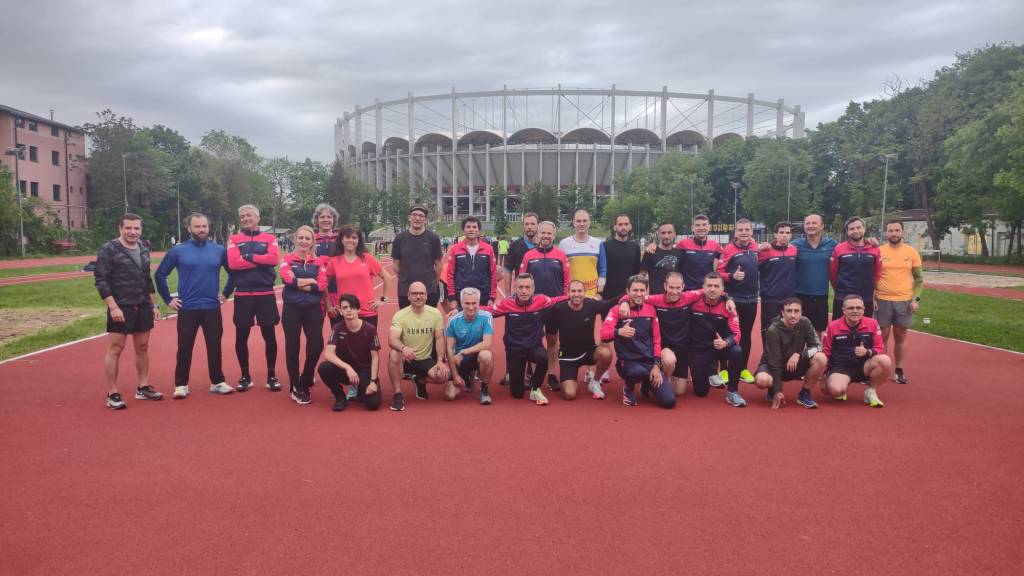
Of great help for me was running with the running group “Trupa lui Fane”. Although I moved to Krakow in 2020, we continued the collaboration remotely all these years. Many thanks to Stefan Oprina and “Trupa lui Fane” members for their support!

With “Trupa lui Fane” in May 2023

I crossed the 10k km mark at the last training before running the half-marathon in Bucharest. This way, the first and the last of the 10k km were run in the same stadium (the one in the picture above).

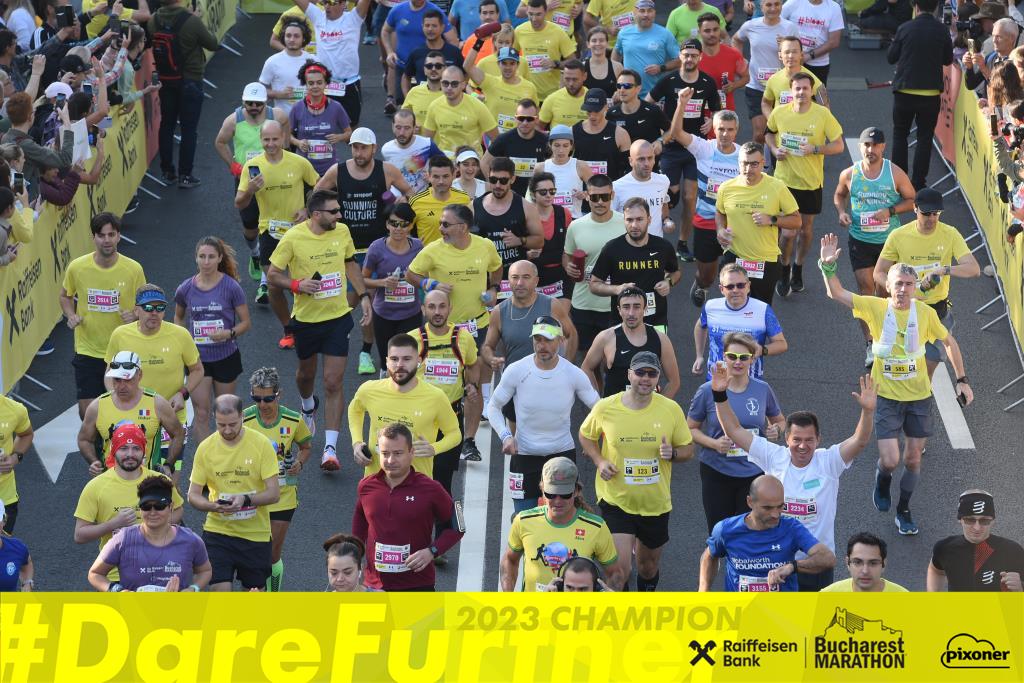
My first half-marathon was 8 years ago at Bucharest MIB. As mentioned in a previous post, to celebrate this distance milestone, I chose to run this year’s edition of the same half-marathon in Bucharest on October 15th. I participated in 6 of the last 8 editions of MIB.

With Bobo at the start. He finished 12 minutes ahead of me. Great run!

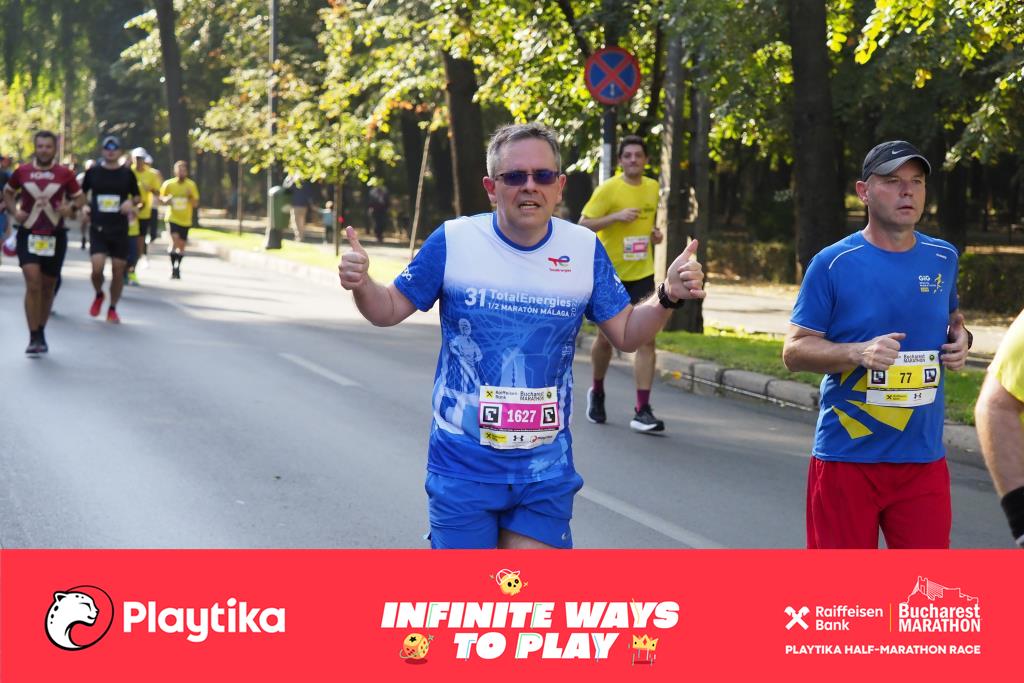
The organization for this event was amazing, as usual. Music bands, water and isotonic, pacemakers, and many volunteers make it a great event. The only thing I would like to see improved is the opportunity for runners to buy their photos at a good resolution and without a watermark. The pictures are free now but with a watermark, as shown above and below.

I wasn’t in good shape for this half-marathon, but I know my limits well. It was also hot that day, not ideal for running.

About the half of a half-marathon

I kept my pace around 5’30” for most of the race, with the last 2 km being the most difficult, and ran harder for the final straight line. My official time was 1:57:40.

I met many people I knew before or during the half-marathon. This was cool and makes MIB my favorite race. You get in line with someone you know, exchange a few words, and continue the race. Precisely like in life, only at a different pace.

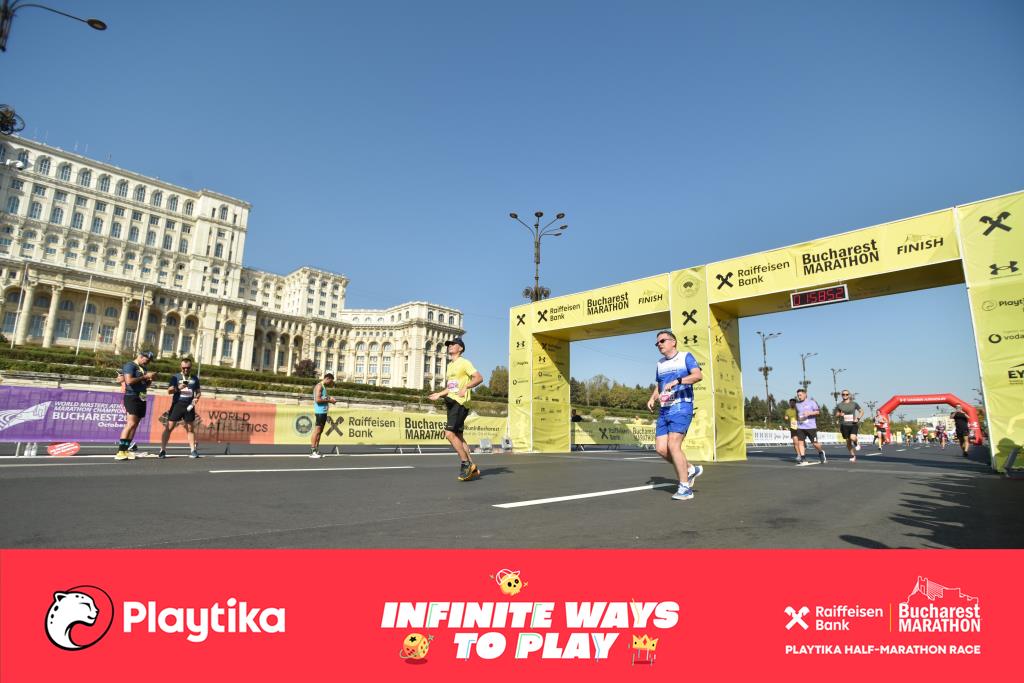
Crossing the finish line

I registered for 3 half-marathons in the spring 2024 to celebrate this achievement. Lisbon on March 10th, Prague on April 6th, and Helsinki on May 11th. Lisbon and Prague are part of the “super halves”, while Helsinki has a unique story. Superhalfs are a series of 6 essential half-marathons in Europe. You get an additional medal if you finish all 6 in 5 years or less.

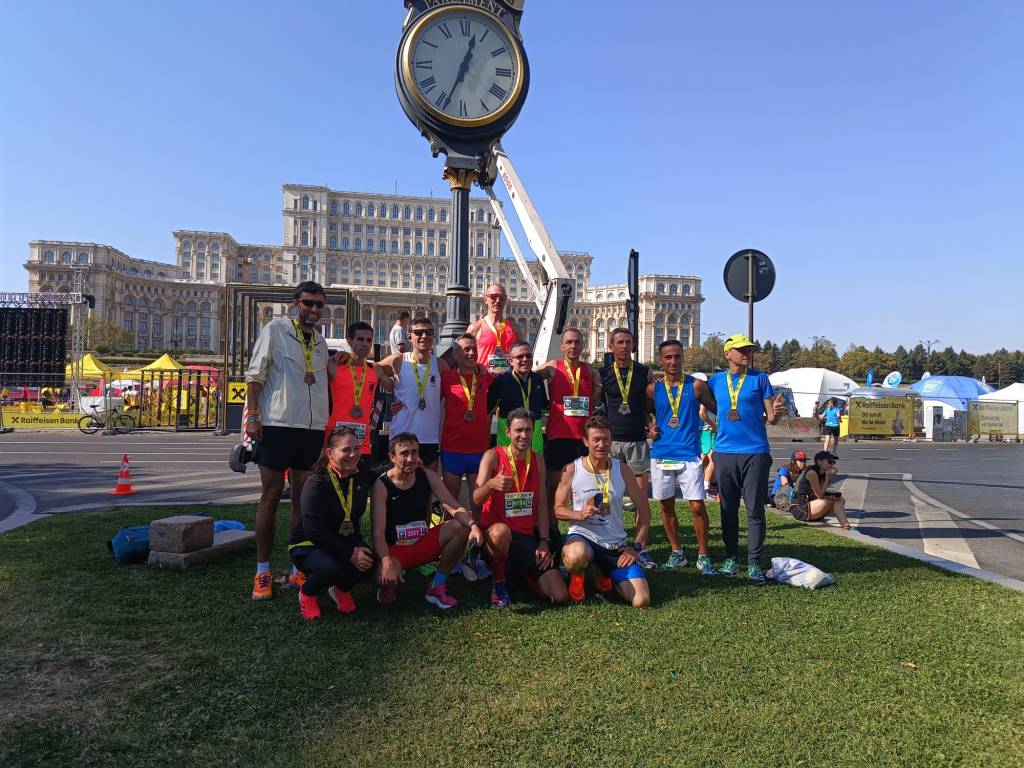
Celebrating with colleagues after the finish

Running shaped my personality and helped me deal with many things in life. I met great people while running. It is a walk of life that you can do at a slower or faster pace, how you like it. During the first years, it was hard to motivate myself to go outside in cold weather and run. I had no coach at the time and did everything alone. Today, I am happy I chose to continue running those days despite the hardships.

I had no talent for running and no experience before I started to run. It is never too late to change your life and run, even if this is not your strength. If I could do it, everyone can.

“I’m learning to fly, but I ain’t got wings.” – I saw running as a way to learn to fly.

Concertos – a subjective history

Concerto is a musical genre composed originally for vocal music in the late 16th century in Europe. From the end of the 17th century, it becomes mostly instrumental.

The term “concerto” was initially used to denote works that involved voices and instruments with independent parts—as opposed to the Renaissance common practice in which instruments that accompanied vocalists doubled only the voice parts.

Due to my ignorance and lack of knowledge, I don’t pretend this post covers all the important concertos in the history of music. It covers just concertos I like in chronological order. I would be happy if some readers discover here pieces of music they also find interesting.

Arcangelo Corelli was the first composer that greatly influenced how the concerto genre developed. His pieces are among the first that stood the test of time. I choose “La Follia,” composed in 1700 from his concertos.

Antonio Vivaldi is a better-known composer, mostly for his ”The Four Seasons” concertos. Here I will mention two other compositions I like. Vivaldi composed his own “Follia” in 1705, and you can hear the influence of Correli in that piece. Later in 1713, he wrote “La Stravaganza”, another composition for violins.

While we are in the 18th century with this subjective review, Johann Sebastian Bach’s concertos make a strong impression even today. First, his Brandenburg concertos, composed in 1721, have a fascinating history, being lost until found and published in 1850. This way, they could not influence the development of this music genre. I like the Brandenburg concertos no. 3, 4, and 5. Around 1730 Bach composed the “Concerto for Two Violins in D minor,” where you can notice the influences from Correlli and Vivaldi.

The next great composer of concertos is Mozart. His talent is beyond anyone else. While living only 35 years, he composed a lot of masterpieces. Mozart left for humanity concertos for many instruments ( piano, violin, brass, horn, flute, oboe, etc.). Of his works, I like most “Piano Concerto no 21” ( one of the 27 he composed) from 1785.

Moving to the 19th century, my next preferred composer was Beethoven. I like his symphonies and sonatas. Among his concertos, I prefer “Piano Concerto no 5” (the Emperor Concerto) from 1809.

Things became more complex in the 19th century. It was a time with many talented composers. My preference here goes towards Pyotr Ilyich Tchaikovsky’s compositions. In 1875 he wrote the “Piano Concerto No. 1”, first played the same year in Boston. The same composer wrote “Violin Concerto in D Major”, his only violin concerto, in 1878. The violin concerto is featured in the movie “Le Concert” by Radu Mihaileanu.

At the beginning of the 20th century, in 1901, Sergei Rachmaninoff composed “Piano Concerto No.2 in C minor”. I find a connection here with the Piano Concerto No.1 by Tchaikovsky. That should not be a surprise, as the former composer influenced Rachmaninoff.

As we get closer to the present day, the length of concertos diminishes. The last concertos mentioned here are all under 10 minutes.

My list of concertos for the last century includes a composition less famous by a Romanian author Nicolae Kirculescu. It is called “The musical moment” and dates from 1950. The “moment” is well known in my country as it was the generic music for a famous tv show in the last 60 years.

In 1967 for the movie “Les Demoiselles the Rochefort”, Michel Legrand wrote a short concerto I am also adding here.

As mentioned, in the beginning, in the 16th century, concertos were vocal. I chose to end my short list with a concerto for one voice by Saint Preux from 1967, ”Concerto pour une voix”.

The best way to share these compositions is by creating a playlist on youtube that you can find here.

By no means I am saying these are the best compositions, it is just music I like. I have no studies in music, I only read about music history. Maybe you’ll find something that you also like here.

San Francisco

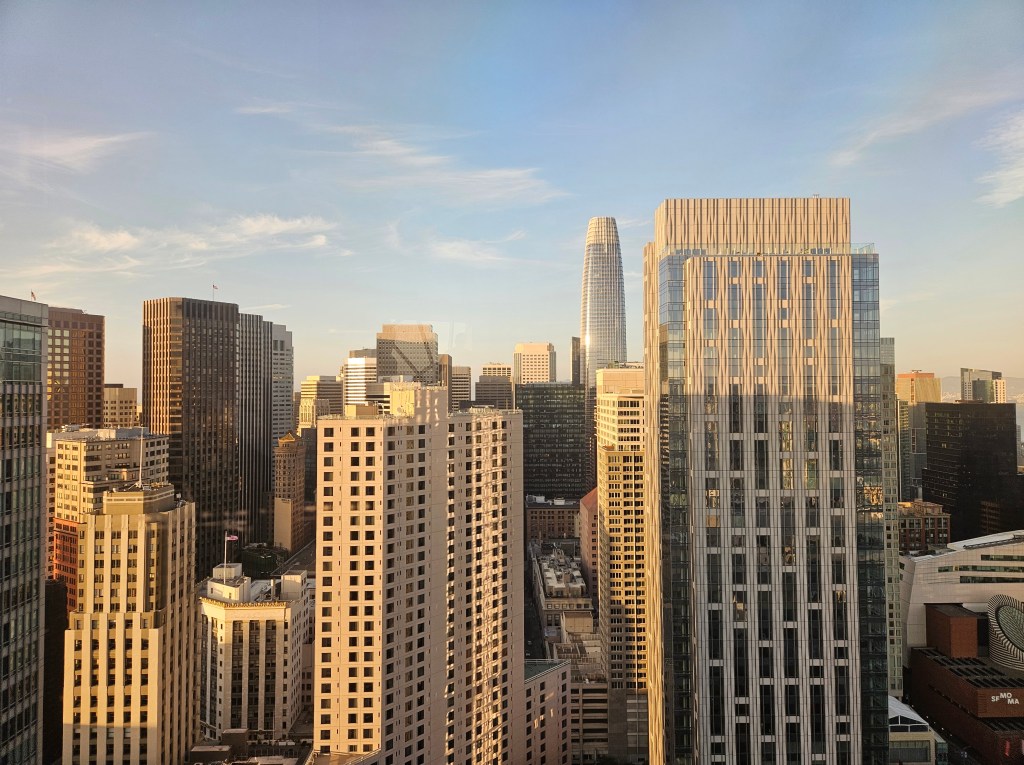
I spent the first weekend of June in San Francisco before returning to Krakow. SF is a city I first visited in 2011 and then on several other occasions, the last time six years ago. I’ve always found San Francisco beautiful. The curiosity to see how the city evolved brought me here again.


Before the pandemic, San Francisco was so crowded that you could hardly find restaurants to go to during weekends. Today things have changed. Many companies moved their businesses elsewhere because of the city’s high crime rate. However, things are better than they seem. When I came to the town from the airport, I saw many homeless people on the streets. On some roads, there were many tents on the sidewalks. In those neighborhoods, the situation is worse than it used to be. But in the central areas, the city is cleaner, and there are fewer homeless people than in the pre-pandemic times. That makes the visitor experience better as you don’t risk much.


Although I have visited the city a few times already, there are many tourist attractions, and I chose to see places I have yet to see. This time I went to Botanical Garden and Ashbury-Haight neighborhood.


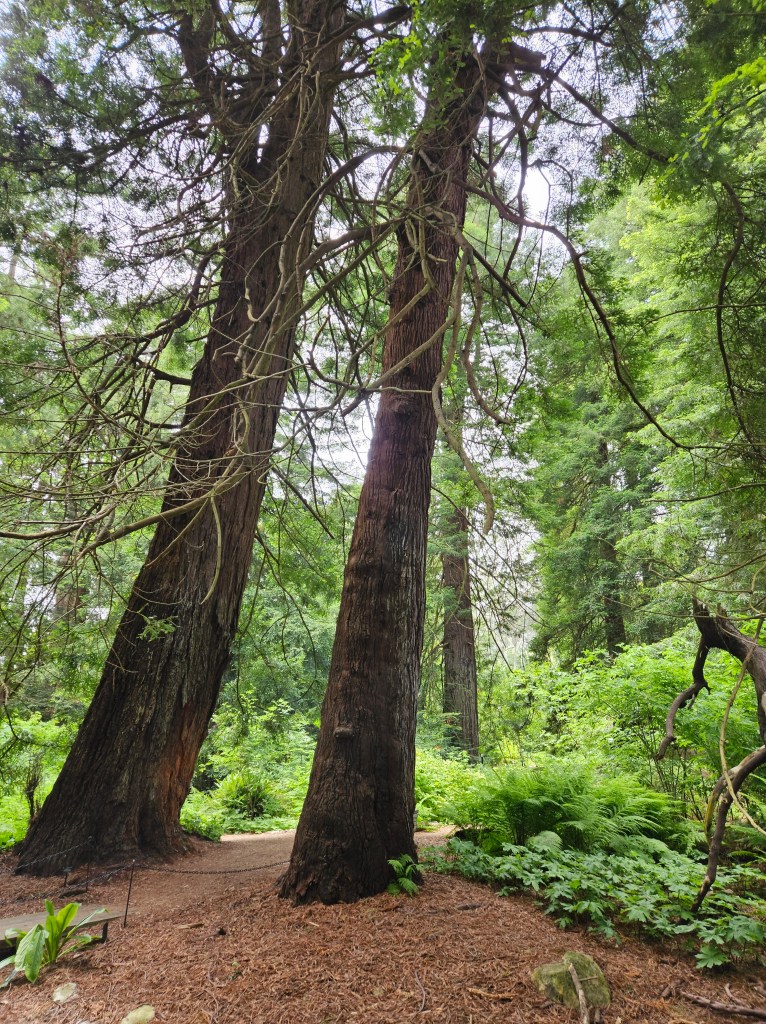
The botanical garden is enormous. San Francisco weather allows having here plants and trees from all over the world. There are sections of the park dedicated to many geographical regions. Plants I had not seen before from Australia and New Zealand and a vast part devoted to Asian, African, and South American continents. I am not a specialist in Botanics, but I enjoy seeing plants from places I have not been before and may never go to. Flowers in strange shapes and a wide range of colors, some scented, others not.


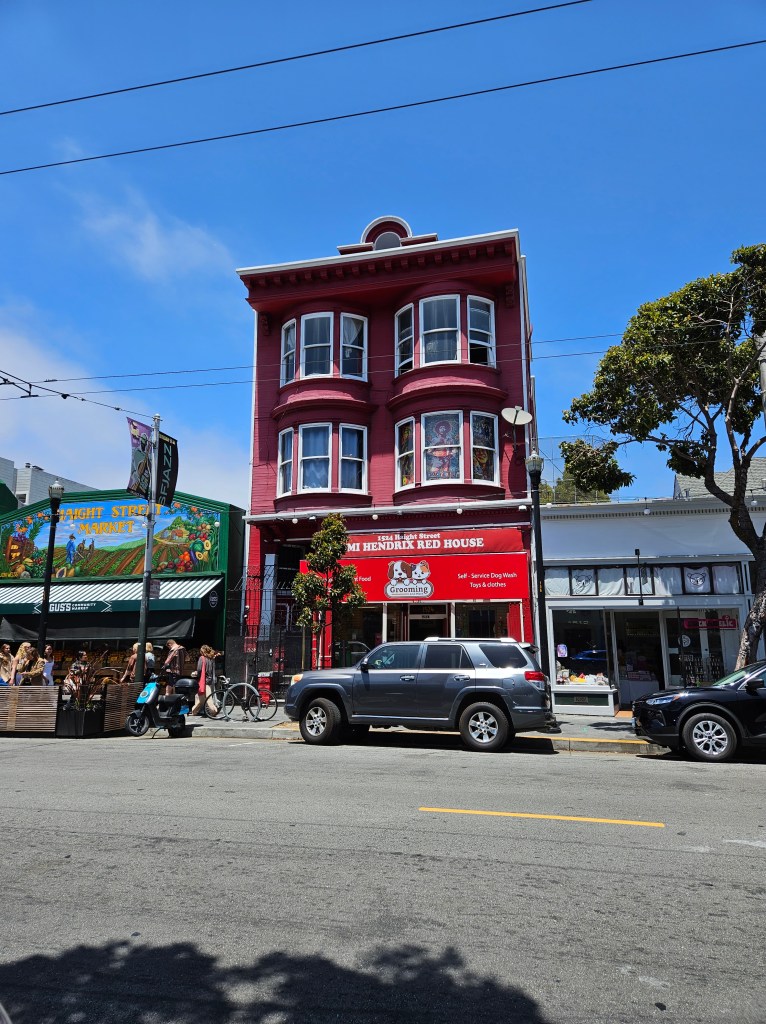
The other highlight of the visit was the Ashbury Haight neighborhood. The place is famous as the place where the 1967 “Summer of Love” social phenomenon occurred. At that time, young people moved here attracted by the low rent. It is funny how things have changed in terms of rent prices. The area still has a hippie and psychedelic appearance after all these years. Walking down the Haight streets, one could see Jimmy Hendrix’s house or some other places reminding of the history of that area. Pictures explain better and can trigger memories or things you associate with “Summer of Love”. People still remember that movement even more than 55 years later. You can still wear some flowers in your hair.


Of course, I’ve again seen the main attractions of San Francisco: the Golden Gate Bridge, Pier 39, the Coit Tower, Union Square, and Market Street.
If you are careful where you stay in San Francisco, I recommend visiting the city. It has charm, beautiful hills, lovely views, and a fantastic bridge.

The best view of Golden Gate is from Battery Ridge. Not on misty days.

Seattle

At the end of May, I spent a week in Seattle. I could not help to compare the city with my first impressions from 6 or 7 years ago when I visited it for the first time. At that time, I liked the city very much because it was like San Francisco but more relaxed and safer. The town was growing, and many new skyscrapers were in development. Also, Amazon was increasing its presence by building more offices in the city. It was a busy place but chilled also. One thing that helped is that although people complained about the weather in Seattle, I had great weather both then and now.

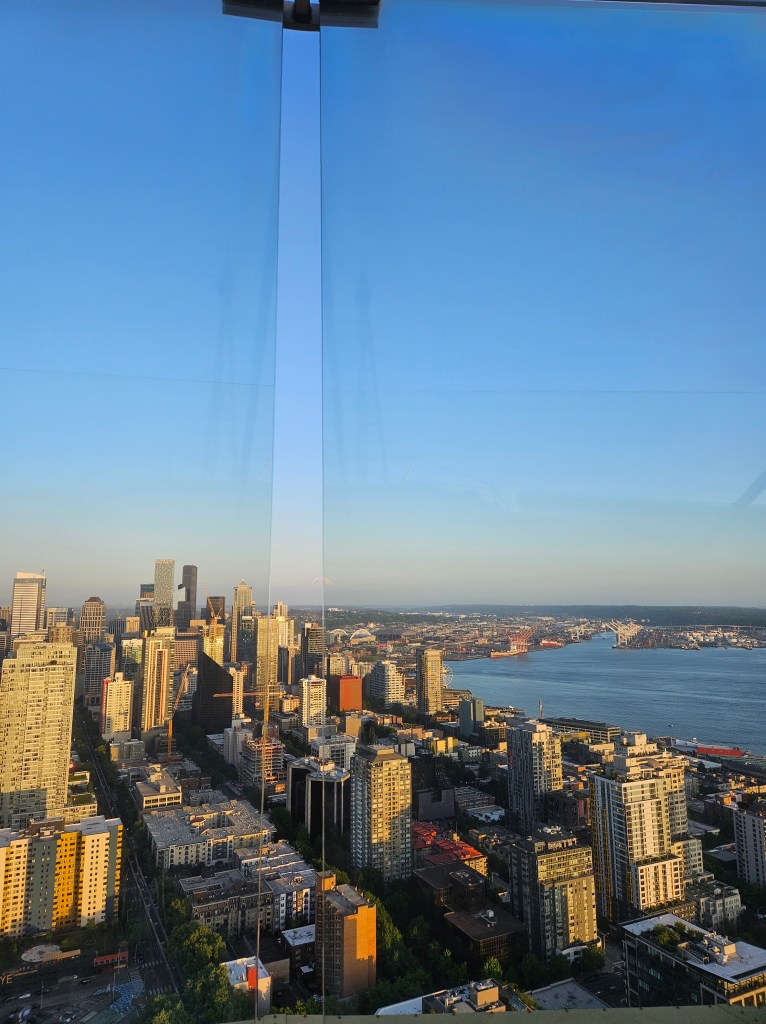
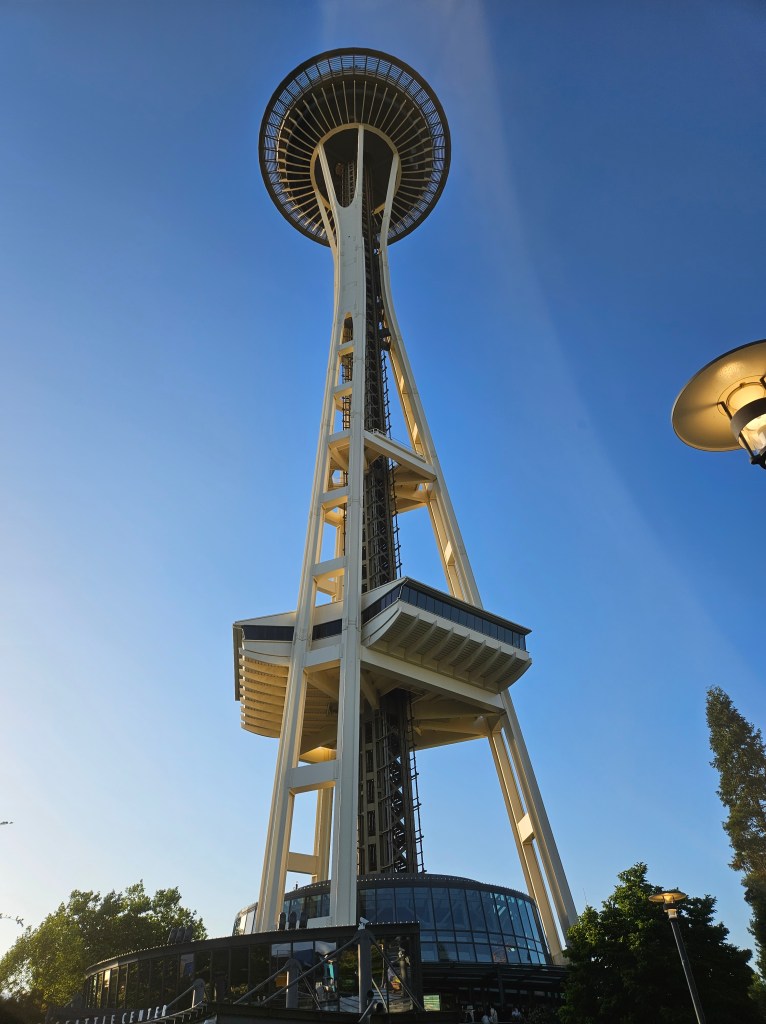
View from Space Needle

Nowadays, many companies choose to keep remote work for their employees. That makes Seattle look like a deserted city. Prices for houses outside of the town grew. Instead of busy people on the streets, you see more homeless people. This change could give people a sense of insecurity. That might change again if more companies ask employees to work from the office.
If you want to see Seattle, you can wander downtown and visit Space Needle for beautiful views. You can also take a ferry to Bainbridge Island for lovely views from Elliott Bay. Regarding attractions, you can take the boat to Washington Lake or hike the mountains close to the city. Next time I will do that.

Interesting looking skyscraper

What is impressive about Seattle is that it all started 170 years ago when the first colonists settled in. The main business in the area was often changed throughout the years. It began with exporting wood cut from the forests, then mining coal or building ships during the gold rush. In 1897 even the mayor of Seattle quit his job and went on for the gold rush instead.
During the First World War, planes and ships were built here. Later the Boeing company drove innovation in the city. Then Microsoft became a vital software company worldwide, and recently Amazon changed the experience of delivering products to customers everywhere in the world. All major software companies have offices here.

There is one explanation for that. Seattle has the highest percentage of college and university graduates of any major U.S. city. This might be the secret to the city’s success. But let’s take a look back at history. Seattle’s first colonists came here in 1851, and the University of Washington was founded in 1861, only ten years later.

Space needle has been a symbol of Seattle since 1962

The adaptability to change in this city is a lesson for survival for everyone. One could also understand the importance of education in developing a community.

PS. While talking about change, an AI may write my next blog posts. Or has it already started?

Gothenburg half-marathon 2023

Gothenburg has a long tradition of organizing running competitions. The first edition of the Gothenburg half-marathon was in 1980. Before the pandemic, there were over 60000 runners in some years participating in this famous race.

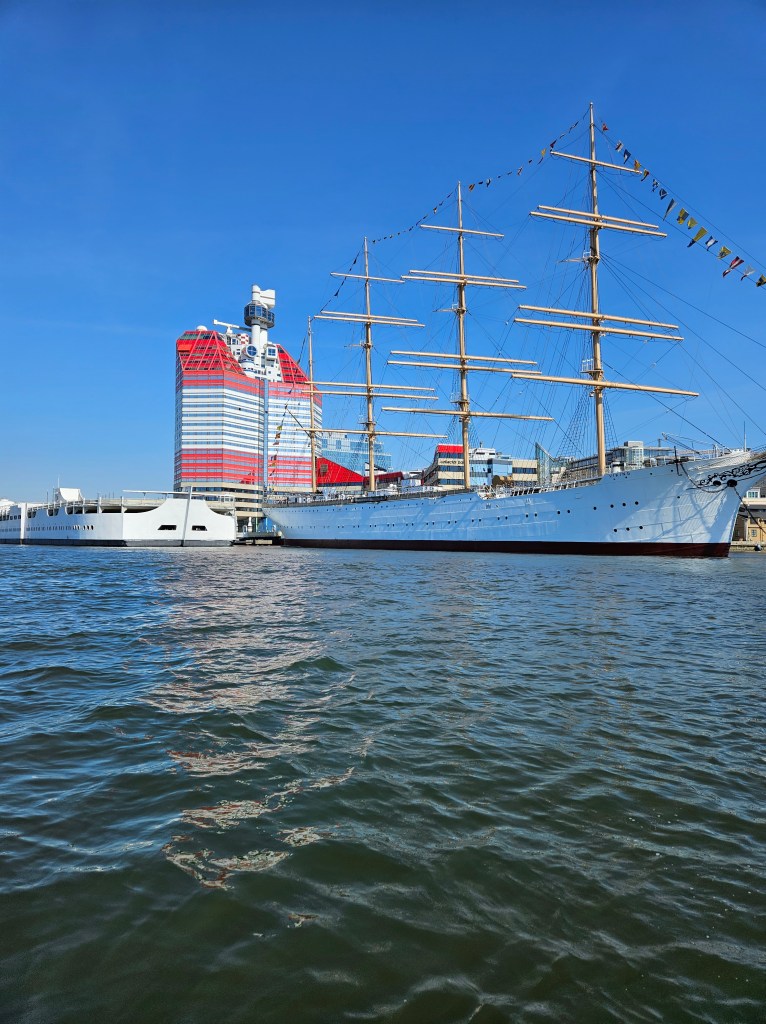
This building is called “The Lipstick” because of its shape. It is considered the ugliest building in Sweden. You have excellent views from the top of it because you don’t see “The Lipstick” building.

This year there were only 38000 people registered as the race is growing again after the first post-pandemic edition last year. Some things make this race unique. It happens on Saturday, while most marathons and half-marathons happen on Sunday. Another thing is that the race starts at 1 PM in contrast with other races that begin in the morning. People are grouped in 25 chunks, departing one after another based on their expected finishing time. Due to the grouping of people, the start lasts for 3 hours ( from 1 PM to 4 PM). If we add that the last people pass the finish line sometime after 7 PM, that makes it a full-day event in Gothenburg from the morning until evening.

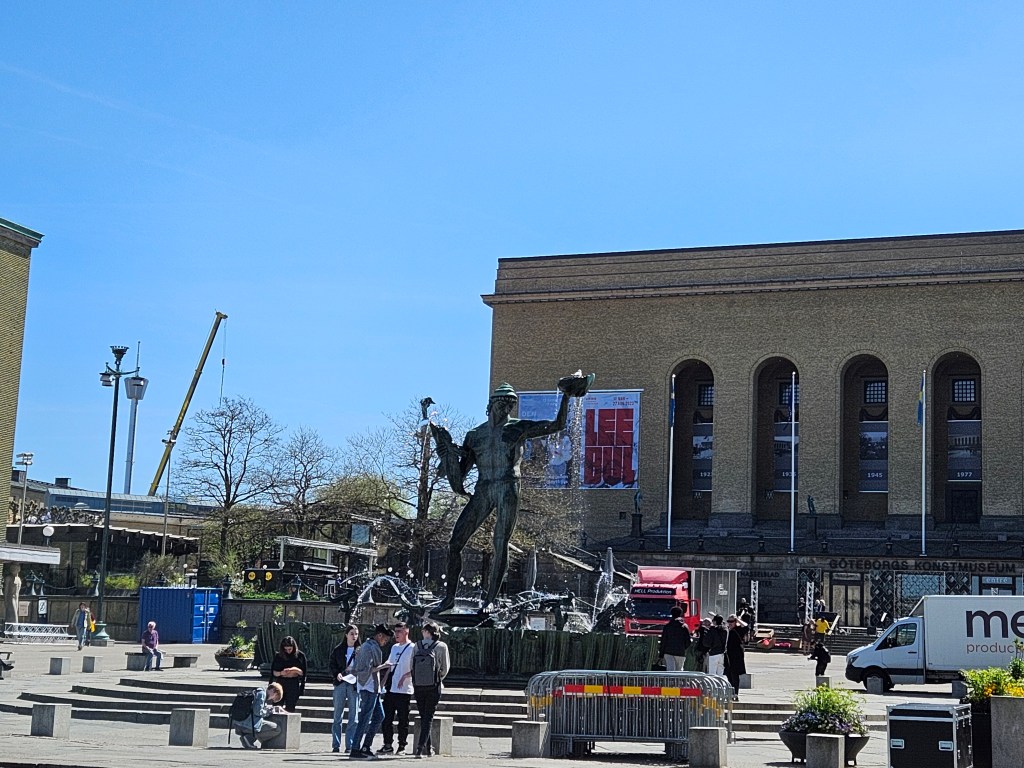
The Poseidon statue is a symbol of Gothenburg. At km 16 in the race, you run around this monument.

Each group has a designated area where the people should gather at a specific time. The organizers take that group of people and bring them to the start when their time to run has come. It is pretty impressive to see that.

Unfortunately, I was seeded by default in the group with a target time of 2:50. The only way to be moved to a faster group was to have a time faster than 1:45 in an official half-marathon ( or similar times in 10k or marathon). Based on my previous results, I wrote to organizers asking to start in the 1:50 group, but they rejected my ask because the rules needed to cover that. My suggestion to organizers is to improve those thresholds ( add more criteria, not just 1:45), as it’s not fun if you want to run with a pace of 5’15″/km to run in a group that has an average speed of 7’30″/km on narrow streets. My friend Bobo was lucky. He had an official time under 1:45 and was placed in the 1:45 group.

Skansen Kronan fortress

It was a hot day on May 13th. The organizers emailed participants the day before, asking people to keep it calm and not target personal records or good times because of the weather. On the positive side, they had water and isotonic drinks every other kilometer. That differs from most races with only 3 or 4 refreshing points on the route.

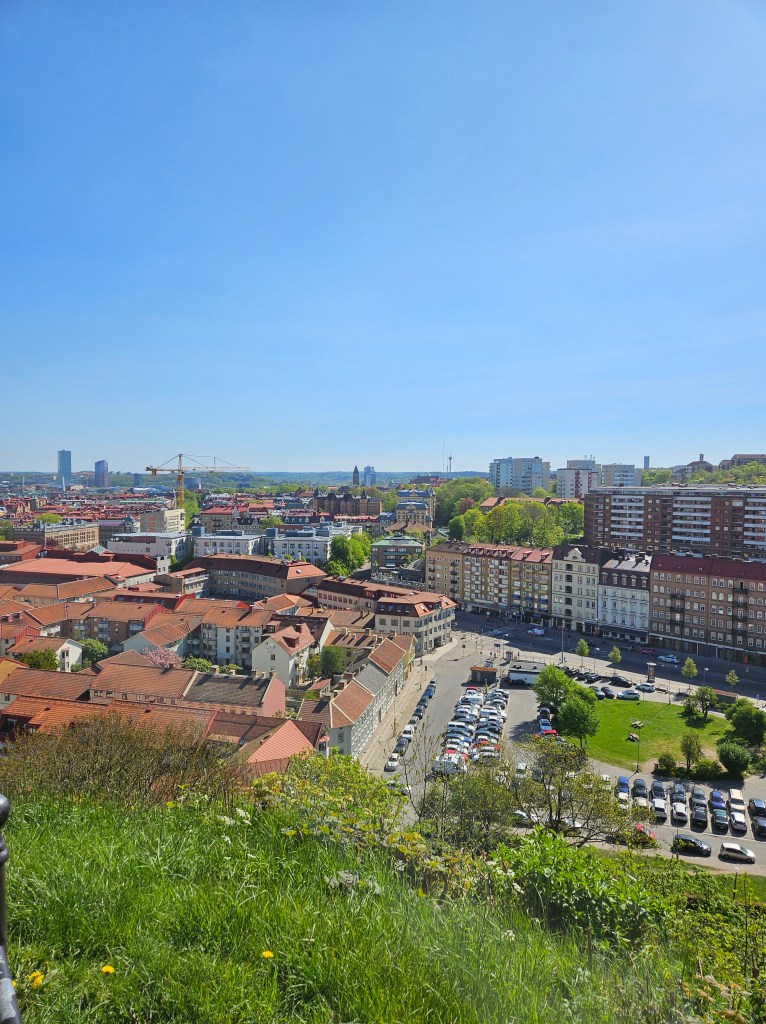
View from the fortress at km 18 of the race.

Considering these things and that the route had uphills and downhills, I decided to enjoy the sightseeing and do a slow race. To enjoy the run and the show and not care about the time. By the time I started the race, Bobo was about to finish it. There were no events during the race, and I finished at 2:10, less tired than after other races. Bobo had an ambitious race and good result finishing in 1:48. Quite impressive given the circumstances.

I liked that many improvised showers were on the route with cold water. You were supposed to run through them, but one participant in front of me stopped under the water, and I had difficulty avoiding him.

Close to the finish line after 20 km run

Another positive thing was the live singing bands. There were more live bands than kilometers on the way. They played music from classical, marching bands, rock, or PostModern Jukebox style. Generally, you’ll see three or maybe four bands in every half-marathon, but not around 20.

The finish happened inside a stadium, similar to the Malaga half-marathon, and I like this part as a running competition is historically connected with the stadium. A special mention to the wonderful crowd of people that was encouraging the runners all the way in the city. Some people brought chairs and drinks on the street and sat to enjoy the show.

Happy to have finished a difficult race

I am delighted that I had the chance to run all the races I planned last year and even one more (Malaga). That means five half-marathons in 9 months. In the meantime, I also ran 1000 km from that moment, and now I passed the 9400 km mark.

This time I will not make plans like the previous year, but I would like to run in the Bucharest half-marathon on October 15th as it would be a symbolic cross of the 10000 km run in a race that was my first half-marathon run back in 2015.

Paris half-marathon 2023

Last weekend, on March 5th, I ran the half marathon in Paris. Harmonie Mutuelle Semi was the best organized half marathon of the ones that I participated in. With over 45000 finishers, this was also the biggest running event I had ever attended.

Here are some highlights of this event for people interested in participating in the following editions. The 45k runners are leaving in groups based on the target time to finish. You know when to go at the start line. Around 200 people start every minute, then the next group follows. The time is measured from the moment you cross the start line. The route is not through the center of Paris; therefore, only a few people will try to cross the street in front of you. You can have a personalized T-shirt with your name on it. This was helpful as many people on the road encouraged the runners by their names when reading them on the T-shirt. There are lots of entertaining points during the course. Over the last kilometer, thousands of people strongly encouraged the runners, which was quite spectacular. You get an SMS with your official time once you cross the finish time. The organizers take pictures of the runners during the race, which you can pay for and download later.

I don’t know the general statistics of half marathons, but 37% of Paris participants were women, which looks great.

Suppose you want to run in France or Italy half marathons (or marathons) distance in official events. In that case, you need to obtain a certificate from sports or general medicine that you are healthy to run for such an event. A runner should get the certificate less than one year before the event. The doctor who gave me the certificate told me they conducted a study in Italy and observed that people who participated in long-distance running without proper training had a higher incidence of a heart attack after the race. Second, there were no isotonic beverages, only water or fruits at refreshments points at km 6, 12, and 17. It was the first time during a half marathon that I saw no isotonic drinks provided to runners. Isotonic drinks are absorbed faster and help you keep hydrated without decreasing performance.

The Harmonie Mutulle Semi de Paris was sold out six weeks before the race day. Keep that in mind if you want to register for next year. If they kept the registration open, there were probably 50k runners at the start.

Enthusiasm in the first part of the race

It was a cold morning in Paris last Sunday, about 5 degrees Celsius, but it was ok for a run. Runners were admitted at the start based on their Bib numbers. Trainers on platforms above the crowd were helping the participants to warm up before going into the race.

Usually, I have no aim for a particular time, but this time I made an exception. I wanted to finish in less than 1:53 to apply for the 1:49-1:53 group at the Gothenburg half marathon in May. In Malaga, I finished at 1:53:10, so I needed a better time.

I planned to take two gels and drink isotonic at the refreshments places. I took one gel after 9 km but chose not to drink water (because there was no isotonic available). In my case, drinking water slows me down until the liquid is absorbed. Because of the lack of beverages, I chose not to take the second gel.

I went a little faster than planned for the first part of the race, and things were ok until the 18th km with an average time of 5’15” per km. For the next 2 km, I struggled at a 5’48” pace. Then something happened when it seemed that I would not achieve my goal. On the last kilometer, the thousands of people strongly encouraging us created an extraordinary atmosphere for runners. That helped me regain my strength and finish with a 5’10” on that km for an official time of 1:52:40, thus achieving my goal at the last moment. I was placed 20k from 45.3k finishers.

Closer to the finish

Although it was a race with a happy ending, I’ve learned from my mistake. Next time I will drink water if isotonic is unavailable and take the second gel.

My friend Bobo had a great race finishing in 1:52:02, a fantastic time given that he was not at his full potential and was still recovering after some health issues the month before.

With Bobo before the race

The last achievement was that I passed the 9200 km run threshold in this race, and I hope to pass the 10k km later this year.

As usual, many thanks to my coach Stefan Oprina who continued to train me remotely all this time!

The Paris Half Marathon starts on the small island on the Seine river, continues on the Seine shores, and then goes around Bois de Vincennes to return on the other side of the Seine and finish on Place de la Bastille. This route reminded me of a song of Barbara: “Bien sûr nous, nous avons la Seine, Et puis notre bois de Vincennes…”. “Göttingen” is a famous song that started the rebuilding of French and Germans friendship after World War II. War is still going on, and we should hope for better times.

Barbara – Göttingen

European Rapid and Blitz Chess Championship 2022

This year’s edition of the European Rapid and Blitz Chess Championship was a great success. The event was hosted in the same location as in 2021, the Spodek Arena in Katowice. What makes this tournament special is the combination of a big arena, band music, and over 900 competitors playing each other for a weekend. The idea of an arena with spectators, music playing, and some people performing arts or fighting has been a hit for thousands of years. Greek antic theatre, Olympic games, or gladiator fights are such examples. A recipe for success that still pays off.

Spodek Arena in Katowice

Compared to the previous year, the number of participants increased by more than 50% in the rapid section. Also, the percentage of women from all participants who played rose from 17% to over 20% in 2022. The reason is the constant interest in chess worldwide combined with no Covid restrictions this year.

The rapid section of the tournament consists of 11 rounds of chess, and in each round, you get to play someone who has the same amount of points as you. In the end, the person with the most points is declared the Champion of Europe in Rapid chess. Also, the woman who gains the most points is Woman European Champion. This year the winner was Jaime Santos Latasa from Spain with 9.5 points, followed by ten players with 9 points. Aleksandra Maltsevskaya from Poland won the women’s title with 8.5 points. Aleksandra’s win was a surprise as the rating favorite was Alexandra Kosteniuk, who is also the woman world champion in rapid chess. Alexandra Kosteniuk also had 8.5 points but an inferior tiebreak result and ended in second place. Both women represented Russia before, but now that country is banned by FIDE from chess events. Russian players must play for another country or under the FIDE flag in official chess events.

Before the second round. In the center of the picture, you can spot the playing band

It was snowing heavily in Poland during those days, and the train was the safest way to get there, although many trains had delays because of snow. That weekend was also the final of the world soccer championship. The organizers changed the schedule of the chess tournament to finish before the start of the world cup final. Therefore on Sunday, we played without pauses for the 5 rounds and completed the chess in time before the soccer started.

There were players across all of Europe there. Many players are from Ukraine, as the border is close; for them, it was also a way to forget about the war. It is the end of a challenging year, and people want to enjoy a normal life for a weekend as if nothing has happened. Things around us can change anytime; we should enjoy the present moment and what we have.

As always, the event had excellent broadcasting on Youtube with comments and interviews. Here you can watch the last day of the games:

I only wanted to have fun, and am happy with the outcome. I won 5 games and lost 6, no draws, and lost 48 Elo points in the end. I met three titled players, and the best was the International Grandmaster Ralf Akesson from Sweden. The game was excellent but required a lot of mental energy. In the diagram, the black and white bar on the left of the chess table represents the computer evaluation of the position. When the bar becomes completely white, white is clearly winning.
European rapid in Katowice is one of my favorite chess tournaments. It is fun and exciting; you forget about anything else in life for a while. I liked the atmosphere there, and it is hard to express that in words. Perhaps this article explains better what I am trying to say.