Valencia half-marathon 2025

The best proof that what I wrote last year about the Valencia Half-Marathon was true is the fact that I decided to run it again this year.

With limited race options, I have to choose carefully where to compete. The Valencia Half-Marathon makes that decision easy, it’s one of the best-organized and most enjoyable races in Europe. For returning runners, registration is even smoother: the organizers give priority to those who ran in the previous edition.

If you’re trying to run Valencia for the first time, you’ll need to enter a ballot in November. If you don’t get in, there’s still hope. Several official travel agencies offer guaranteed race entries as part of their packages.

This post isn’t about repeating what I said last year. It’s about sharing what was new. I also want to share what I learned this time around.

What Was New This Year

The Wardrobe Service

This year, I paid 6 EUR to leave my luggage at the start area wardrobe. It was absolutely worth it. Not having to run with my phone or other items made the experience much more comfortable.

Slippery Grids on the Course

After kilometer 10, the route passes along a street full of metal grids covering subway vents. When it rains (as it did this year and last), these grids can get very slippery. Tip: stay on the left side of the road, where the surface is safer.

The Energy of the Drummers

One of the things I love most about Valencia is the number of live drumming bands along the course. The beat of the drums has an incredible effect. It pushes you forward in a way that no playlist ever could.

My Race

I learned from last year’s mistakes. This time, I didn’t eat too much before the race. I made sure to finish my breakfast more than two hours before the start.

I started in wave 7 at 9:01 a.m. and took it easy at first, running the first 5 km at around 6:00 min/km. I planned to pick up the pace later. However, by kilometer 15, I realized I wasn’t going to finish under two hours. At that point, I decided not to push too hard. Whether it’s 2:02 or 2:03 doesn’t make a huge difference. I crossed the finish line in 2:04:11, an average result, but still 22 minutes faster than in Tallinn!
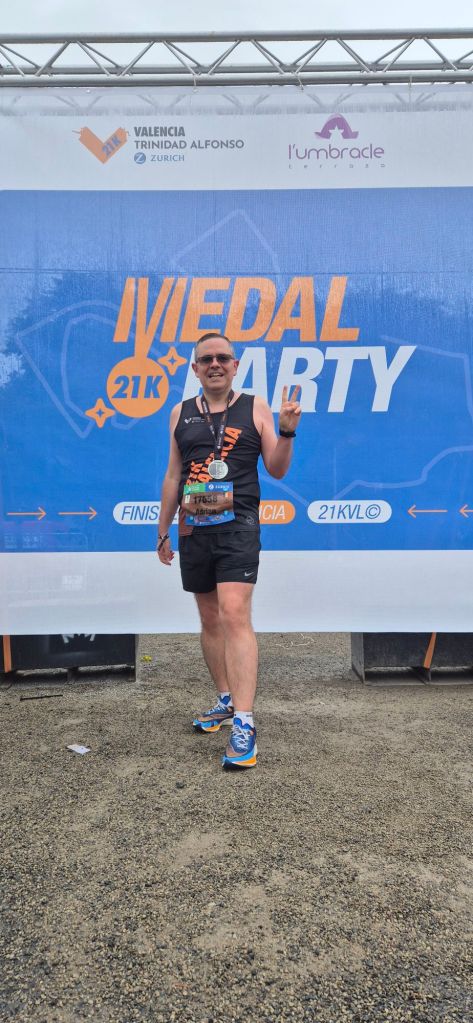
After the race

Our Team – “Trupa lui Fane” in Valencia

This year, five of us from Trupa lui Fane ran in Valencia. That made the whole experience even better. We shared the excitement, compared strategies, and celebrated together after the race.

“Trupa lui Fane” in Valencia

Everyone had a strong performance, close to their personal bests:

  • 🥇 Mihai1:24:54, our fastest runner, finishing among the first 2,000 participants
  • 💪 Andreea1:34:52, the only one to set a new personal best
  • 👟 Bogdan1:44:24, two minutes slower than last year
  • 🔥 Sorin1:56:06, at his first SuperHalfs race, very close to his PB

Congratulations to all of them for their fantastic results!
And a big thank you to our coach, Ștefan Oprina, for helping us become better runners over time!

Valencia remains, without question, my favorite half-marathon in Europe.

Later that day in Valencia I met someone who didn’t look quite happy with his result.

Not everyone looked happy that day

Valencia 2025 reminded me once again why I love running. It’s the rhythm, the people, and the stories. These moments stay with you long after you cross the finish line.

PS.1 A Seagull and a Song

On race morning, I woke up early, opened the window, and saw a lonely seagull flying above the hotel. It reminded me of a Joe Dassin song I’ve always loved:

“Moi, de temps en temps, je me sens pareil
À cet éternel exilé
Lui, qui ne sait pas replier ses ailes
Moi, qui ne sais pas m’arrêter.”

A small, poetic moment before the adrenaline of the start line.

PS.2 Remembering the Floods of 2024

The day before the race, Valencia held a large protest. It was in memory of those who lost their lives during the 2024 floods. Last year, we left the city on Monday after the half-marathon. The next day, torrential rain caused devastating flooding that claimed 224 lives in the province. One year later, people are still unhappy with how the authorities responded.
It’s a sobering reminder that life is unpredictable. Every race, every trip, and every day, is something to be grateful for.

PS.3 Goodbye, Mihai Suba

On Sunday, October 26, the day of the race, Grandmaster Mihai Suba (1947–2025) died near Valencia in Spain. Before 1990, Romania had only three chess grandmasters — and Suba was one of them, a true original. He made significant contributions to chess, particularly in middlegame theory and the Hedgehog system. I’ve read a few of his books; Dynamic Chess Strategy was a particular favorite. He was admired worldwide for his creativity and deep understanding of the game. May he rest in peace — and may his ideas continue to inspire players for generations.

Chess story

Usually, at the end of the year, I write about chess tournaments. Unfortunately, the European Rapid and Blitz Chess Championship moved from Katowice to Zagreb this year. I couldn’t find a convenient flight to Zagreb. I looked for a similar tournament somewhere in Europe where I could easily travel. I found a tournament in Cluj, which is part of the Romanian Grand Prix tournaments. I booked the travel details for Cluj in advance, but it proved too much in advance. For some reason, the organizers moved the tournament from Cluj to Sebes. Sebes is 120 km south of Cluj, hard to reach from Cluj if you don’t have a car, and has few attractions. In these circumstances, I could visit Cluj as a tourist in November or lose the money spent traveling there. I chose the first option, and I am happy with that. Cluj has greatly developed in recent years and is a vibrant and modern city.

Instead of playing chess, I write about the game. In my opinion, the most interesting thing that happened in chess was the Polgar experiment.

Laszlo Polgar, a Hungarian educational psychologist, wanted to prove his idea that geniuses are made and not born. He said he would prove this theory using his children. His theory is “that any child has the innate capacity to become a genius in any chosen field, as long as education starts before their third birthday and they begin to specialize at six.”

Together with his wife Klara, they had three daughters and chose to prove the theory by making the girls champions in the chess field. The chess results are very measurable. For example, in the last 40 years, only two players, Kasparov and Carlsen, were number one globally.

Although it was a hardship during communist times in Hungary, and they had to fight with the authorities, they managed to keep the children out of school and teach them at home. The results started when Susan, the eldest daughter, became the highest-rated woman in the world in 1984. Later, in 1988, the Hungarian women’s team, with all three sisters playing, won the Women’s Chess Olympiad. It was a remarkable result and raised a lot of interest about how that was possible.

One should remember that in the 1980s and 1990s, chess was a game played mostly by men. There were few tournaments for women. Conditions were harsh. For example, players smoking at the table during official games was ordinary. A game lasted 6-7 hours in most cases, with intense fighting each day for nine days or more during a tournament. The girls had to fight mentalities and biases to progress in chess.

An example of rough behavior. Sofia Polgar won against former vice-world champion Viktor Korchnoi.

Laszlo Polgar, to prove his theory, aimed for his daughters to become not the best women chess players but the best in the world. For this reason, Susan only played in men’s tournaments for a while. In 1991, Susan became the first woman to obtain the title of chess grandmaster according to the rules and not honorary (as the other two women before her). Later, when it became clear that she couldn’t become the world chess champion, she turned towards women’s tournaments. Susan became the Woman World Champion in 1996.

But the most impressive result was obtained by the youngest daughter, Judit. In 1991, the same year as Susan, Judit became a chess grandmaster at age 15 (the youngest GM in the world at that time). She won many tournaments and aimed to become a world chess champion. In 2005, she played in the candidates’ tournament in Argentina. The winner of that tournament with eight players would become the world champion. Judit did not win the title that time. After that event, she was never close to becoming a champion again. Judit was the highest-rated woman in the world for more than 25 years until she retired from playing official events. Her peak rating was 2735, which made her the 8th highest-rated player in the world. For reference, in chess history, only three women made it to the top 100 players in the world, and only Judit to the top 10. It is hard to put into words how huge this accomplishment was.

Judit Polgar beating Garry Kasparov in a game. At that time, Kasparov was the best player in the world.

To better understand the results, let’s look at some data. The average rating of the top 100 best chess players worldwide was 2692 in December 2023. The average of the top 100 women was 2418. There is a gap of 174 ELO points between the top men’s and women’s players.

Recently, FIDE ( the International Chess Federation) published results on the gender gap in chess. The participation of women in tournaments is under 20 percent in most countries and less than 10 percent in developed Western countries. The reduced number of female players is one reason for the gap between men’s and women’s results in chess. But still, there is a big gap even in 2023 between men’s and women’s results.
Based on the above results, Polgar proved his theory is correct. It required a lot of energy and work to achieve these results. Some people condemned Polgar’s experiment, saying he created a “Frankenstein” and put his children to enormous efforts. It is worth mentioning that his children had a successful life outside the chess world. Also, although all are retired these days, their activities are still around chess, and they continue to enjoy the game.

Retired Judit Polgar playing against Magnus Carlsen, the best player in the world, in 2022

Polgar’s idea is that with educated geniuses, humanity can make breakthroughs in science and medicine. I don’t know if anyone is willing these days to make such an effort with children, given that the world has changed so much. The hope for breakthroughs in science and medicine now relies on artificial intelligence.

This experiment had a positive impact in attracting women to play chess and breaking barriers in this game. Despite the statistics above, the number of women in chess has seriously improved. Susan Polgar was the first woman to have a grandmaster title in 1991. Now, there are 41 grandmasters women worldwide.
Please keep in mind that the theory works only on children. I witnessed older players trying to improve at chess (including myself), and it is much harder to make progress. If you don’t do it while young, forget about developing later.

I’ve been close to the chess world for 30 years and have witnessed how education works and how children are treated by their parents. Polgar’s experiment is unique. In most other cases, the parents pressure children to obtain results. It is a way for parents to achieve the results they could not get in their own lives through their children. This pressure results in children hating the game and quitting it as soon as possible once they can avoid their parents’ authority. This behavior is happening in all sports or domains where there is competition. Only time will say who was right and who was wrong.

I will end with my favorite chess quote: “In every position, there is a move to be found – but you have to search for it! “– Paul Keres.

Judit Polgar and her sisters organize a chess festival every year in Budapest.

Revolution songs from the previous century

The XX century was turbulent, with many revolutions and wars. In this post, I will write about some of the songs that encouraged the fighters to combat those bloody events.

The criteria for the songs were to be composed in the XXth century and to cover events from the same century. For this reason, I had to eliminate pieces like “The Internationale,” “Warszawianka,” or “Ay Carmela !” which were composed in the XIXth century. Another criterion was to add only songs I like. It is a subjective list, and I don’t claim to be an exhaustive list. It is essential to mention that I don’t associate myself with the message of all the songs. It would be impossible to sustain both communist and anti-communist causes simultaneously. However, that doesn’t stop me from appreciating beautiful and motivating songs. Conversely, I chose not to write about some events because I failed to find lovely songs with my subjective taste. Some pieces were contemporary with the revolutions they referred to, while others were composed before or later. I chose to cover only revolutions and not World Wars.

From a chronological perspective of the XXth century, the first six decades were dominated by communist or anarchist revolutions. In comparison, the last four decades were democratic revolutions fighting against dictatorship.

The first revolution of the XX century we cover here was the 1905 uprising in Russia. In our times, we remember those events in the movie “Battleship Potemkin” by Serghei Eisenstein from 1925. That movie remains a masterpiece of cinematography and propaganda. It is possible that the song “Potemkine” by Jean Ferrat, composed in 1965, was inspired by that movie.

We continue with the Mexican Revolution from 1910-1920. The most known song from that period, “La Cucaracha,” was from the previous century. Therefore, I chose “La Adelita,” a song about the women “Soldaderas” participating in the revolution.

The next event was the Russian Revolution of 1917. The most known hymn of the “great revolution” is “The Internationale,” which dates from the 1870s. For the same reason as above, I chose “Farewell of Slavianka,” composed in 1912 by Vasily Agapkin and played during the events.

After the Russian Revolution, there were many tries by communists to seize power in different European countries. Most notable would be the revolution in Germany during 1918-1919. A representative piece of that revolution is “Brüder, Ergreift Die Gewehre,” written by Max Barthel, although some things are unclear about this song.

The Spanish Revolution happened in the 1930s. There are many beautiful songs from that time. My first choice would be “Ay Carmela !” but since it was from the previous century, I selected “Si me quieres escribir,” a song of the Left forces composed in the 1920s. It has to be added that “A las barricadas” is, in fact, “Warszawianka” melody with Spanish verses.

The Cuban Revolution started in 1953 and succeeded in 1959. The well-known song “Hasta siempre comandante” was composed in 1965 as a response to a farewell letter from Ernesto Che Guevara to the Cuban people. Che Guevara was an Argentinian anarchist who, after the success of the Cuban revolution, left Cuba to support the uprisings in other countries, in Congo and later in Bolivia, where he was murdered.

We can say that communist and anarchist revolutions died with Che Guevara. The subsequent revolutions covered here are fights for democracy.

In 1956, the first anticommunist uprising in Europe took place in Hungary. There was no official song for that event, but 10 years later, in 1966, an Italian journalist, Pier Francesco Pingitore,  wrote the lyrics commemorating those events. It was called “Avanti ragazzi di Buda” to remember the young students who participated in that rebellion. The Hungarian uprising was crushed the same year by the Soviet Army.

The Spring in Prague happened in 1968. Again, it was a fight for freedom and democracy. The Warsaw Pact countries’ armies occupied Czechoslovakia and crushed the democratic movement. Romania was the only country from the Warsaw Pact without sending troops and condemning the aggression instead. The Prague Spring had a huge impact all over Europe. Many poems and melodies were composed for the revolution in Prague. I had to select four songs: one in Czech, two in French, and one in Italian. Guicini’s song refers to the self-immolation of Jan Palach in Prague in 1969, a moment with broad impact at the time and over the years. His death is covered in other songs, like this one from Salvatore Adamo:

“Y en a qui meurent au printemps
Comme des éclairs, comme des flambeaux
Barrant la route un court instant
Aux chars d’assaut” -Mourir dans tes bras

The following two events are not revolutions in the classical sense. In 1970, Salvador Allende became president of Chile, moving the country to socialism. In 1973, there was a coup d’etat, which led to Salvador Allende’s death and starting of dictatorship in Chile. “El pueblo unido” was composed in Chile in 1973, a few months before the coup.

In 1974, Greece changed the ruling regime from dictatorship to democracy after the unsuccessful Cypriot coup followed by the Turkish invasion of the island. Mikis Theodorakis, the famous composer, returned to Greece and had concerts where they sang his composition “To Yelasto Pedi,” among others.

In 1989, there was a significant event in Eastern Europe, and democracy was instated in East Germany, Poland, Hungary, Czechoslovakia, Romania, and Bulgaria. This is the only event I witnessed live from the last century’s revolutions. I chose a wonderful Czech song from that time.

I really enjoyed doing the research for this article because I discovered many beautiful songs. It is not easy to match the objective history with the subjective pieces. It was a complex century, but at least they wrote beautiful music. I recommend this webpage as a starting point if anyone is interested in doing a similar job or wants to learn more on such a topic.

Disclaimer: Don’t listen to these songs before you go to sleep.

If you wonder what the usage of this post my answer is that it can be used as a playlist to be listened to during running or exercising.

Playlist with all the songs described in this post