This May marks 10 years since I started running. A full decade of runs, finish lines, and the quiet rhythm of feet on pavement. One month earlier I crossed the 12,000 km distance. I’ve written before about other key milestones in this journey, crossing the 6,000 km and later the 10,000 km marks. Both were moments that made me stop, reflect, and appreciate how far I’ve come.
A Tale of Two Cities
The 6,000 km mark was more than just a number, it marked the end of an era. I had spent five years running in Bucharest, where this journey began. Those were the years of building a base, getting to know my limits, and discovering what running meant to me.
Since then, I’ve spent the last five years running in Krakow, a city that’s become just as meaningful. New routes, different seasons, a different pace of life and yet, the same sense of satisfaction after every run.
Racing More Than Ever
After passing the 10,000 km milestone in late 2023, I didn’t slow down. Quite the opposite. I’ve run eight half-marathons and one 10k race in the last 2,000 km alone. This has actually been the most race-filled period of my running life.
What made it even better? Every race was in a different European city. Running became an excuse to travel, a way to combine city breaks with something I love. Explore during the day, race in the morning, and leave with new memories. I’ve shared stories from those races in earlier posts, but they continue to be highlights of the journey.
The Support Behind the Scenes
A big part of what’s kept me going has been the remote coaching and encouragement from Ștefan Oprina. He’s been in my corner all this time, offering structure, insight, and motivation. Having someone experienced guiding me, even from afar, has made a big difference. So thank you, Ștefan!
Setbacks and Slower Paces
Of course, not every step has been smooth. In January 2025, I pulled a hamstring. This likely happened because I pushed too hard on a treadmill session. I was running for 30 minutes at a steady, fast pace. That was a wake-up call. It’s been my only injury, but it reminded me that rest and balance are just as important as discipline.
Lately, my pace has slowed. I haven’t gone under 1:59 in a half-marathon recently. That’s been tough to accept at times, but I’m optimistic that things will pick up again, hopefully starting this autumn.
Looking Ahead
Next up: a race in Tallinn this September. And I’m genuinely looking forward to it. It’s not just about the result. It involves showing up and exploring a new place.
Because at the end of the day, that’s the most important thing: the journey continues.
A traditional duathlon typically combines running and cycling. It’s less well-known than the triathlon, which includes swimming, cycling, and running—in that order. In both formats, the winner is the person who crosses the finish line first.
While I was in Bucharest this May, I experienced a rare coincidence. Two major sporting events were scheduled for the same weekend. One was the Bucharest Half-Marathon, and the other was the Bucharest Chess Grand Prix.
I wanted to participate in both, but unfortunately, the starting times overlapped. Luckily, the running festival included a 10 km race on Saturday morning, which ended before the chess tournament began. That turned out to be the better option. Not only did it fit my schedule, but running 10 kilometers requires significantly less energy than a half-marathon.
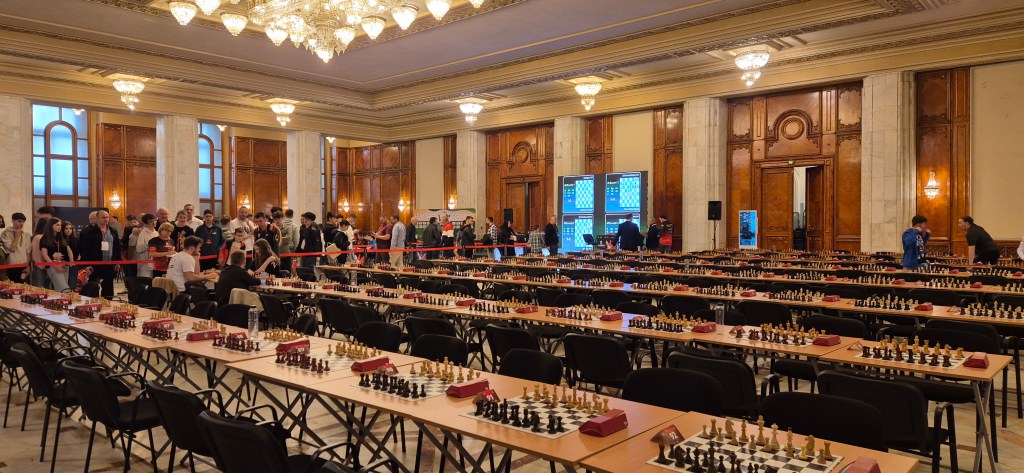
The venue for the chess tournament. Also the finish for the running was in front of the same building
I set myself a simple goal: to finish in the top half of both competitions. For the 10K run, this meant aiming for a time under 58 minutes based on the previous year’s results. For chess, it was more ambitious: scoring at least 5 out of 10 points. My best previous performance had been 4.5 points at the 2022 edition, and I hadn’t done much preparation this time.
The Running Phase
The last kilometer of the race
The day began with the 10K race, an event as well-organized as ever. The weather was perfect for running: cool (6–8°C) with a light drizzle. I started at a pace of about 5:20 per kilometer and maintained it for the first half. I was feeling strong. I sped up for the second half and dropped below 5 minutes per kilometer. I even sprinted the last 200 meters at a pace of 4/km.
I finished with an official time of 52:08, far better than expected. I placed 312th out of 2,957 finishers, putting me in the top 10.5%. However, this statistic is somewhat misleading, as most of the stronger runners competed in the half-marathon on Sunday. So, the field for the 10K wasn’t as competitive.
After the race with colleagues from Trupa lui Fane
A major factor in my performance was the training I did for a month with “Trupa lui Fane” in Bucharest. That preparation made a big difference. For context, I ran the Berlin Half-Marathon in 1:59:32, while the 10K time I just achieved projects to about 1:55:00 for a half-marathon. That gives me hope to break 1:55 at the upcoming Tallinn race.
Many thanks to Ștefan Oprina, who has helped me overcome health challenges and become a better runner over the years!
The Chess Tournament
Later that day at the chess tournament
After the run, I had time to shower and eat before the chess tournament began.
The tournament followed a 10 round Swiss format. That means each player is paired in each round with another player who has the same score. Each game was timed at 15 minutes per player. There was a 5-second increment per move. This is standard practice these days to avoid losses on time in winning positions. The schedule included 4 rounds on Saturday and 6 rounds on Sunday.
I started with 2 points from the first 4 rounds, not great, but acceptable. Sunday started well with a win. Then, I lost against a Candidate Master. I followed up with two more wins (one also against a Candidate Master). That brought me to 5 points from 8 rounds, achieving my goal of finishing in the top half. Unfortunately, I lost the last two rounds against stronger players. In the end, I placed 213th out of 475 players. This result put me in the top 45%. Additionally, I gained 5 ELO points.
A New Type of Duathlon?
This experience made me think: what if we organized duathlons that combined very different events like running and chess?
One idea is to use a simple average of ranks or scores across both disciplines to determine an overall winner. A more refined method could involve using normalization. Each result could be compared to the best and worst performances in each category. This approach allows fair comparisons.
I was thinking of a way to compare results from independent events. In this case a rough formula could be:
Eval = 2×ELO Performance−Race Time (seconds)
The idea is to reward high chess performance. The higher the performance, the better. It also aims to penalize long race times. The lower the race times, the better. I’ll work on refining this formula in a future post.
A Special Chess Anniversary
This year marks the 100 year anniversary of the Romanian Chess Federation. With almost 500 players this was the biggest chess open tournament ever organized in my country. It attracted many strong players and also gave me the chance to reconnect with my chess roots.
I was delighted to see my former coaches again.
I first met Iulian in 1992 when he visited our class during a math lesson. He had just opened a chess club and invited students to join. Our teacher asked who already knew how to play chess, and a few of us raised our hands. He encouraged us to learn more about the game. Shortly afterward, I joined the club, and chess became a lifelong journey. Iulian didn’t play this year, but he was there coaching five juniors. I was part of his first generation of students; since then, many others have followed. Here we are 33 years later still enjoying the game.
With Iulian my first coach
Cristian, a chess master, coached me between 2018 and 2020 before I moved to Poland. He was one of the referees at the tournament and continues to coach young players. During our time working together, I focused a lot on the psychological aspects of chess—understanding how emotions influence decision-making. Chess often goes beyond logic; it’s also about how you manage your internal state.
With Cristian
I’m deeply grateful to both of them for their impact on my life.
Seeing them again, by chance, after several years was one of the weekend’s highlights. We’ve kept in touch, but nothing compares to meeting in person.
There’s a quote I really believe in:
“In life, what matters most is the people you meet and the books you read.”
Cardiff half-marathon is part of Superhalfs which makes it one of the most attractive races in England. Initially my thought was to run there because it’s one of the 6 half-marathons you need to finish to complete the Superhalfs series. I didn’t know much about Cardiff or the race before going there; hence, this half marathon was a pleasant surprise for me.
By the time I wanted to register for the event in Cardiff, the registration was already closed. Generally, such races sell out more than six months before the event date, so you need to plan your participation well ahead of time. For example, by October 10, 2024, the Cardiff Half Marathon for 2025 was sold out. According to the organizers, all spots were sold within 12 hours of the registration opening.
If you are late and still want to run there, you can get help from a sports travel agency. Such agencies guarantee your participation and accommodation for a fee. They may also organize training sessions and a pasta party for their clients. This time, I went with Interair, a German sports travel agency, and I was happy with their services; everything was great.
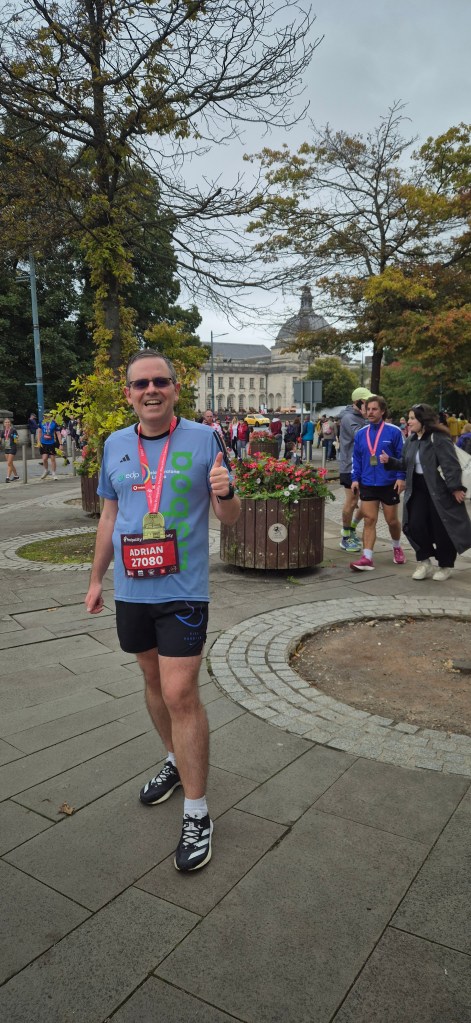
Before the race
On October 6th, it was a good time to run in Cardiff, with temperatures around 12 degrees Celsius and light drizzle at the start. There was enough space to warm up before the race. The runners were organized in waves, as is normal for a half marathon with 28,000 participants.
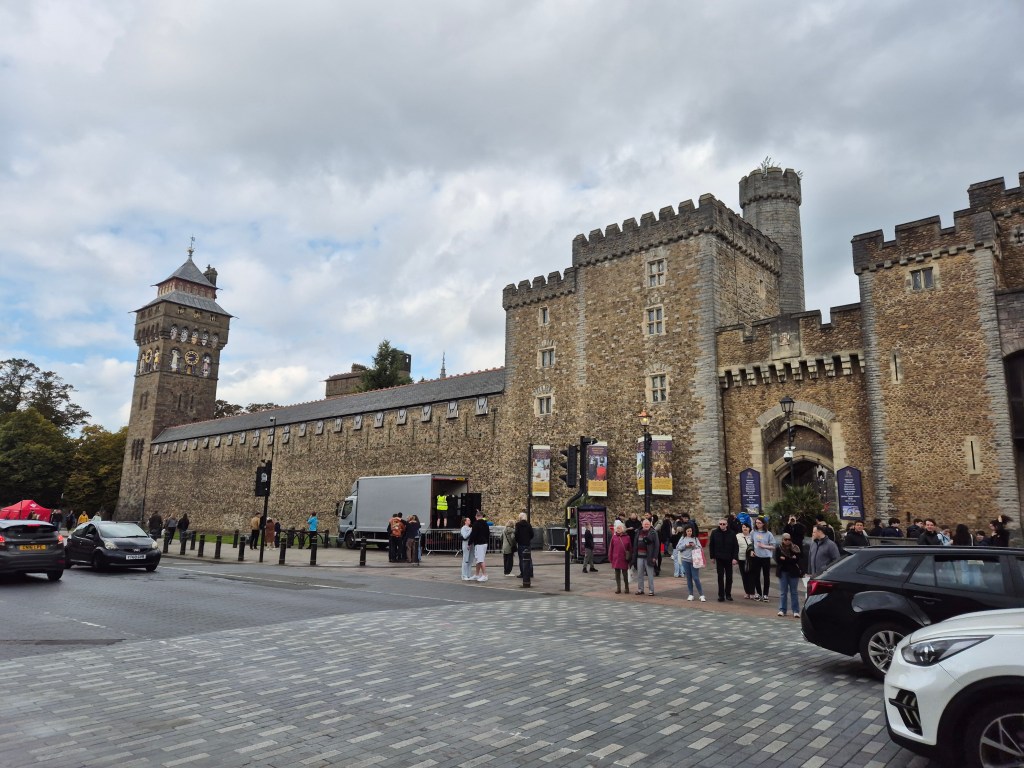
The start is at Cardiff Castle, and the route winds through the city, including the bay area, before returning to the center and the castle. The first part of the race is either descending or flat; from kilometer 15, it starts to ascend, with some hills around kilometer 18, and towards the end, there is a significant difference in altitude.
I started with a pace of around 5:40 per kilometer and maintained that until kilometer 10 when the two-hour pacers went ahead of me. I made an effort to keep them in sight for as long as I could. By the 18th kilometer, I was confident that I could finish in under two hours. Then the small hills came, and I thought there was no way I would finish in less than two hours. Fortunately, with a final burst of energy, I finished in 1:59:58!
After the race
During the race, I used two GU gels and drank water twice, at kilometers 10 and 15. Water stations were available every 5 kilometers and also at kilometer 18.
One must remember that in England, races are marked in miles—13.1 miles as opposed to 21.1 kilometers in the rest of Europe. In this context, it’s useful to have an accurate GPS watch or to keep pace with the pacers if achieving a specific time is important to you.
As you can see, I’ve run many races in Europe, and I have never seen so many supporters encouraging runners as I did in Cardiff. The respect for runners is high in the UK compared to elsewhere. There were thousands of people spread over the half marathon distance, showing support for the runners. This can significantly boost one’s motivation to finish the race. I believe this played an important role in my success in finishing under two hours for the first time this year.
Cardiff Castle
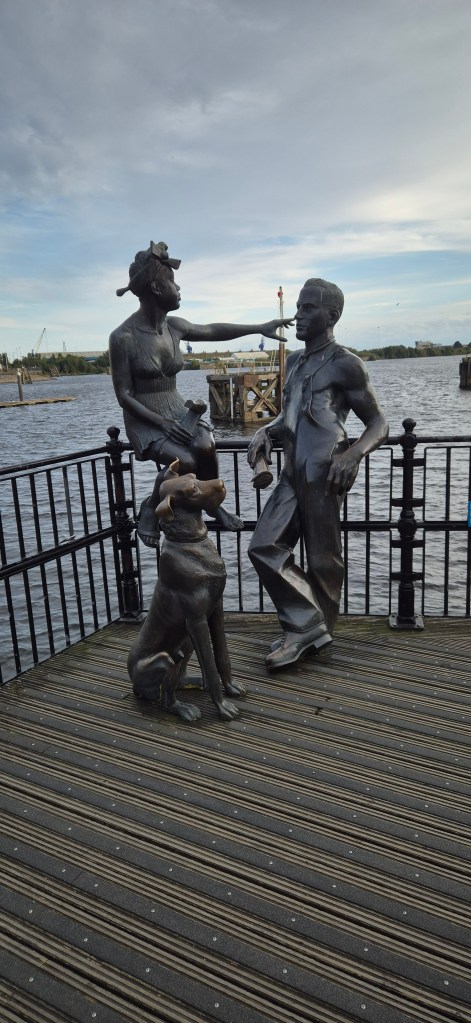
The other pleasant surprise was the city of Cardiff. The capital of Wales has a beautiful, typical British castle worth visiting. You can explore the bay area, the old market, and the city center. There is a village museum outside the city and a cathedral, but I did not have time to see them. There are nice restaurants and many people partying during the weekend.
Cardiff bay area
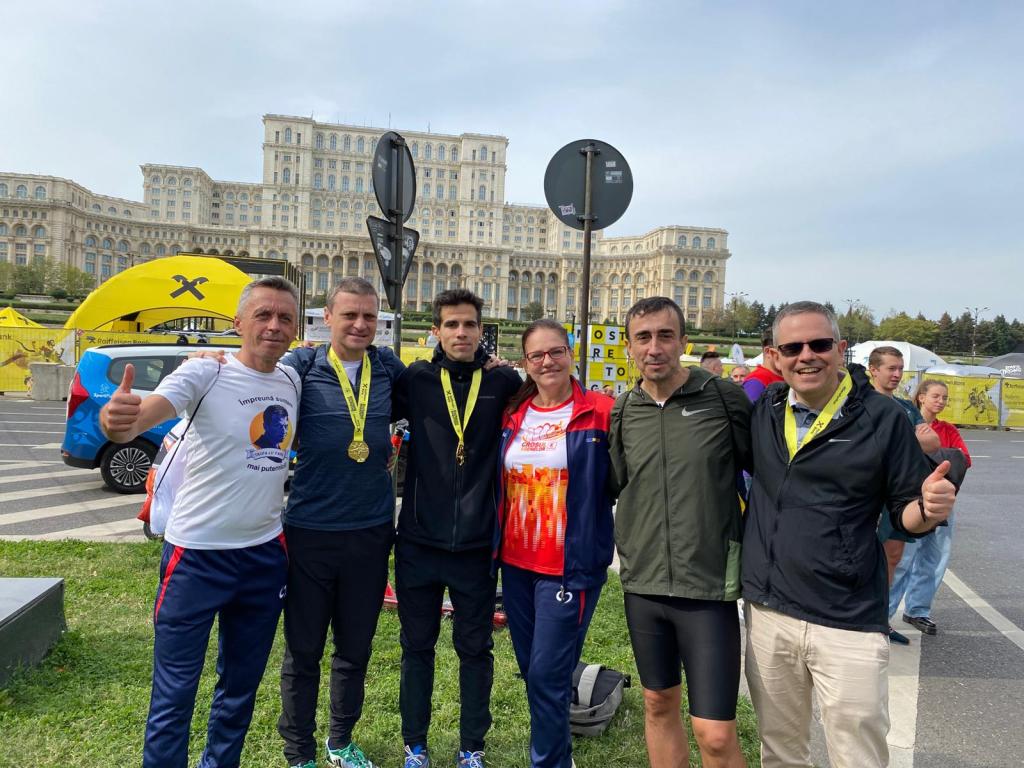
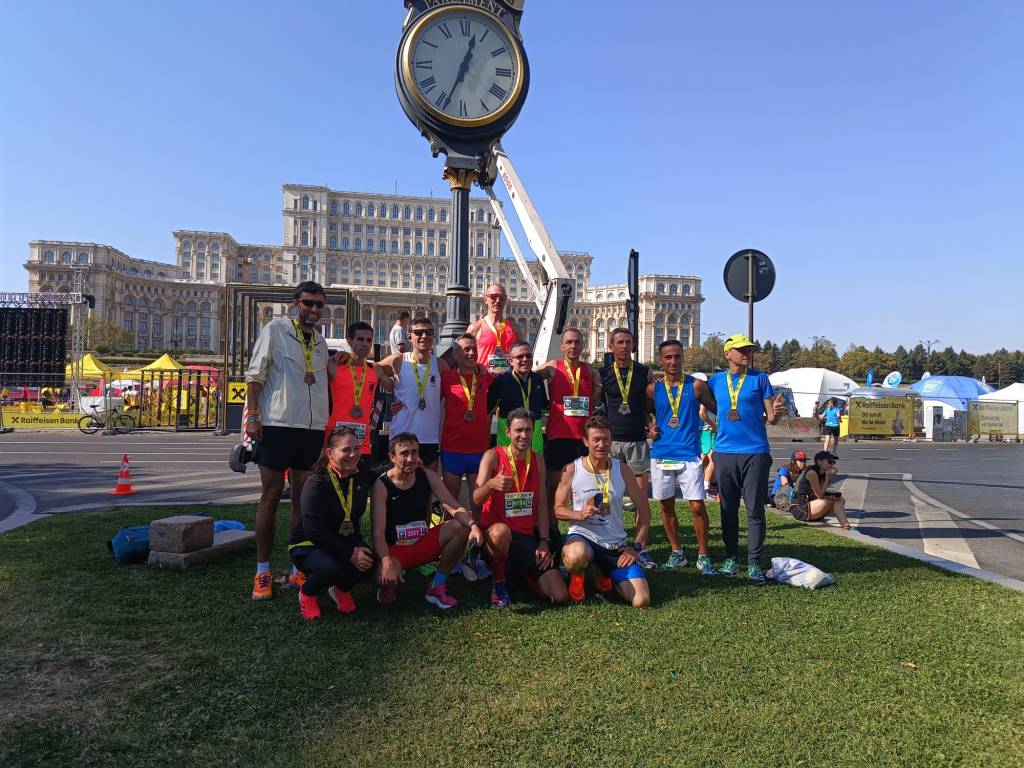
The weekend after Cardiff, I traveled to Bucharest to watch the Bucharest Marathon and encourage my colleagues from “Trupa Lui Fane”. They achieved great results, with four of them finishing the marathon in less than three hours! That reflects a lot of hard work and training. There were also good results in the 10K, half marathon, and relay races. Many thanks to our coach, Stefan Oprina, who has been training me remotely for the last four years!
With colleagues and coach after their race in Bucharest
Cardiff was a great experience, and I encourage you to try it; it will be fun!
I started running in 2015. After 8 years, I recently crossed a distance of 10k km running. I am happy with my motivation to continue running for 8 years at an average of 2 miles (3.2 km)/day. The 10k km is not a long distance for 8 years. People who want performance in running should aim for at least twice as much as I did. A professional runner covers a distance four times longer than I did within the same time, so 10k km in just two years!
Statistics say I ran, on average, over 100 km each month. The total time spent on running is 41 days, or 1.5% of 8 years. It was the best time invested in one activity as it gave me much health in return. My average pace was 5’52” per km. I ran alone for 6 out of the 8 years.
Of great help for me was running with the running group “Trupa lui Fane”. Although I moved to Krakow in 2020, we continued the collaboration remotely all these years. Many thanks to Stefan Oprina and “Trupa lui Fane” members for their support!
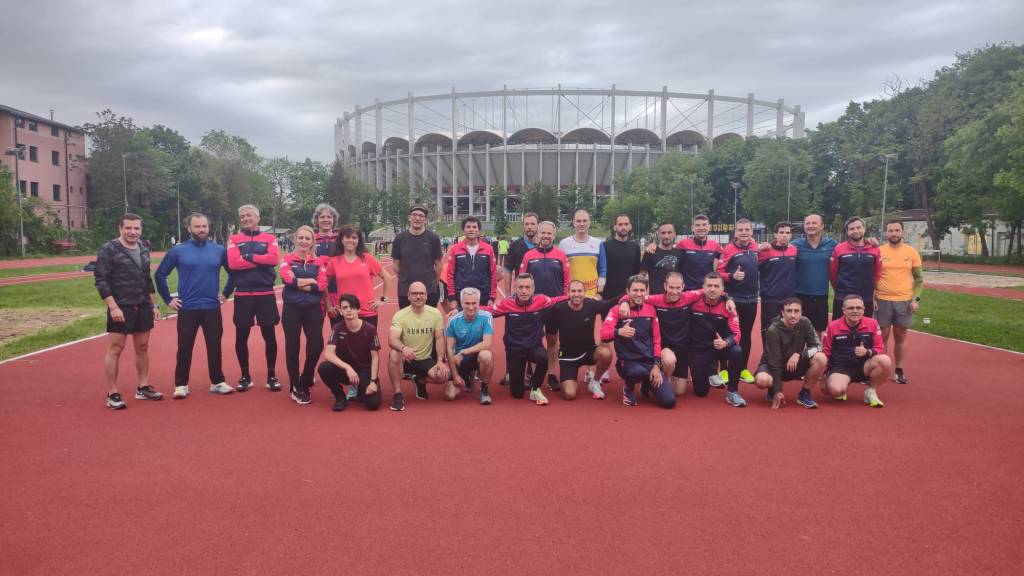
With “Trupa lui Fane” in May 2023
I crossed the 10k km mark at the last training before running the half-marathon in Bucharest. This way, the first and the last of the 10k km were run in the same stadium (the one in the picture above).
My first half-marathon was 8 years ago at Bucharest MIB. As mentioned in a previous post, to celebrate this distance milestone, I chose to run this year’s edition of the same half-marathon in Bucharest on October 15th. I participated in 6 of the last 8 editions of MIB.
With Bobo at the start. He finished 12 minutes ahead of me. Great run!
The organization for this event was amazing, as usual. Music bands, water and isotonic, pacemakers, and many volunteers make it a great event. The only thing I would like to see improved is the opportunity for runners to buy their photos at a good resolution and without a watermark. The pictures are free now but with a watermark, as shown above and below.
I wasn’t in good shape for this half-marathon, but I know my limits well. It was also hot that day, not ideal for running.
About the half of a half-marathon
I kept my pace around 5’30” for most of the race, with the last 2 km being the most difficult, and ran harder for the final straight line. My official time was 1:57:40.
I met many people I knew before or during the half-marathon. This was cool and makes MIB my favorite race. You get in line with someone you know, exchange a few words, and continue the race. Precisely like in life, only at a different pace.
Crossing the finish line
I registered for 3 half-marathons in the spring 2024 to celebrate this achievement. Lisbon on March 10th, Prague on April 6th, and Helsinki on May 11th. Lisbon and Prague are part of the “super halves”, while Helsinki has a unique story. Superhalfs are a series of 6 essential half-marathons in Europe. You get an additional medal if you finish all 6 in 5 years or less.
Celebrating with colleagues after the finish
Running shaped my personality and helped me deal with many things in life. I met great people while running. It is a walk of life that you can do at a slower or faster pace, how you like it. During the first years, it was hard to motivate myself to go outside in cold weather and run. I had no coach at the time and did everything alone. Today, I am happy I chose to continue running those days despite the hardships.
I had no talent for running and no experience before I started to run. It is never too late to change your life and run, even if this is not your strength. If I could do it, everyone can.
“I’m learning to fly, but I ain’t got wings.” – I saw running as a way to learn to fly.
During WWII, while working in Bletchley Park to break the Enigma code, Alan Turing invented a game that combined chess and running. The contest rules: You sit with your opponent in front of a chess table. You make your move and run around the house. The other player has to move before you return. Once you sit down at the table, the other player runs around the house. Then you have to move, etc. You lose if you are checkmated or fail to move before your opponent returns to his chair.
The above mentioned is a rare example of a game that exercises both mind and muscles hard. But what made Turing invent such a strange game? At Bletchley Park, there were excellent chess players ( e.g., C. H. O’D. Alexander was the British chess champion and became International Chess Master). They were playing a lot of chess. Turing was a modest chess player despite all his tries. But he was a very competitive person. And a great runner with a personal best of 2:46 per marathon. That would be a fantastic time, even by today’s standards. The game mentioned above helps the fast runners as it gives them more time to think.
Romanian Parliament House
During my stay in Bucharest, I played in a chess tournament and ran a half marathon in May. The chess event happened inside the giant House of Parliament, the most prominent building in Europe. The start and finish of the race were in front of the same house. That made me think about the game proposed by Turing, although in my case, the two events (chess and run) happened within one week, not on the same day.
Side view of the Parliament House
It is funny to imagine Turing’s game inside the House of Parliament in Bucharest. One run around this house is longer than 3 km, and after just 14 moves, you run more than the equivalent of a marathon. This game would require players with great physical shape. This is an amusing edge case for the proposed game.
Playing venue inside the Parliament House.
First, it was the chess event. About 200 players from 15 countries gathered in a massive hall from Parliament House. There were 10 rounds of rapid chess (15′ +5″ format). My result was 4.5 points from 10. Because 9 out of 10 opponents were ranked higher than me, I gained 38 ELO points. My opponent had a considerable advantage from the opening in one of the games. I continued playing as I still had pieces on the table. He relaxed, and his advantage started to decrease. I kept calm and played the best I could. The position was drawn, and then I had the advantage and won. The win was not because of a blunder but because of the constant improvement of the situation. Later, I saw that my opponent was above 2200 ELO in classical chess while I was 1800. The lesson is to continue the game as long as the position still could give some hope. Playing in this tournament was a fun experience!
I was happy to see that chess is becoming more popular in Romania.
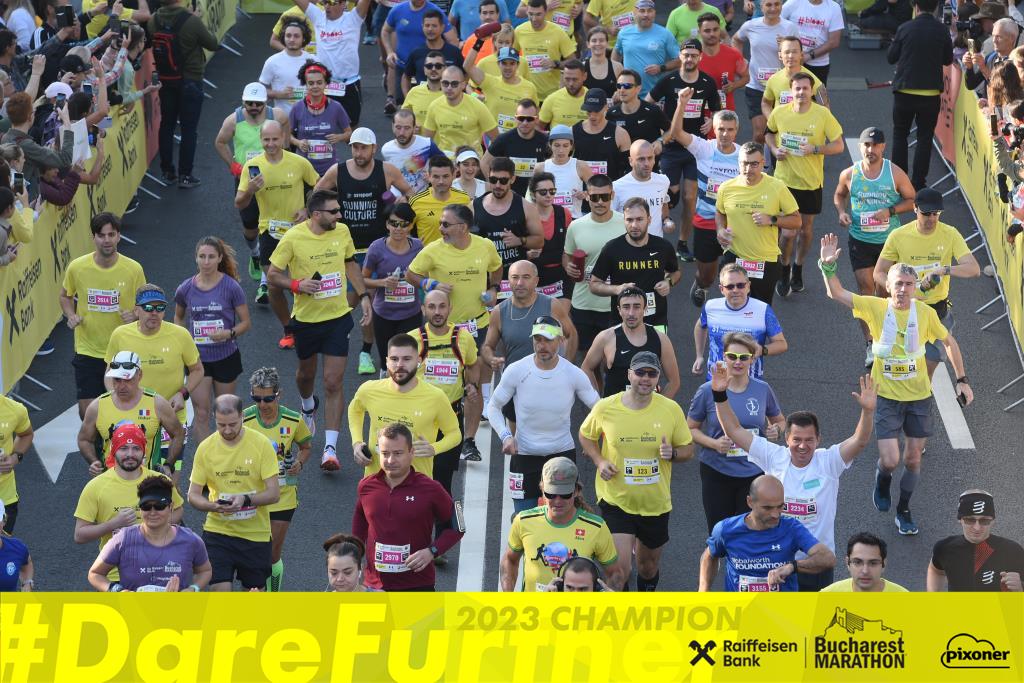
At the start of the Bucharest Half Marathon
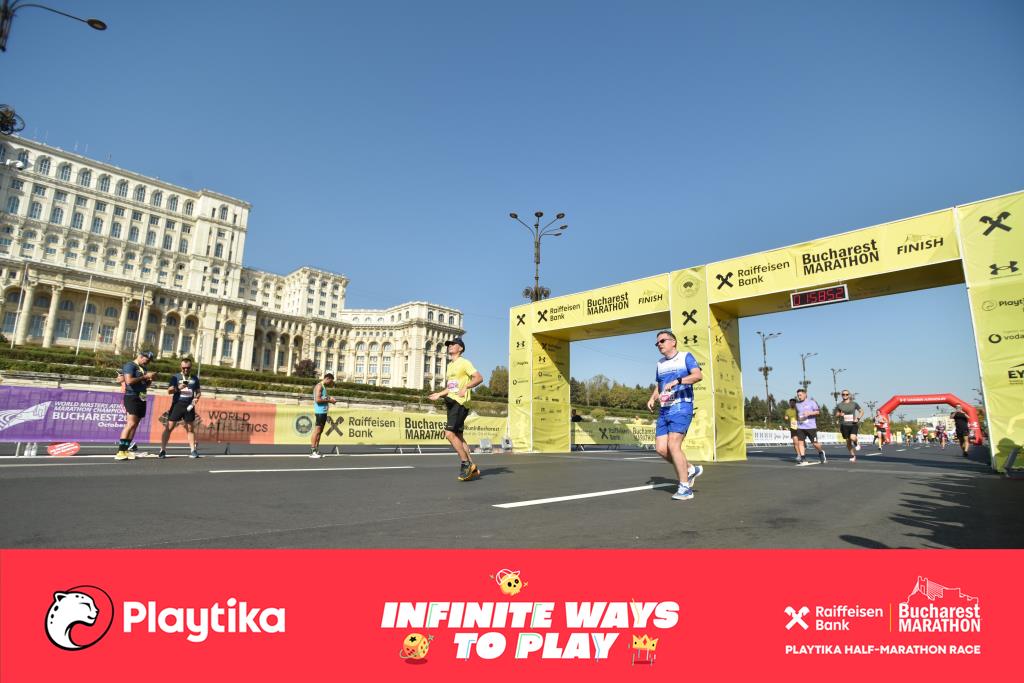
The second event was the Bucharest Half Marathon. I’ve participated in the last five editions of this competition. This year the weather was ideal for running. I tried to improve my time from the Warsaw half marathon in March but failed to do that for 3 seconds! The official time was 1:54:30.
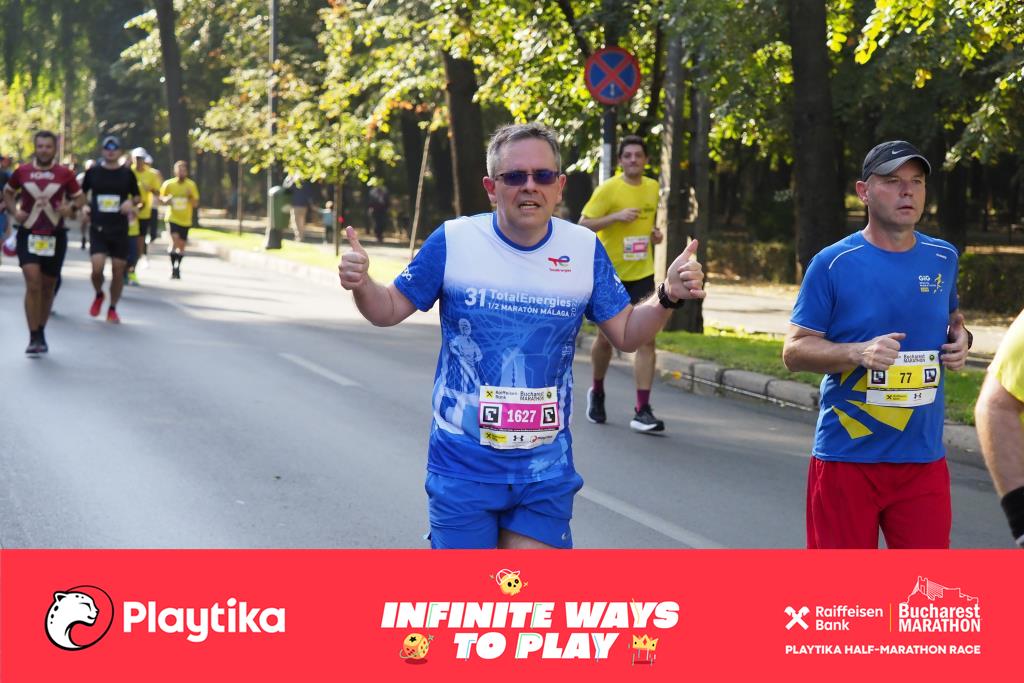
Close to km 10.
One statistical aspect is that the average time for finishing this half-marathon was 1:58, while in Warsaw was 1:54, and in Krakow, 1:52. Although I failed to improve my time, I was happy to see many people I knew. It is good to say hi! and exchange a few words.
With colleagues from “Trupa lui Fane” after the race
Let’s get back to the story about Turing. The run-around-the-house chess had no success. Nobody was willing to play it (for some reason, runners are not interested in chess, and chess players do not run). Turing did not give up. He came up with the idea to create a program to play chess and defeat his colleagues. At the time, the computer was at its beginnings. Turing created the first chess program called Turochamp in 1948. His idea was that if I couldn’t beat you, I would make a program that would do that. This second plan was much better. It led to a challenge between man and machine. These days a chess program on any smartphone can defeat the best human chess player.
Being in Bucharest, with some administrative issues since August I had the chance to participate in Bucharest Half Marathon 2021 on September 5th. This was the tenth edition of this competition and my fourth participation.
Since it was an event during It was an event during the pandemic. The organizers required participants to be vaccinated or taking a Covid test that should have a negative result. I don’t know how many people were at the start. Only that about 1100 finished the 21.1 km race, including those participating in relays.
II was also registered at Poland Business Run. This was a virtual and remote team race of 4 km, taking place on the same day, September 5th. I do not have enough energy to run 4 km fast after a half marathon. The only option was to run both races at the same time. My choice was to run fast the first 4 km stop the watch and record the result. Then continue for the next 17 km to finish the half marathon. Obviously, I did not care about the finishing time of the half marathon.
At the start of the half marathon. I am at the bottom of the image with a blue cap
The weather was good for running at 8:30 AM when the race started. The organizers asked us to run with masks for the first 100m of the race. As you can see, many runners ignored that ask. I ran the first 4 km in 23 minutes. The time was not good. I made another try. I ran the next 4 km 40 seconds faster and used this time for the Poland Business Run race.
During the race, after 8 km
The picture above is taken at 8 km into the half marathon race. I had only one race to focus on at that time. The remaining 13 km of the half marathon. After 14 km I was tired, but that was not a surprise. The 8 km of faster speed at the beginning were taken their toll. I did not force myself at all. I was just having fun for the rest of the race.
At the finish line, in the center of the image
At 10 AM, it was already sunny and not that easy to run. I crossed the finish line after two hours and ten minutes. It was not a good time. Usually, I should finish in under two hours. But given the circumstances, I was happy with finishing both races. A fun fact is that at this competition, they had the heaviest medal I have ever seen. After running 21 km, they put the medal around my neck. My head went in front, carried by the heavy metal. The joke was that the medal was twice as heavy this time. Because last year there was no competition and they doubled the metal quantity this time.
After the race with some of my colleagues and our coach Stefan Oprina. In this picture, next to Stefan is Valeria Racila van Groningen, the organizer of this competition and of the most important running event in Romania (Bucharest International Marathon)
Despite the pandemic, the event was very well organized. Many thanks to the organizers for the opportunity to run again with such a great community. Everything was well prepared. There were hydration points, many bands singing on the way, and an army of volunteers checking that everything was ok.
During my stay in Bucharest, I trained with my colleagues at “Trupa Lui Fane”. It was great seeing them again after more than one year. I was happy that I could run with them. Many thanks to Stefan for giving me the chance to continue training with the rest of the team!
Another thing worth mentioning is that, among others, I am allergic to ragweed (in Romanian “ambrosia”). I did not know because the previous year, I was not in Bucharest during this time. Two years ago, it wasn’t that bad. It is estimated that around 10% of people in Romania are affected by this allergy. The recommendation is to stay at home during the morning when ragweed is more active. Not only that I did not stay at home that day. But I also ran for more than 2 hours. The result was that during that night, I could not breathe and therefore sleep. If people allergic to ragweed are taking Claritine, xyzal, or both, the symptoms will disappear.
If you are allergic to ragweed and plan to travel to Bucharest between mid-August and the end of September, please take care of this.
Ending on a positive note running a half marathon is always an experience to remember. As Emil Zatopek, the greatest runner once said:” If you want to run, run a mile. If you want to experience a different life run a marathon”…or at least a half marathon, if I may add.
When playing Chopin’s Nocturne 20 on September 23rd, 1939 at Warsaw Radio, Wladyslaw Szpilman did not know that it will be his last performance for a long time. Hours later, a German bombardment destroyed the power supply. The radio was shut down for almost six years.
Chopin Nocturne 20 played by Wladyslaw Szpilman
Last year, while reading The Pianist by Wladyslaw Szpilman, I had no idea that Covid will come. That everyone will be isolated inside, living like the hero of this book during World War II. The book reminded me of a famous journal in Romanian literature, Mihail Sebastian’s Journal. As a consequence, this year, during isolation, I read, again, Sebastian’s journal. This happened after more than twenty years from my first lecture.
These days, when the Covid pandemic affects the whole world, I found these two books inspiring and powerful. Despite the tragedies happening at every step in the books, I found them very human. These are real-life stories. They describe how the authors kept going in difficult circumstances. I hope people reading these testimonies will find help in overcoming the current situation.
These books depict the stories of two men, a pianist, and a writer. Both were highly esteemed before the war for their talents. During World War II they lost everything they had. In both cases, the only reason behind this was their Jewish origin. One lived during the war in Warsaw. The other one in Bucharest. They went on living and fighting for their lives during hard times. They overcome the difficulties in the end.
If you don’t have the time to read the book, you can watch Szpilman’s story in the video below. Or you can watch the famous movie directed by Roman Polanski.
Szpilman recounting his life in Warsaw during the German occupation.
I don’t have a video for Sebastian’s story. But his journal is very well written. He was a talented writer. His family kept his journal private for more than fifty years after his death. It was published in 1996. By then, most of the people mentioned in the book were no longer alive.
Below is a short video of his biography. He was honored with a Doodle on the occasion of his birthday in October 2020.
Mihail Sebastian was honored with a Doodle on October 18th, 2020 on his 113th birthday anniversary
Both books offer great insight into historical events. And how ordinary people lived them. We can read in history books about what happened during World War II. However, reading about day to day life is like zooming in on a historical moment.
When reading Sebastian’s journal, I realized that possibly before the war, Sebastian listened to Szpilman playing live on PolishRadio. He mentions in the journal a few times listening to classical music at the Warsaw Radio. Once, it was a three piano concerto. Szpilman worked with Polish Radio since 1935.
That happened in a normal world, before the war. A writer passionate about music could listen to a talented musician from another European country. Then the war came. Szpilman was no longer playing the piano. Sebastian was not allowed to write plays or novels. Because he was a jew. However, during the war, in 1942, he wrote his best play. He named it “A star without a name”. Somebody else had to assume writing that play to bypass the law. Sebastian saw the great success of the play. Yet, he took no credit for it until the end of 1944.
Szpilman lived with his parents, his brother, and sisters at the beginning of the war. By 1945 all his family members died in the Treblinka concentration camp. Sebastian lived alone before the war. He had to move back with his parents and his brother during the war. He lacked money. At the end of the war, Szpilman was the only one alive from his family. Sebastian the only one who died.
There were many stories in both books that impressed me. In most cases, it’s about human nature. The books contain mostly sad and sometimes tragic scenes. But in the end, after going through all these difficult experiences, the message is optimistic.
In 1945, when the Polish Radio station broadcasted again, Szpilman played the same Nocturne by Chopin as in 1939. It was a superb way to resume life and overcome the pains suffered during the war.
One day, like him, we’ll have the chance to resume our usual lives.
Vera Lynn -We’ll meet again. A message that remains actual.
Since we’re all staying at home and I achieved the title mentioned milestone by running while we were still allowed to run outdoor, I thought to share here about how running changed my life.
On May 17th, 2015, almost five years ago, I left home with the goal to run for as long as I could at a low pace. My weight was over 90 kilograms and there were almost 20 years since my last one-kilometer run. That day, I was able to run one mile at a 7:30 min/km pace before I lost my breath. The next days the muscular pain was hard, I could barely walk and I was able to run again only one week later for two kilometers.
In 2015 just before I started running
From that moment, for every run, my goal was to stop running only when something in my body couldn’t continue. I was either losing breath, or my feet couldn’t keep the pace, or my liver or other internal organ told me to stop. In two months I reached the 5-kilometer mark. One month later I could run 10 kilometers. And in September, four months since I began to run I was able to run 18 kilometers. Very happy with my achievements, I registered for a half marathon (21.1 km) race in October 2015.
I was reading about other people’s experiences running a half marathon, how difficult it was for them during the race and how well they felt after they finished it. For me, it was a great experience only the first five minutes after the start. Until then I was running alone for five months and suddenly around me, there were ten thousand other runners. Because I was very excited I began to run too fast for my abilities and soon the energy left me. That race was a very painful experience and I felt no satisfaction once I finished the race after two hours and fifteen minutes of run.
I’ve learned from that painful experience and kept training. Next year, in May 2016 I finished the half marathon in two hours and four minutes, a considerable improvement. I was finally happy after a race. In the same year, in October, I finished it in 1:54, reducing the time by another 10 minutes.
In 2017 at Bucharest Marathon
In 2018 I joined “Trupa lui Fane” and achieved my current personal best time in October same year 1:46:46 based on the guidance I got from Stefan Oprina, our coach.
In October 2018, I achieved my best result so far. The photo was taken when I just crossed the finish line.
Here are some of the things I’ve learned during these five years of running.
It’s better to run in a group than only by yourself. I’ve been running three years alone and two years in a group. While I was running alone, my posture was incorrect and it took my coach a lot of time trying to adjust my running posture, which is better now but far from perfect.
While running alone I did no warm-up and as a result, I had many injuries which kept me from running for long period of times, even for one or two months.
Let’s say you can buy a book and start reading about how to properly train, but the experience of a coach weights a lot. He can see what is not ok with your running and can make recommendations based on his experience.
Running in a team is a really fun experience. In a team, people will encourage you because they all know how hard it is to run a half marathon or longer distances. They will also congratulate you on achieving your results or on finishing your races.
Running improved my health very much. Before running, I used to get tired easily. I also got cold easily. Since I go to the dentist every year I noticed a big improvement in my teeth’ condition due to running.
When you are running long distances you learn not to give up. As a chess player before I started running once I lost a game I used to lose other games as well. I couldn’t focus well. Running taught me to keep fighting and after a lost game to be able to come back. I would say that running long distances is a boost for self-trust.
If you run for, let’s say, 20 kilometers in the morning, you will feel great for the rest of the day.
I did lose weight, about 20 kilograms, you can see it from the pictures above. The best part of it is that I could still eat anything I wanted without any diet.
I met many people and learned about interesting life experiences and this enriched my horizon.
If you are a middle age person with no experience in running and you want to run there are many books and posts on social media about how to create good behavior.
But, more important, you need motivation. In this aspect, the trigger is very important and it will differ from person to person. Some run for fun, this is the smallest percentage, but they do exist. Obviously not the case of someone who starts running in the 30s, 40s or even later. For others it’s the competition, they like to compete and to win. For some it’s because they want to stay healthy, many runners are in this category. There are people who run to brag about it: “I do run marathons”. For some, it’s about their dreams, for others their demons. Some run to deal with grief and some to avoid life. Some people run because they want to learn how to fly, others are put in motion by the last verse from “Divina Commedia”.
Running it’s a fight with yourself, it’s about how you can control your emotions and a way to know yourself better.
Dear reader, find your inner motivation and running will help you deal better with life. Running it’s not an easy journey but it’s a beautiful one and it worth trying it.
This was my story and it still continues. If everything goes well, I will reach the 10000 km run milestone in less than three years from now. Since this post was a personal story about running, I thought it’s appropriate to end it with the soundtrack of the movie “Running“.
The National Masters Athletics Championship Indoor took place on February 22nd and 23rd in Bucharest. The only difference compared to the senior championship is that in masters everyone is competing for their age category and there are winners for each age category. The limit age for masters is 35 years old and people are grouped together in a race depending on how old they are. The first age category is 35 to 39 years and then 40 to 44 and so on from every 5 years. This is the standard that applies worldwide.
The national championship has all the track and fields of indoor disciplines. The running distances are ranging from 60 meters to 3000m. Besides running, there are also competitions of high jump, long jump, triple jump, pole vault, etc.
Initially, I wanted to run in the 1500 meters in my age category and I registered for that. However, when I saw the starting list I realized that all the other 9 competitors were about to finish the race under 5 minutes while my personal best time stays at 6:00. In these circumstances, I thought a lot and decided to skip this race. It is not common for me to change my mind after announcing that I will participate so I was not happy with that. However, this race was with people from a different league.
On Saturday, I went to the “Ioan Soter” athletics hall only as a spectator to watch the masters races during that day.
I even recorded using my phone the race where I was supposed to run that day. The winner in the 40-45 age category was Marius Busca who won it with a time of 4:07 which was a new national record for the age category. The previous record was 4:17. One week later, I saw Marius Busca running in the 3000m seniors championship final where he was the only runner over 35 years. Yet he finished 5th in that race also beating the M40 masters national record for 3000m.
1500m M40 race at Romanian Master Championship
As you could see in the above race, all the runners finished under 5 minutes except for the last one who did it in 5:18 but nevertheless, he would still have finished with one lap ahead of me.
Since I am writing about 1500 meters races, that day there were other two national records beaten in the same race distance. Stefan Ciochina at M60 surpassed the previous record held by Ilie Cioca by almost 20 seconds and finished in 4:59, a great time. Yet, Cioca Ilie responded the same day by beating the M75 national record with a time of 6:05. This is the beauty of running in the masters series. Every five years you enter a new category and aim for your best performance according to your age.
On Sunday, the second day of the championship, there was amongst other races the 3000m run. This is the longest distance to run in indoor competition. In this competition, there were again two new national records. Stefan Chiochina has beaten the M60 record previously owned by Ilie Cioca by 40 seconds. And Cioca Ilie replied in the same race by beating the M75 national record. This sounds like “Groundhog Day”, right?
The most spectacular race of the day was the 800 meters run at M50 where our colleague Victor Bratu who owned the 1500m record in M50 tried to beat the national record for 800m too. But in that race, it was also Gheorghe Romascanu who owned the 800m record.
Better to see the race and convince yourself that it was a nice competition. Victor Bratu had the white shirt and Gheorghe Romascanu the orange one.
800m M50 race at Romanian Masters Championship
Victor Bratu won the race with a new national record of 2:16 for 800m!
I would like to congratulate all my colleagues from “Trupa lui Fane” who won the titles of National Champion for their age category: Bogdan Nitulescu M45 3000m, Laura Panaitescu F35 3000m and 1500m, Gloria Suciu F50 1500m, Cristina Ciobanu F55 1500m, 800m, 400m and, 200m, Victor Bratu M50 800m, Gil Popistasu M70 800m, Vali Puzderica M50 400m, Dan Constantin M45 60m, 200m and, 400m. Many thanks to our coach Stefan Oprina who helps us becoming better runners!Congratulations also to all the athletes who participated in this event!
This was a nice championship and I am looking forward to my next race, this month on March 22nd at Baneasa Forest Run where I will run 11km.
It’s been a while since I haven’t written about chess on this blog, and I think it’s time to cover a chess tournament.
In Romania, if you are not a chess grandmaster, international or FIDE master you have to play in a semifinal tournament to qualify for the final phase of the National Chess Championship. The Federation chose five cities in Romania ( Timisoara, Cluj, Iasi, Bucharest and Braila) to stage semifinal tournaments in February. The players finishing on the first ten places in the semifinals have the right to participate at the National Championship Final in April.
Because I live in Bucharest, I played here in the semifinal tournament. The venue was the new building of the Polytechnic Library on the University campus. The library was an excellent location because it’s quiet and has lot of natural light on the last floor.
National chess semifinals in Bucharest in UPB Library
There were nine rounds played during two weekends full of two rounds per day and one day with three rounds. It would have been nice if instead of having three rounds in the second Saturday we could play one round in the Friday evening and two rounds on Saturday.
At the start of the game each player has one hour and a half on the clock and gets an additional 30 seconds for every move he or she makes. This way one round could last for four hours or even more in some cases. The thirty seconds increment is to make sure that if a player reached a won position he or she has enough time to convert that position and not to lose the game because the time has run out.
The only unpleasant thing to mention was during the first Saturday when in parallel with the chess tournament there was a robotics competition in the same Library on the second floor. This was very nice and the young people participating there were very enthusiastic. The problem was that the Library had open space between floors and we heard all day screams and loud announcements from the second floor making our concentration difficult.
To qualify for the finals a chess player needed 6 points out of 9 games. There were no prizes and the only thing at stake was the qualification for the next phase of the National Championship. It was natural that all the players who were at 5.5 or 6 points made quick draws in the last round.
As for myself since I only had 4.5 points before last round and a win would not be enough to qualify I decided to play a nice game.
In the last game, I had the white pieces and we played a Sicilian Najdorf variation in which I went for a classical English attack on the king’s side. Twenty moves have passed and we reached the position below with white to move.
What do you think about the move rook takes h7 pawn? Do you think this sacrifice works?
I spent a lot of time thinking about whether the sacrifice works or not. If it doesn’t work, and I would move something else, the white offensive on the kingside will end and it will be black to counter-attack on the queenside.
Looking into the defensive resources of the black player I noticed that in the mainline he can protect his king with the bishop from e6 moving to g8, but I thought I can manage that if I bring my rook to h7.
The complexity of the above position is above my power of calculation. However, my intuition told me that the sacrifice is correct hence I did sacrifice a rook on h7.
To answer the question I asked my readers above I will tell you that the sacrifice is indeed correct. The sacrifice works only if white at the next move diverts the black queen from defending the e6 bishop. The move order is rook takes h7 pawn, the king takes the rook on h7, knight to a5, attacking the black queen and black queen goes to c7 then white plays queen to h2 check, the king takes the pawn on g7 and white rook from d1 to h1. This way the white queen penetrates the black defensive lines winning the game.
Unfortunately, in the game, both I and my opponent made serious mistakes. Once the rook was taken I played Queen to h2 and then Rook to h1 without diverting the black Queen. My opponent played Rook takes f3 pawn which gives the advantage back to the white player. I played Queen h7 check and after king to f8, I moved the white Queen to h8 allowing the defensive Bishop g8 and the game is lost for white. Instead, if I moved the knight to d2 I would have had a won position.
It’s not common in chess to have so many ups and downs in a few moves. This is an example where the intuition is far better than the calculation power of a player.
It’s good and very helpful in life in general to have a good intuition. The calculation power can be improved by solving many chess problems and this where I can do better.










 Adrian Matei's blog
You must be logged in to post a comment.