Małoposka international chess championship 2025

In the second half of June, I participated in the 35th edition of the International Chess Championship of Małopolska. It was held once again at the Galaxy Hotel in Kraków. This marked my third appearance at the tournament, following my previous participations in 2022 and 2024. The organization was excellent, just like in past editions, nothing to complain about.

The time control was classical. Each player had 90 minutes for the entire game. An additional 30 seconds was added per each move. As a result, many games stretched to four hours or even longer.

This year, the number of participants dropped to 270, compared to 390 last year. I’m not sure what caused the decrease. The playing conditions remained unchanged, and given that a tournament I attended last month in Bucharest had a record turnout, I doubt there’s a general decline in interest in chess. The dip might be connected to the recent underwhelming performances of Poland’s top chess players. This could have reduced national enthusiasm. Nevertheless, this is purely speculative.

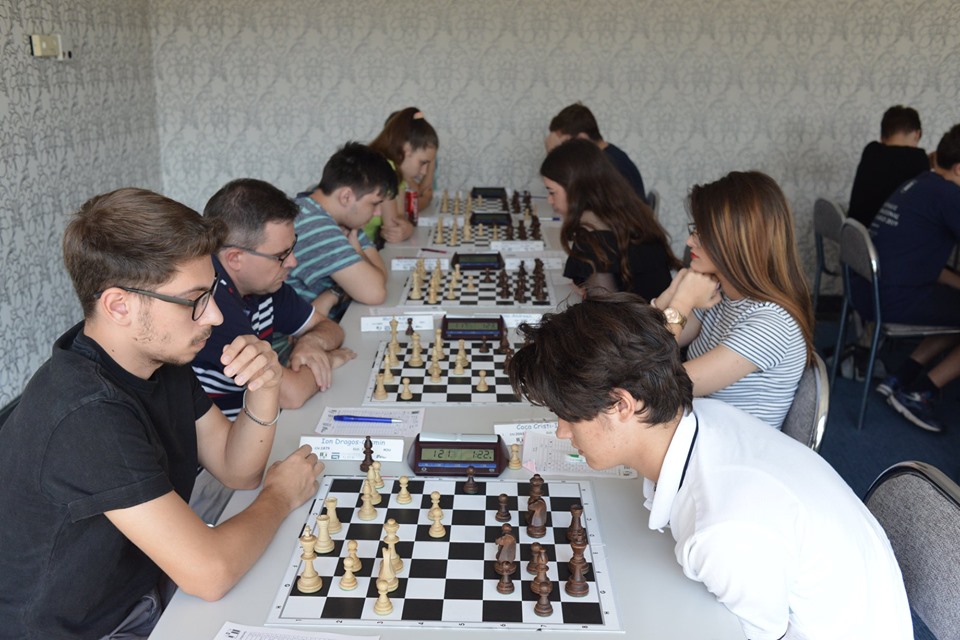
Playing hall for tournament C

This time there were less chess players from Ukraine compared to last year. They wore the T- shirts of the Lvov chess club. They also looked more sad, the long war is influencing the lives of the young people in Ukraine.

I played in Tournament B. It consisted of seven rounds over four days. There were two games per day, except for the final day, which featured only one round. My opponents were all young Polish players aged 16 to 23. I was pleasantly surprised by their excellent command of English. It’s encouraging to see how widespread English has become among younger generations in the EU.

Tournaments A and B

I approached this year’s tournament with a relaxed mindset, aiming to enjoy the experience and create complicated, fighting positions. I started well, scoring two points in my first two games. In round three, I lost a dynamic battle against the eventual tournament winner. This was followed by a sharp draw in round four, leaving me with 2.5 points—already a better result than in my previous two participations. I added another win in round five, but unfortunately lost the final two games. The last round was particularly frustrating. I had a clear path to a draw. However, I overpressed for a win and ended up losing.

In 2022, I finished with 2 points. In 2024, I managed 2.5. This year, I scored 3.5—noticeable progress despite the fact that, generally, age doesn’t help one’s chess performance. What changed?

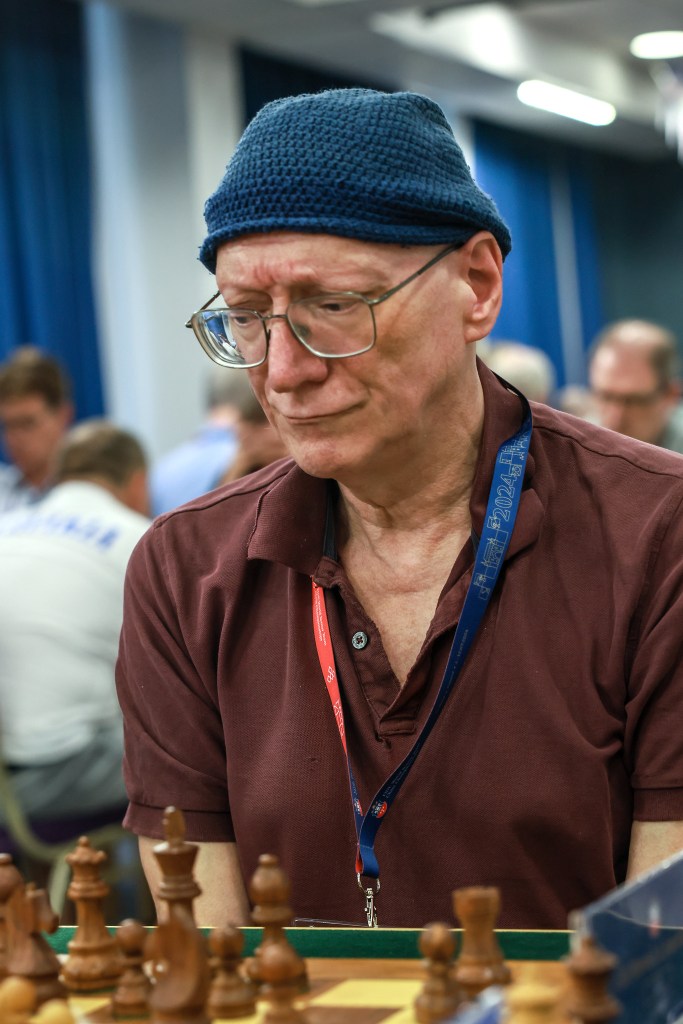
Portrait of a chess player

I didn’t train more. I didn’t exercise more. I firmly believe the difference was sleep. Over the last couple of years, I’ve found that I sleep significantly better when there’s no light in the room. I also sleep better when there’s no sound. I now sleep with an eye mask and earplugs, and the improvement in the rest has been remarkable. Chess, with its high cognitive demands, is a great way to measure mental sharpness. My performance this year supports the idea that better sleep leads to better results.

Chess has great benefits. It effectively trains the mind, much like physical exercise strengthens the body. The results of physical training are visible. Mental training is subtler, but no less important. And in my case, definitely more enjoyable than running marathons.

John Lennon – Mind games

A Personal Duathlon: Running and Chess in Bucharest

A traditional duathlon typically combines running and cycling. It’s less well-known than the triathlon, which includes swimming, cycling, and running—in that order. In both formats, the winner is the person who crosses the finish line first.

While I was in Bucharest this May, I experienced a rare coincidence. Two major sporting events were scheduled for the same weekend. One was the Bucharest Half-Marathon, and the other was the Bucharest Chess Grand Prix.

I wanted to participate in both, but unfortunately, the starting times overlapped. Luckily, the running festival included a 10 km race on Saturday morning, which ended before the chess tournament began. That turned out to be the better option. Not only did it fit my schedule, but running 10 kilometers requires significantly less energy than a half-marathon.

The venue for the chess tournament. Also the finish for the running was in front of the same building

I set myself a simple goal: to finish in the top half of both competitions. For the 10K run, this meant aiming for a time under 58 minutes based on the previous year’s results. For chess, it was more ambitious: scoring at least 5 out of 10 points. My best previous performance had been 4.5 points at the 2022 edition, and I hadn’t done much preparation this time.

The Running Phase

The last kilometer of the race

The day began with the 10K race, an event as well-organized as ever. The weather was perfect for running: cool (6–8°C) with a light drizzle. I started at a pace of about 5:20 per kilometer and maintained it for the first half. I was feeling strong. I sped up for the second half and dropped below 5 minutes per kilometer. I even sprinted the last 200 meters at a pace of 4/km.

I finished with an official time of 52:08, far better than expected. I placed 312th out of 2,957 finishers, putting me in the top 10.5%. However, this statistic is somewhat misleading, as most of the stronger runners competed in the half-marathon on Sunday. So, the field for the 10K wasn’t as competitive.

After the race with colleagues from Trupa lui Fane

A major factor in my performance was the training I did for a month with “Trupa lui Fane” in Bucharest. That preparation made a big difference. For context, I ran the Berlin Half-Marathon in 1:59:32, while the 10K time I just achieved projects to about 1:55:00 for a half-marathon. That gives me hope to break 1:55 at the upcoming Tallinn race.

Many thanks to Ștefan Oprina, who has helped me overcome health challenges and become a better runner over the years!

The Chess Tournament

Later that day at the chess tournament

After the run, I had time to shower and eat before the chess tournament began.

The tournament followed a 10 round Swiss format. That means each player is paired in each round with another player who has the same score. Each game was timed at 15 minutes per player. There was a 5-second increment per move. This is standard practice these days to avoid losses on time in winning positions. The schedule included 4 rounds on Saturday and 6 rounds on Sunday.

I started with 2 points from the first 4 rounds, not great, but acceptable. Sunday started well with a win. Then, I lost against a Candidate Master. I followed up with two more wins (one also against a Candidate Master). That brought me to 5 points from 8 rounds, achieving my goal of finishing in the top half. Unfortunately, I lost the last two rounds against stronger players.
In the end, I placed 213th out of 475 players. This result put me in the top 45%. Additionally, I gained 5 ELO points.

A New Type of Duathlon?

This experience made me think: what if we organized duathlons that combined very different events like running and chess?

One idea is to use a simple average of ranks or scores across both disciplines to determine an overall winner. A more refined method could involve using normalization. Each result could be compared to the best and worst performances in each category. This approach allows fair comparisons.

I was thinking of a way to compare results from independent events. In this case a rough formula could be:

Eval = 2×ELO Performance−Race Time (seconds)

The idea is to reward high chess performance. The higher the performance, the better. It also aims to penalize long race times. The lower the race times, the better. I’ll work on refining this formula in a future post.

A Special Chess Anniversary

This year marks the 100 year anniversary of the Romanian Chess Federation. With almost 500 players this was the biggest chess open tournament ever organized in my country. It attracted many strong players and also gave me the chance to reconnect with my chess roots.

I was delighted to see my former coaches again.

I first met Iulian in 1992 when he visited our class during a math lesson. He had just opened a chess club and invited students to join. Our teacher asked who already knew how to play chess, and a few of us raised our hands. He encouraged us to learn more about the game. Shortly afterward, I joined the club, and chess became a lifelong journey. Iulian didn’t play this year, but he was there coaching five juniors. I was part of his first generation of students; since then, many others have followed. Here we are 33 years later still enjoying the game.

With Iulian my first coach

Cristian, a chess master, coached me between 2018 and 2020 before I moved to Poland. He was one of the referees at the tournament and continues to coach young players. During our time working together, I focused a lot on the psychological aspects of chess—understanding how emotions influence decision-making. Chess often goes beyond logic; it’s also about how you manage your internal state.

With Cristian

I’m deeply grateful to both of them for their impact on my life.

Seeing them again, by chance, after several years was one of the weekend’s highlights. We’ve kept in touch, but nothing compares to meeting in person.

There’s a quote I really believe in:

“In life, what matters most is the people you meet and the books you read.”

What is life?

Chess – now and then

This post is split into two parts. The first part talks about my chess activity, and the second part is about the world of chess on the eve of a special celebration. The two parts are independent, and the second one is more interesting.

Part I

Recently, I played in two chess tournaments in Krakow. They were both of classical chess time controls, which lasted 3-5 hours per game.
First was the 35 edition of the International Chess Championship of Malopolska. I played in the B group of this tournament, for players rated between 1750 and 2000. The venue was Galaxy Hotel on the shores of the Vistula River. Many foreigners participating in this tournament were kids from Ukraine from Lviv Chess Academy. They had T-shirts with their club name on them. They played well; of the international players, the Ukrainians were the only ones who gained ELO points. There were also two players from Romania I did not know who also played in the Grenke tournament. We chatted during those days in Krakow; they were also impressed by the Grenke tournament. We all agreed that the chess level played in Krakow was much better than in Karlsruhe at the same rating. If you want to win games, go to Grenke; if you want to play good chess, come to Krakow. My result could have been better, but my games were exciting and fun, even when losing. That made me want to play one more time.

International Chess Championship of Malopolska

The second tournament was the 12th edition of the Cracow International Chess Championship. I played the B group of players again, rated below 2200 ELO. The group consisted of 185 players from 27 countries. I was the only Romanian this time. The venue for this tournament was Hotel Premier in Krakow, situated outside of the city center but easy to reach by car or bus. The special guests of the tournament were the Botez sisters, who streamed their games online. They have a well-known Youtube channel with 1.6 million subscribers. They were born and lived in Canada, but their parents are Romanian. Also, more than 15k people were watching their games live during the tournament. They finished with 5.5 points from 9 rounds each, while my result was 5 points from 9. I will share one of their rounds below to show how difficult playing an official chess game is. Their coach’s commentary is instructive.

Live streaming from BotezLive channel

I’ve discovered a powerful connection between sleep and chess results. The nights I slept well, I ended up with 5.5 points out of 6 games, while when I did not sleep well, I got 0 out of 5 games. It is not that I was biased. I tried to play better in each game. In one of the games, I had a winning position but made a mistake and lost.

Cracow International Chess Championship

With these tournaments, my results for the 25 classical games I played in 3 tournaments this year are 13 points, a little over 50%. I won 11 games, made 4 draws, and lost 10 times.
This concludes my chess games this year, as I don’t have enough vacation days left. I will focus only on running, with three half-marathons planned for autumn, the first of which is Cardiff.

Part II

On July 20, 2024, the International Chess Federation (FIDE) celebrates 100 years of existence. On that day, in 1924, 14 countries, including Romania and Poland, signed a document establishing FIDE in Paris. This part of the article is a small tribute to chess history.
If you want to understand the rest of this post, please watch the documentary below. No chess knowledge is required, only a sense of humor. Stephen Fry went to Thessaloniki in 1988 and made a movie about the 28th Chess Olympiad. The chess Olympiad is played every two years and is a team event; it is the most crucial chess team event.

This was the last Olympiad before the fall of Iron Curtain in 1989. Many things have happened since. Yet, in the chess world time flows differently. Grandmaster Anand, 55 years old, who played at that event for India is rated 11th player in the world today, 36 years later.

In July 2024, in Krakow, the World Senior Team Chess Championship was held for players over 50 and 65. This tournament was played in Galaxy Hotel, the same venue as my first tournament in Part I. In chess, there are only two categories for veterans: 50+ and 65+. I’ve counted 20 to 30 players from the Thessaloniki Olympiad playing in Krakow 36 years later. Team England 65+ featured two players from Stephen Fry’s documentary: John Nunn and Jonathan Mestel. However, the rest of the players in the documentary continue to be close to chess; Jonathan Speelman plays in many chess tournaments each year, and Nigel Short plays in a chess tournament this year.

What happened with the members of the USSR Olympic team who won in Thessaloniki? Kasparov retired from chess 20 years ago and moved to politics, being one of the most important Russian opposition leaders. Karpov also stopped playing chess about five years ago. Artur Yusupov retired for many years. Beliavsky plays for Slovenia and is an active player. Ivanchuk, at 55, is the 100th player in the world, is still very active, and plays for Ukraine. Jan Ehlvest plays for the United States at the World Senior Team Chess Championship in Krakow.

World Senior Team Chess Championship in Krakow

John Nunn and Jonathan Mestel played for the England team for the first time at the 22nd Chess Olympiad in 1976 in Haifa. That was almost 50 years ago. Nunn played on the primary team of England until 1994 and later moved to the senior teams. England won the World Chess Championship in Krakow in the 65+ category. They did not win in 1988 but continued and won in 2024. This is indeed true in a different context. As you can see in chess, playing strong for a very long time is possible.

England’s team won the World Chess Championship for seniors 65+ in 2024

Another English player has even more impressive results in time. Michael Adams played for the first time for the England team at the Chess Olympiad in 1990. He has played in the main team ever since and is expected to play even this year. At 53, rated 2672, Michael Adams is the 55th player in the world and the third player in England. However, as he is over 50, he also played in Krakow’s senior championship 50+ section.

Michael Adams in Krakow

Unlike other sports, the world of chess has changed slowly over time. These people are in their seventies, still going strong, and very sharp mentally. Studies have shown a much lower risk of mental diseases for people who play chess.

Chess is an individual game and such the history of FIDE is made of many such individual histories and dramas. It offers many lessons of life for people willing to pay attention.

Across the world, many events celebrate the anniversary of chess. In Bucharest, a special event was held at the Triumphal Arch to mark the 100th anniversary of FIDE. In Krakow, a chess photography exposition was opened. In London, in Trafalgar Square, on July 7th, more than 23000 people gathered to play chess in a special yearly event.

World Chess Torch at the Triumphal Arch in Bucharest

FIDE motto, “Gens Una Sumus,” translates to “We are one family.” FIDE has 201 state members in 2024. Another chess Olympiad, the 45th edition, will begin in September in Budapest. Chess has a history of over 1500 years but has never been as popular as it is today.

Grenke chess tournament 2024

Five years ago, when I played in the Grenke chess tournament, I said to myself that if I had the chance, I would like to return to play this tournament in Karlsruhe. Years passed, and the Grenke Open was canceled until this year because of COVID-19 and some other reasons. This year, it was announced on short notice that the event would happen again. It is impressive what the organizers managed to do in less than two months!

The atmosphere of thousands of people playing chess simultaneously differentiates Grenke Chess Festival from other tournaments worldwide. These people range from the best players to absolute beginners, mainly from Germany and other countries.

At the start of the previous edition of the tournament, there were about 2000 players, but this year, after five years of pause, around 2600 players joined, making Grenke the biggest chess tournament in the world. This happened because the popularity of chess has been rising since the Queen Gambit series.

The festival consists of 4 different tournaments. The classic tournament had only 6 players, among the best in the world. The Open A tournament is open for players with an ELO rating above 2000. The B open is for players below 2000, and the C open is for beginners with less than 1600 ELO FIDE. All the open tournaments were 9 rounds played for 5 days: one round on Thursday, March 28th, and then 2 rounds daily for the next 4 days.

According to some statistics, were 935 players in the A-open, 1177 in the B-open, and 500 in the C-open. One interesting fact is that if the number of rounds is smaller than log2(n) -1, where n is the number of participants, you can end up with more than one player having a maximum number of points at the end of the tournament, which makes it hard to establish a winner. For example, in tournament B, log2 (1177) – 1 > 9 (number of rounds), but fortunately, there was just one winner with 8.5 out of 9.

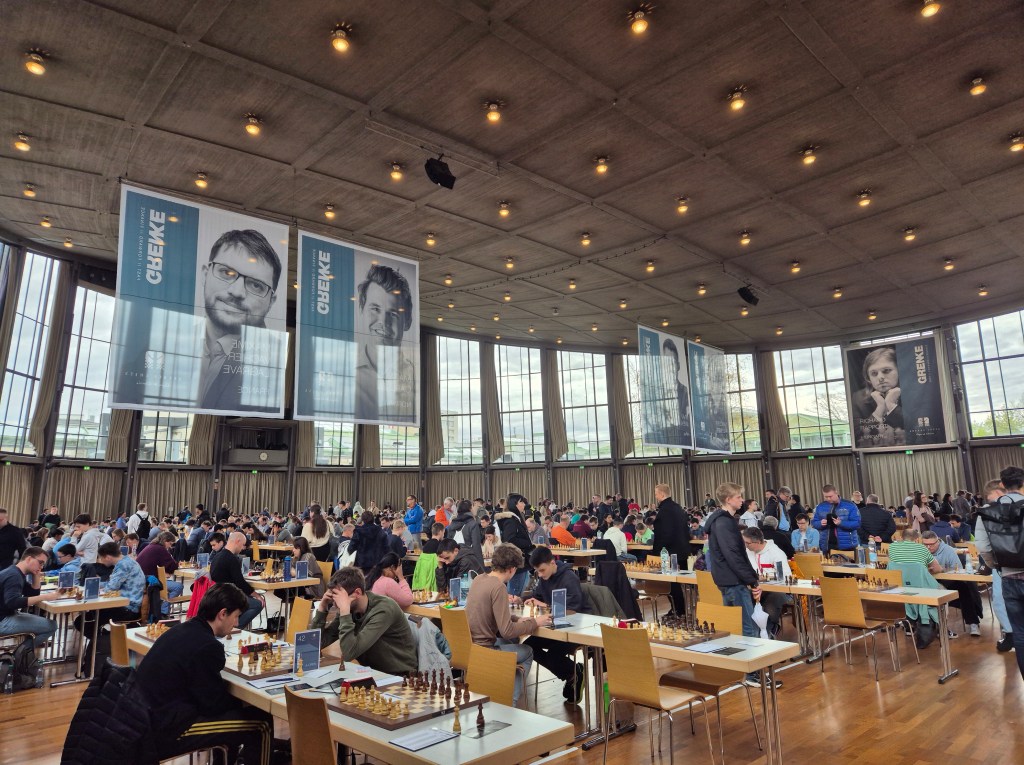
The main playing hall

I played the B open with an ELO rating of 1857. I scored 5.5 out of 9 games: 5 wins, 1 draw, and 3 losses. Two of my losses were against players above 1900, including the last winner of the B tournament. The third lost game was against a lower-rated player in a completely won material and positional position. I guess I just relaxed too soon and blundered one piece and the game. I ended up at position 244 from 1177, which was better than my initial ranking of 303. As a result, I lost 3 ELO rating points. For comparison, 5 years ago, I was rated 1874 and made 6 points out of 9, losing 9 rating points and finishing 109 out of 797 players. The overall result was better last time, but the rating performance was better this time. This is possible when you play against people with higher ratings.

Overall, I am happy with my result because I don’t spend time preparing for chess.. Five years ago, I was more serious about training and playing than I am now. You can’t make progress in chess if you don’t work on it.

Part of the tournaments B and C area

Some sensation from the tournament was the draw obtained in round 2 by a junior Romanian FIDE master against the 9th player in the world, Arjun Erigaisi ( also the rating favorite of A-open). The winner of the classic chess tournament was Magnus Carlsen, the best player in the world. The winner of the A-open was Hans Moke Niemann, known in the chess world for the trial against Magnus Carlsen.

Some recommendations for people interested in participating in future editions. The playing venue is great, the space and the conditions are perfect. They have wooden boards and pieces for everyone ( they needed more than 1300 boards and pieces this time). The tables are big, the chairs are good, you have enough space during the game. The only downside is the noise. You can’t be silent in an ample open space with more than 1500 simultaneously. This was not a problem for me, but I saw some players wearing earplugs. This recommendation is good for people who can’t focus because of noise. Don’t come to Grenke if this is your first tournament. The reason is that 4 days with double rounds means intensively playing chess for 7-8 hours each day. It may be like running a marathon by an untrained person.

Excellent conditions to play chess in Karlsruhe

I also have some recommendations for the organizers: Send SMS/WhatsApp messages to players with the pairings for the next round. Make some announcements in English, not only in German.

The chess world has changed a lot in the last five years. Now, all the top tournaments have live coverage on YouTube, with Grandmasters covering the games. Recently, players of different strengths have come to play in tournaments with tools, stream their games online, and have someone else comment live on them. For me, this is useful as I can learn more from the games of a 2000 ELO-rated player (close to my level) than I can learn from 2700+ players.

I would happily return to this tournament because of the unique positive vibe and energy.

As in this article, I compared this edition with the one five years ago and chose to end with a song on this theme.

Chess story

Usually, at the end of the year, I write about chess tournaments. Unfortunately, the European Rapid and Blitz Chess Championship moved from Katowice to Zagreb this year. I couldn’t find a convenient flight to Zagreb. I looked for a similar tournament somewhere in Europe where I could easily travel. I found a tournament in Cluj, which is part of the Romanian Grand Prix tournaments. I booked the travel details for Cluj in advance, but it proved too much in advance. For some reason, the organizers moved the tournament from Cluj to Sebes. Sebes is 120 km south of Cluj, hard to reach from Cluj if you don’t have a car, and has few attractions. In these circumstances, I could visit Cluj as a tourist in November or lose the money spent traveling there. I chose the first option, and I am happy with that. Cluj has greatly developed in recent years and is a vibrant and modern city.

Instead of playing chess, I write about the game. In my opinion, the most interesting thing that happened in chess was the Polgar experiment.

Laszlo Polgar, a Hungarian educational psychologist, wanted to prove his idea that geniuses are made and not born. He said he would prove this theory using his children. His theory is “that any child has the innate capacity to become a genius in any chosen field, as long as education starts before their third birthday and they begin to specialize at six.”

Together with his wife Klara, they had three daughters and chose to prove the theory by making the girls champions in the chess field. The chess results are very measurable. For example, in the last 40 years, only two players, Kasparov and Carlsen, were number one globally.

Although it was a hardship during communist times in Hungary, and they had to fight with the authorities, they managed to keep the children out of school and teach them at home. The results started when Susan, the eldest daughter, became the highest-rated woman in the world in 1984. Later, in 1988, the Hungarian women’s team, with all three sisters playing, won the Women’s Chess Olympiad. It was a remarkable result and raised a lot of interest about how that was possible.

One should remember that in the 1980s and 1990s, chess was a game played mostly by men. There were few tournaments for women. Conditions were harsh. For example, players smoking at the table during official games was ordinary. A game lasted 6-7 hours in most cases, with intense fighting each day for nine days or more during a tournament. The girls had to fight mentalities and biases to progress in chess.

An example of rough behavior. Sofia Polgar won against former vice-world champion Viktor Korchnoi.

Laszlo Polgar, to prove his theory, aimed for his daughters to become not the best women chess players but the best in the world. For this reason, Susan only played in men’s tournaments for a while. In 1991, Susan became the first woman to obtain the title of chess grandmaster according to the rules and not honorary (as the other two women before her). Later, when it became clear that she couldn’t become the world chess champion, she turned towards women’s tournaments. Susan became the Woman World Champion in 1996.

But the most impressive result was obtained by the youngest daughter, Judit. In 1991, the same year as Susan, Judit became a chess grandmaster at age 15 (the youngest GM in the world at that time). She won many tournaments and aimed to become a world chess champion. In 2005, she played in the candidates’ tournament in Argentina. The winner of that tournament with eight players would become the world champion. Judit did not win the title that time. After that event, she was never close to becoming a champion again. Judit was the highest-rated woman in the world for more than 25 years until she retired from playing official events. Her peak rating was 2735, which made her the 8th highest-rated player in the world. For reference, in chess history, only three women made it to the top 100 players in the world, and only Judit to the top 10. It is hard to put into words how huge this accomplishment was.

Judit Polgar beating Garry Kasparov in a game. At that time, Kasparov was the best player in the world.

To better understand the results, let’s look at some data. The average rating of the top 100 best chess players worldwide was 2692 in December 2023. The average of the top 100 women was 2418. There is a gap of 174 ELO points between the top men’s and women’s players.

Recently, FIDE ( the International Chess Federation) published results on the gender gap in chess. The participation of women in tournaments is under 20 percent in most countries and less than 10 percent in developed Western countries. The reduced number of female players is one reason for the gap between men’s and women’s results in chess. But still, there is a big gap even in 2023 between men’s and women’s results.
Based on the above results, Polgar proved his theory is correct. It required a lot of energy and work to achieve these results. Some people condemned Polgar’s experiment, saying he created a “Frankenstein” and put his children to enormous efforts. It is worth mentioning that his children had a successful life outside the chess world. Also, although all are retired these days, their activities are still around chess, and they continue to enjoy the game.

Retired Judit Polgar playing against Magnus Carlsen, the best player in the world, in 2022

Polgar’s idea is that with educated geniuses, humanity can make breakthroughs in science and medicine. I don’t know if anyone is willing these days to make such an effort with children, given that the world has changed so much. The hope for breakthroughs in science and medicine now relies on artificial intelligence.

This experiment had a positive impact in attracting women to play chess and breaking barriers in this game. Despite the statistics above, the number of women in chess has seriously improved. Susan Polgar was the first woman to have a grandmaster title in 1991. Now, there are 41 grandmasters women worldwide.
Please keep in mind that the theory works only on children. I witnessed older players trying to improve at chess (including myself), and it is much harder to make progress. If you don’t do it while young, forget about developing later.

I’ve been close to the chess world for 30 years and have witnessed how education works and how children are treated by their parents. Polgar’s experiment is unique. In most other cases, the parents pressure children to obtain results. It is a way for parents to achieve the results they could not get in their own lives through their children. This pressure results in children hating the game and quitting it as soon as possible once they can avoid their parents’ authority. This behavior is happening in all sports or domains where there is competition. Only time will say who was right and who was wrong.

I will end with my favorite chess quote: “In every position, there is a move to be found – but you have to search for it! “– Paul Keres.

Judit Polgar and her sisters organize a chess festival every year in Budapest.

European Rapid and Blitz Chess Championship 2022

This year’s edition of the European Rapid and Blitz Chess Championship was a great success. The event was hosted in the same location as in 2021, the Spodek Arena in Katowice. What makes this tournament special is the combination of a big arena, band music, and over 900 competitors playing each other for a weekend. The idea of an arena with spectators, music playing, and some people performing arts or fighting has been a hit for thousands of years. Greek antic theatre, Olympic games, or gladiator fights are such examples. A recipe for success that still pays off.

Spodek Arena in Katowice

Compared to the previous year, the number of participants increased by more than 50% in the rapid section. Also, the percentage of women from all participants who played rose from 17% to over 20% in 2022. The reason is the constant interest in chess worldwide combined with no Covid restrictions this year.

The rapid section of the tournament consists of 11 rounds of chess, and in each round, you get to play someone who has the same amount of points as you. In the end, the person with the most points is declared the Champion of Europe in Rapid chess. Also, the woman who gains the most points is Woman European Champion. This year the winner was Jaime Santos Latasa from Spain with 9.5 points, followed by ten players with 9 points. Aleksandra Maltsevskaya from Poland won the women’s title with 8.5 points. Aleksandra’s win was a surprise as the rating favorite was Alexandra Kosteniuk, who is also the woman world champion in rapid chess. Alexandra Kosteniuk also had 8.5 points but an inferior tiebreak result and ended in second place. Both women represented Russia before, but now that country is banned by FIDE from chess events. Russian players must play for another country or under the FIDE flag in official chess events.

Before the second round. In the center of the picture, you can spot the playing band

It was snowing heavily in Poland during those days, and the train was the safest way to get there, although many trains had delays because of snow. That weekend was also the final of the world soccer championship. The organizers changed the schedule of the chess tournament to finish before the start of the world cup final. Therefore on Sunday, we played without pauses for the 5 rounds and completed the chess in time before the soccer started.

There were players across all of Europe there. Many players are from Ukraine, as the border is close; for them, it was also a way to forget about the war. It is the end of a challenging year, and people want to enjoy a normal life for a weekend as if nothing has happened. Things around us can change anytime; we should enjoy the present moment and what we have.

As always, the event had excellent broadcasting on Youtube with comments and interviews. Here you can watch the last day of the games:

I only wanted to have fun, and am happy with the outcome. I won 5 games and lost 6, no draws, and lost 48 Elo points in the end. I met three titled players, and the best was the International Grandmaster Ralf Akesson from Sweden. The game was excellent but required a lot of mental energy. In the diagram, the black and white bar on the left of the chess table represents the computer evaluation of the position. When the bar becomes completely white, white is clearly winning.

European rapid in Katowice is one of my favorite chess tournaments. It is fun and exciting; you forget about anything else in life for a while. I liked the atmosphere there, and it is hard to express that in words. Perhaps this article explains better what I am trying to say.

Run around the house and chess in Bucharest

During WWII, while working in Bletchley Park to break the Enigma code, Alan Turing invented a game that combined chess and running. The contest rules: You sit with your opponent in front of a chess table. You make your move and run around the house. The other player has to move before you return. Once you sit down at the table, the other player runs around the house. Then you have to move, etc. You lose if you are checkmated or fail to move before your opponent returns to his chair.

The above mentioned is a rare example of a game that exercises both mind and muscles hard. But what made Turing invent such a strange game? At Bletchley Park, there were excellent chess players ( e.g., C. H. O’D. Alexander was the British chess champion and became International Chess Master). They were playing a lot of chess. Turing was a modest chess player despite all his tries. But he was a very competitive person. And a great runner with a personal best of 2:46 per marathon. That would be a fantastic time, even by today’s standards. The game mentioned above helps the fast runners as it gives them more time to think.

Romanian Parliament House

During my stay in Bucharest, I played in a chess tournament and ran a half marathon in May. The chess event happened inside the giant House of Parliament, the most prominent building in Europe. The start and finish of the race were in front of the same house. That made me think about the game proposed by Turing, although in my case, the two events (chess and run) happened within one week, not on the same day.

Side view of the Parliament House

It is funny to imagine Turing’s game inside the House of Parliament in Bucharest. One run around this house is longer than 3 km, and after just 14 moves, you run more than the equivalent of a marathon. This game would require players with great physical shape. This is an amusing edge case for the proposed game.

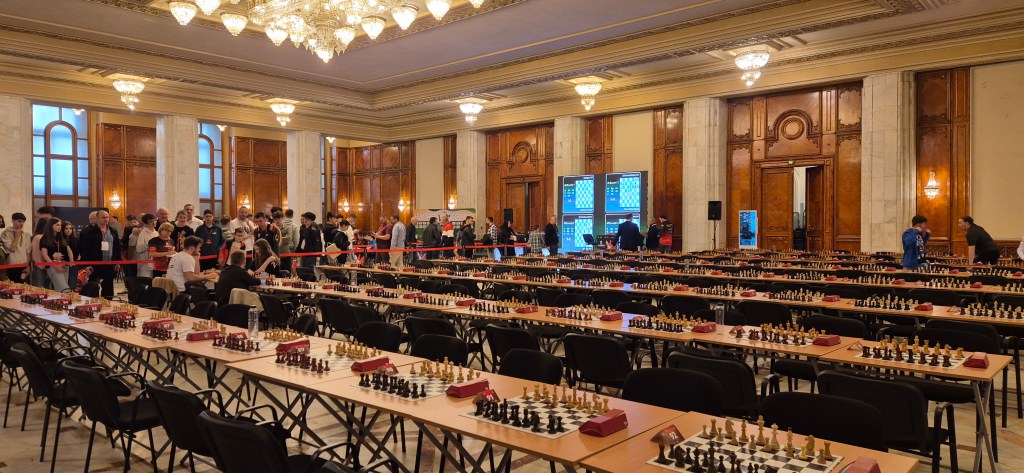
Playing venue inside the Parliament House.

First, it was the chess event. About 200 players from 15 countries gathered in a massive hall from Parliament House. There were 10 rounds of rapid chess (15′ +5″ format). My result was 4.5 points from 10. Because 9 out of 10 opponents were ranked higher than me, I gained 38 ELO points. My opponent had a considerable advantage from the opening in one of the games. I continued playing as I still had pieces on the table. He relaxed, and his advantage started to decrease. I kept calm and played the best I could. The position was drawn, and then I had the advantage and won. The win was not because of a blunder but because of the constant improvement of the situation. Later, I saw that my opponent was above 2200 ELO in classical chess while I was 1800. The lesson is to continue the game as long as the position still could give some hope. Playing in this tournament was a fun experience!

I was happy to see that chess is becoming more popular in Romania.

At the start of the Bucharest Half Marathon

The second event was the Bucharest Half Marathon. I’ve participated in the last five editions of this competition. This year the weather was ideal for running. I tried to improve my time from the Warsaw half marathon in March but failed to do that for 3 seconds! The official time was 1:54:30.

Close to km 10.

One statistical aspect is that the average time for finishing this half-marathon was 1:58, while in Warsaw was 1:54, and in Krakow, 1:52. Although I failed to improve my time, I was happy to see many people I knew. It is good to say hi! and exchange a few words.

With colleagues from “Trupa lui Fane” after the race

Let’s get back to the story about Turing. The run-around-the-house chess had no success. Nobody was willing to play it (for some reason, runners are not interested in chess, and chess players do not run). Turing did not give up. He came up with the idea to create a program to play chess and defeat his colleagues. At the time, the computer was at its beginnings. Turing created the first chess program called Turochamp in 1948. His idea was that if I couldn’t beat you, I would make a program that would do that. This second plan was much better. It led to a challenge between man and machine. These days a chess program on any smartphone can defeat the best human chess player.

Krakow International Chess Festival 2020

Traditionally, at the end of the year, there are many chess tournaments around the world. At that time, most chess players are on vacation. The most famous example is Hastings International Chess Congress, which had its first edition in 1895. This year, because of the Covid pandemic, tournaments decades older moved online or got canceled. There was one exception. The XXXI edition of the Krakow International Chess Festival took place from December 27th to January 4th in a traditional format. Players were meeting face to face. They were grouped by rating in six different tournaments. Almost 500 players participated.

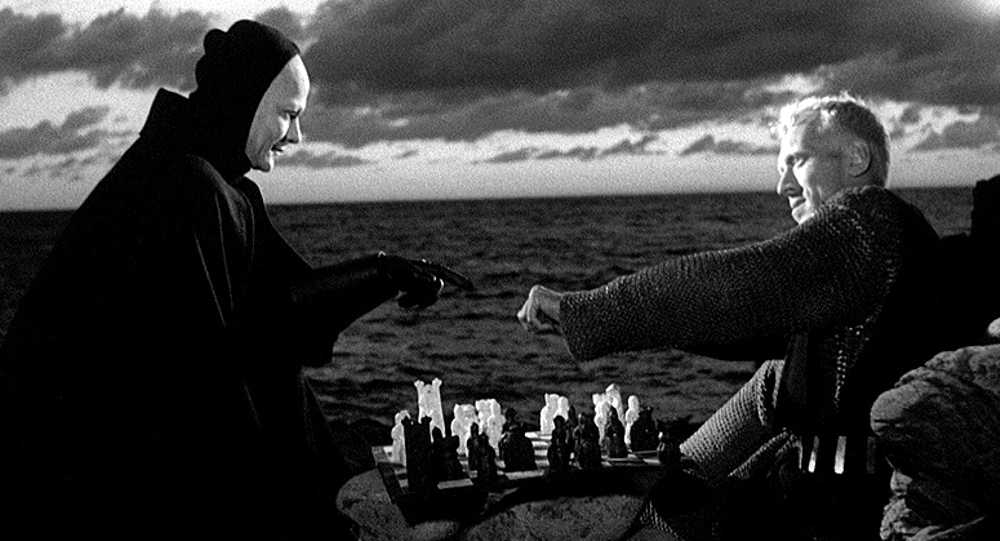
To play chess during a world pandemic… That sounds like Antoninus Block in Ingmar Bergman’s “The Seventh Seal”. “A man seeks answers about life, death, and the existence of God as he plays chess against the Grim Reaper during the Black Plague”. If you haven’t seen the movie, I recommend it. It’s one of the most important movies ever made.

The most famous chess scene in a movie

These days, in chess, Grim Reaper was replaced by computers that can defeat any human being. Computers are trying to kill the soul of chess by exploring all the possible variations of the game.

Returning to real life, there were, of course, special safety measures for the Krakow tournament. All players had to have their nose and mouth covered with a mask. Each player’s temperature was checked at the beginning of the game. The hands were disinfected. Also, no visitors were allowed inside the playing venue. The pictures for this post were taken from the tournament site.

Before entering the playing hall. Arbiters making sure that I respect the tournament rules. On the table, you can see the device for checking the temperature.

Due to the current world situation, I expect to pass a long time until the next chance to play chess at the table. The alternative is not too good. There are many online chess tournaments. The problem with online chess is that some players are cheating with software. They are identified after the games with the help of software that detects computer moves. Unfortunately, the rankings can’t be corrected at the end of the tournaments. The damage remains.

My hope for this tournament was not to get infected with Covid. Now, I can say that I achieved this goal. I was playing in the B section of the tournament. Together with 95 other players and 3 arbiters. We were in the same room for 3 to 4 hours for 9 days. Although we were wearing masks, the risk was present. The context was that at that time, Poland had a high rate of infections.

This is how the tournament B playing hall looked like

The tournament venue was the Galaxy Hotel on the shores of the Vistula river. It is not far from the city center. The playing conditions were great. Many boards were transmitted live on popular chess sites. The organizers had to cancel some other touristic activities planned for the chess players because of Covid.

The only image from the tournament hall where I could identify myself

As for myself, I played in the intermediate level tournament. It was open for players rated between 1700 and 2100. The nine players that I encountered were rated higher than me. I lost 5 games, won 3, and draw one. Not a great result. However, because of the differences in rating, I ended up winning 15 ELO points. More important, I was able to enjoy some chess games. Normally, I would share some chess positions as highlights. Unfortunately, I had no chance to make combinations. The only combination that was played against me was incorrect. I played correctly and my opponent gained nothing out of it. All the games were interesting. It was tough fighting even if there were no fireworks.

Children section of the tournament. The future of chess is in their minds.

I would like to end on a positive note. It makes me really happy that chess is so popular among children. This happens not only in Poland or in Romania but in many other countries around the world. Children can learn a lot of things from chess. Maybe I will write later a post about the benefits of chess.

Across the world, based on the average ratings of the top 10 players, the leading countries are Russia, the United States, China, and India. This can give you insight into how popular chess became worldwide.

National Chess Championship Semifinal in Bucharest

It’s been a while since I haven’t written about chess on this blog, and I think it’s time to cover a chess tournament.

In Romania, if you are not a chess grandmaster, international or FIDE master you have to play in a semifinal tournament to qualify for the final phase of the National Chess Championship. The Federation chose five cities in Romania ( Timisoara, Cluj, Iasi, Bucharest and Braila) to stage semifinal tournaments in February. The players finishing on the first ten places in the semifinals have the right to participate at the National Championship Final in April.

Because I live in Bucharest, I played here in the semifinal tournament. The venue was the new building of the Polytechnic Library on the University campus. The library was an excellent location because it’s quiet and has lot of natural light on the last floor.

National chess semifinals in Bucharest in UPB Library

There were nine rounds played during two weekends full of two rounds per day and one day with three rounds. It would have been nice if instead of having three rounds in the second Saturday we could play one round in the Friday evening and two rounds on Saturday.

At the start of the game each player has one hour and a half on the clock and gets an additional 30 seconds for every move he or she makes. This way one round could last for four hours or even more in some cases. The thirty seconds increment is to make sure that if a player reached a won position he or she has enough time to convert that position and not to lose the game because the time has run out.

The only unpleasant thing to mention was during the first Saturday when in parallel with the chess tournament there was a robotics competition in the same Library on the second floor. This was very nice and the young people participating there were very enthusiastic. The problem was that the Library had open space between floors and we heard all day screams and loud announcements from the second floor making our concentration difficult.

To qualify for the finals a chess player needed 6 points out of 9 games. There were no prizes and the only thing at stake was the qualification for the next phase of the National Championship. It was natural that all the players who were at 5.5 or 6 points made quick draws in the last round.

As for myself since I only had 4.5 points before last round and a win would not be enough to qualify I decided to play a nice game.

In the last game, I had the white pieces and we played a Sicilian Najdorf variation in which I went for a classical English attack on the king’s side. Twenty moves have passed and we reached the position below with white to move.

What do you think about the move rook takes h7 pawn? Do you think this sacrifice works?

I spent a lot of time thinking about whether the sacrifice works or not. If it doesn’t work, and I would move something else, the white offensive on the kingside will end and it will be black to counter-attack on the queenside.

Looking into the defensive resources of the black player I noticed that in the mainline he can protect his king with the bishop from e6 moving to g8, but I thought I can manage that if I bring my rook to h7.

The complexity of the above position is above my power of calculation. However, my intuition told me that the sacrifice is correct hence I did sacrifice a rook on h7.

To answer the question I asked my readers above I will tell you that the sacrifice is indeed correct. The sacrifice works only if white at the next move diverts the black queen from defending the e6 bishop. The move order is rook takes h7 pawn, the king takes the rook on h7, knight to a5, attacking the black queen and black queen goes to c7 then white plays queen to h2 check, the king takes the pawn on g7 and white rook from d1 to h1. This way the white queen penetrates the black defensive lines winning the game.

Unfortunately, in the game, both I and my opponent made serious mistakes. Once the rook was taken I played Queen to h2 and then Rook to h1 without diverting the black Queen. My opponent played Rook takes f3 pawn which gives the advantage back to the white player. I played Queen h7 check and after king to f8, I moved the white Queen to h8 allowing the defensive Bishop g8 and the game is lost for white. Instead, if I moved the knight to d2 I would have had a won position.

It’s not common in chess to have so many ups and downs in a few moves. This is an example where the intuition is far better than the calculation power of a player.

It’s good and very helpful in life in general to have a good intuition. The calculation power can be improved by solving many chess problems and this where I can do better.

Playing chess in Arad

Arad chess open is the most important chess tournament in Romania. This year it was it’s twelfth edition. The tournament was very well organized with players coming from all over the world. The venue for the tournament was the Continental Forum Hotel.

International chess festival – July 24-31- Arad

I took a few pictures from the organizer’s site to illustrate my experience within the tournament. I started the tournament with two loses then I was able to focus better and bounced back with four wins in five games.

At the chessboard during the 4th round

An interesting moment happened in round 7 when my opponent sacrificed two pawns in the opening in order to develop his pieces and tried to capture my queen.

The critical moment in round 7. I took two white pawns which can be seen above this text, but I realized that it was a trap. I spent 30 minutes in that position to understand all the complications and found a good move. I won the game in the end.

The most important game came in round 8th. I played a junior girl rated 150 points above me who had a great tournament. It was a very sharp game with chances on both sides.

I played a sharp English attack against Najdorf defense in round 8th.

The position below was the decisive moment of the game.

She played the black queen to h2 threatening both to checkmate the white king by playing queen takes c2 or to capture the bishop on h3. At first glance in the above diagram, it looks like white is lost. But in reality in this position, it is black who is lost and that is the beauty of chess. White responds with rook from d4 to d2 and stops the checkmate threat. Then the black queen captures the white bishop on h3 and white plays rook to h1 and the black queen is lost as it has nowhere safe to go. White would win the game. Also, instead of playing rook to h1 white has an even more powerful response, he can move the queen to e3, but that move is hard to see by humans. Stockfish 10, a powerful chess engine found that move in a few seconds.

I failed in finding this good defense and took the black knight on a3 instead, then she took my knight on c3 with the rook from c8 and resulted in a position lost for white. I resigned the game a few moves later.

After that game, I lost my focus and did a draw in the last round and ended the tournament with 4.5 points from 9 games.

I have played more than 400 moves in all the games in Arad but the move in the position above made the difference between a good and a bad tournament. This was a perfect example for the quote from Keres mentioned in a previous post: “in every position, there is a move to be found – but you have to search for it!“ Also my opponent deserves congratulations for courage to play a risky move that won the game. As they said: “Audaces fortuna juvat” ( “Fortune favors the bold”).

My participation in the Arad open was a great experience overall. I learned many things and I had the chance to visit Arad and Timisoara for the first time.