Valencia half-marathon 2025

The best proof that what I wrote last year about the Valencia Half-Marathon was true is the fact that I decided to run it again this year.

With limited race options, I have to choose carefully where to compete. The Valencia Half-Marathon makes that decision easy, it’s one of the best-organized and most enjoyable races in Europe. For returning runners, registration is even smoother: the organizers give priority to those who ran in the previous edition.

If you’re trying to run Valencia for the first time, you’ll need to enter a ballot in November. If you don’t get in, there’s still hope. Several official travel agencies offer guaranteed race entries as part of their packages.

This post isn’t about repeating what I said last year. It’s about sharing what was new. I also want to share what I learned this time around.

What Was New This Year

The Wardrobe Service

This year, I paid 6 EUR to leave my luggage at the start area wardrobe. It was absolutely worth it. Not having to run with my phone or other items made the experience much more comfortable.

Slippery Grids on the Course

After kilometer 10, the route passes along a street full of metal grids covering subway vents. When it rains (as it did this year and last), these grids can get very slippery. Tip: stay on the left side of the road, where the surface is safer.

The Energy of the Drummers

One of the things I love most about Valencia is the number of live drumming bands along the course. The beat of the drums has an incredible effect. It pushes you forward in a way that no playlist ever could.

My Race

I learned from last year’s mistakes. This time, I didn’t eat too much before the race. I made sure to finish my breakfast more than two hours before the start.

I started in wave 7 at 9:01 a.m. and took it easy at first, running the first 5 km at around 6:00 min/km. I planned to pick up the pace later. However, by kilometer 15, I realized I wasn’t going to finish under two hours. At that point, I decided not to push too hard. Whether it’s 2:02 or 2:03 doesn’t make a huge difference. I crossed the finish line in 2:04:11, an average result, but still 22 minutes faster than in Tallinn!
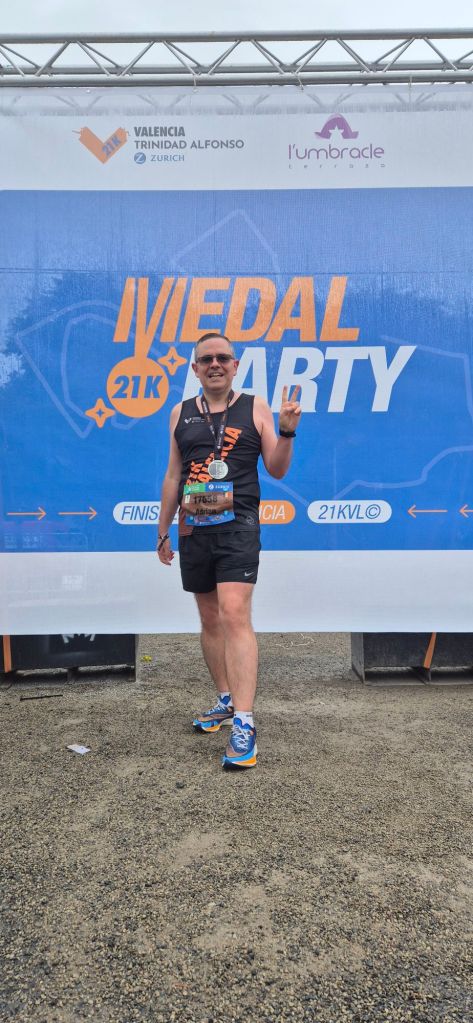
After the race

Our Team – “Trupa lui Fane” in Valencia

This year, five of us from Trupa lui Fane ran in Valencia. That made the whole experience even better. We shared the excitement, compared strategies, and celebrated together after the race.

“Trupa lui Fane” in Valencia

Everyone had a strong performance, close to their personal bests:

  • 🥇 Mihai1:24:54, our fastest runner, finishing among the first 2,000 participants
  • 💪 Andreea1:34:52, the only one to set a new personal best
  • 👟 Bogdan1:44:24, two minutes slower than last year
  • 🔥 Sorin1:56:06, at his first SuperHalfs race, very close to his PB

Congratulations to all of them for their fantastic results!
And a big thank you to our coach, Ștefan Oprina, for helping us become better runners over time!

Valencia remains, without question, my favorite half-marathon in Europe.

Later that day in Valencia I met someone who didn’t look quite happy with his result.

Not everyone looked happy that day

Valencia 2025 reminded me once again why I love running. It’s the rhythm, the people, and the stories. These moments stay with you long after you cross the finish line.

PS.1 A Seagull and a Song

On race morning, I woke up early, opened the window, and saw a lonely seagull flying above the hotel. It reminded me of a Joe Dassin song I’ve always loved:

“Moi, de temps en temps, je me sens pareil
À cet éternel exilé
Lui, qui ne sait pas replier ses ailes
Moi, qui ne sais pas m’arrêter.”

A small, poetic moment before the adrenaline of the start line.

PS.2 Remembering the Floods of 2024

The day before the race, Valencia held a large protest. It was in memory of those who lost their lives during the 2024 floods. Last year, we left the city on Monday after the half-marathon. The next day, torrential rain caused devastating flooding that claimed 224 lives in the province. One year later, people are still unhappy with how the authorities responded.
It’s a sobering reminder that life is unpredictable. Every race, every trip, and every day, is something to be grateful for.

PS.3 Goodbye, Mihai Suba

On Sunday, October 26, the day of the race, Grandmaster Mihai Suba (1947–2025) died near Valencia in Spain. Before 1990, Romania had only three chess grandmasters — and Suba was one of them, a true original. He made significant contributions to chess, particularly in middlegame theory and the Hedgehog system. I’ve read a few of his books; Dynamic Chess Strategy was a particular favorite. He was admired worldwide for his creativity and deep understanding of the game. May he rest in peace — and may his ideas continue to inspire players for generations.

A Personal Duathlon: Running and Chess in Bucharest

A traditional duathlon typically combines running and cycling. It’s less well-known than the triathlon, which includes swimming, cycling, and running—in that order. In both formats, the winner is the person who crosses the finish line first.

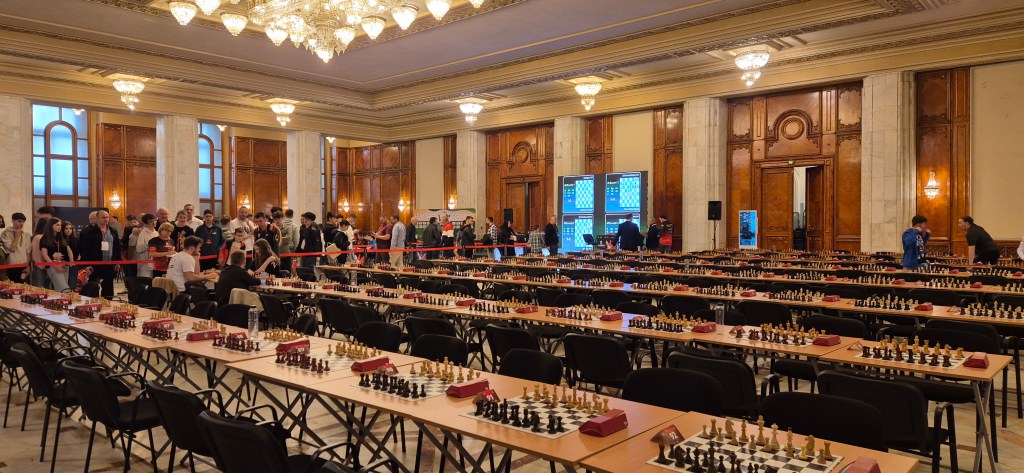
While I was in Bucharest this May, I experienced a rare coincidence. Two major sporting events were scheduled for the same weekend. One was the Bucharest Half-Marathon, and the other was the Bucharest Chess Grand Prix.

I wanted to participate in both, but unfortunately, the starting times overlapped. Luckily, the running festival included a 10 km race on Saturday morning, which ended before the chess tournament began. That turned out to be the better option. Not only did it fit my schedule, but running 10 kilometers requires significantly less energy than a half-marathon.

The venue for the chess tournament. Also the finish for the running was in front of the same building

I set myself a simple goal: to finish in the top half of both competitions. For the 10K run, this meant aiming for a time under 58 minutes based on the previous year’s results. For chess, it was more ambitious: scoring at least 5 out of 10 points. My best previous performance had been 4.5 points at the 2022 edition, and I hadn’t done much preparation this time.

The Running Phase

The last kilometer of the race

The day began with the 10K race, an event as well-organized as ever. The weather was perfect for running: cool (6–8°C) with a light drizzle. I started at a pace of about 5:20 per kilometer and maintained it for the first half. I was feeling strong. I sped up for the second half and dropped below 5 minutes per kilometer. I even sprinted the last 200 meters at a pace of 4/km.

I finished with an official time of 52:08, far better than expected. I placed 312th out of 2,957 finishers, putting me in the top 10.5%. However, this statistic is somewhat misleading, as most of the stronger runners competed in the half-marathon on Sunday. So, the field for the 10K wasn’t as competitive.

After the race with colleagues from Trupa lui Fane

A major factor in my performance was the training I did for a month with “Trupa lui Fane” in Bucharest. That preparation made a big difference. For context, I ran the Berlin Half-Marathon in 1:59:32, while the 10K time I just achieved projects to about 1:55:00 for a half-marathon. That gives me hope to break 1:55 at the upcoming Tallinn race.

Many thanks to Ștefan Oprina, who has helped me overcome health challenges and become a better runner over the years!

The Chess Tournament

Later that day at the chess tournament

After the run, I had time to shower and eat before the chess tournament began.

The tournament followed a 10 round Swiss format. That means each player is paired in each round with another player who has the same score. Each game was timed at 15 minutes per player. There was a 5-second increment per move. This is standard practice these days to avoid losses on time in winning positions. The schedule included 4 rounds on Saturday and 6 rounds on Sunday.

I started with 2 points from the first 4 rounds, not great, but acceptable. Sunday started well with a win. Then, I lost against a Candidate Master. I followed up with two more wins (one also against a Candidate Master). That brought me to 5 points from 8 rounds, achieving my goal of finishing in the top half. Unfortunately, I lost the last two rounds against stronger players.
In the end, I placed 213th out of 475 players. This result put me in the top 45%. Additionally, I gained 5 ELO points.

A New Type of Duathlon?

This experience made me think: what if we organized duathlons that combined very different events like running and chess?

One idea is to use a simple average of ranks or scores across both disciplines to determine an overall winner. A more refined method could involve using normalization. Each result could be compared to the best and worst performances in each category. This approach allows fair comparisons.

I was thinking of a way to compare results from independent events. In this case a rough formula could be:

Eval = 2×ELO Performance−Race Time (seconds)

The idea is to reward high chess performance. The higher the performance, the better. It also aims to penalize long race times. The lower the race times, the better. I’ll work on refining this formula in a future post.

A Special Chess Anniversary

This year marks the 100 year anniversary of the Romanian Chess Federation. With almost 500 players this was the biggest chess open tournament ever organized in my country. It attracted many strong players and also gave me the chance to reconnect with my chess roots.

I was delighted to see my former coaches again.

I first met Iulian in 1992 when he visited our class during a math lesson. He had just opened a chess club and invited students to join. Our teacher asked who already knew how to play chess, and a few of us raised our hands. He encouraged us to learn more about the game. Shortly afterward, I joined the club, and chess became a lifelong journey. Iulian didn’t play this year, but he was there coaching five juniors. I was part of his first generation of students; since then, many others have followed. Here we are 33 years later still enjoying the game.

With Iulian my first coach

Cristian, a chess master, coached me between 2018 and 2020 before I moved to Poland. He was one of the referees at the tournament and continues to coach young players. During our time working together, I focused a lot on the psychological aspects of chess—understanding how emotions influence decision-making. Chess often goes beyond logic; it’s also about how you manage your internal state.

With Cristian

I’m deeply grateful to both of them for their impact on my life.

Seeing them again, by chance, after several years was one of the weekend’s highlights. We’ve kept in touch, but nothing compares to meeting in person.

There’s a quote I really believe in:

“In life, what matters most is the people you meet and the books you read.”

What is life?

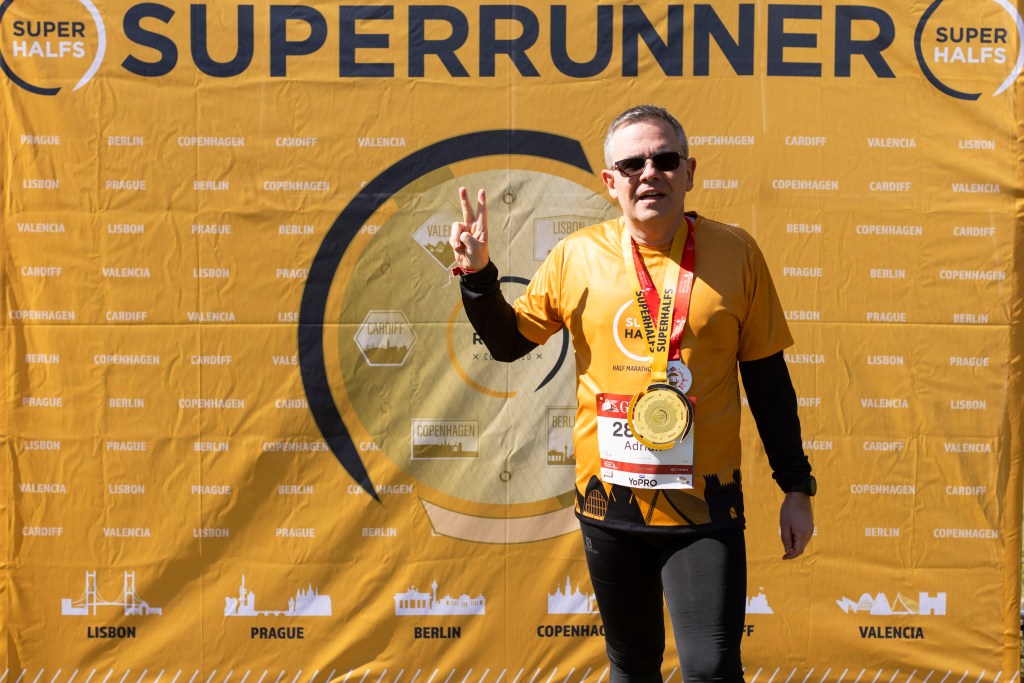
Reflections on the SuperHalfs Series: My Experience and Insights

The SuperHalfs program has grown rapidly in popularity. With increasing demand and limited slots available for each race, the organizers have removed the time limit to complete all six events in the series. This move allows more runners to gradually work toward finishing the series over time.

As of May 2025, only 1,113 runners have completed the entire series. This is an impressively small number. Nearly 100,000 people have participated in at least one of the six races. Given these numbers, I thought it might be helpful to share my personal journey and offer some insights for aspiring SuperHalfs finishers.

While you can find the list of finishers on the official SuperHalfs website, gathering deeper data requires some effort. I used ChatGPT to generate code that helped me analyze the number of finishers by country. Here are the results:

CountryNumber of finishers
Spain193
Great Britain185
Germany136
Denmark100
Portugal92
Italy74
Czechia42
France38
Poland28
Netherlands26
Brazil22

The numbers are interesting. Not a surprise that Spain and Great Britain are on top. In Spain people run fast, they have half-marathons with 2.5 hours time limit to finish, while in the rest of Europe is 3 hours. The UK, meanwhile, has a rich running culture and offers wonderfully organized races. I highly recommend racing in the UK for an unforgettable experience. The first 5 countries from the list are also organizing races from series. Italy is the first country that has many finishers but doesn’t have a race in the program. Interesting Brazil is the only non European country that has many finishers.

Before the Berlin Half-Marathon this spring, only about 480 people had completed the series. Berlin added nearly 700 new finishers in one go, largely because it was newly included in the program just last year.

The SuperHalfs calendar includes three spring races—Lisbon, Prague, and Berlin—and three autumn races—Copenhagen, Cardiff, and Valencia. Since 2025, demand has surged, and most events now use a lottery system to allocate entries.

If you’re not lucky in the lottery, there’s an alternative: official travel agencies offer guaranteed race entries. I used one of these agencies—Germany’s Interair—for the Cardiff Half-Marathon when I joined the event late and couldn’t find an open spot. Their service was excellent.

If you are not lucky winning the lottery, you can use one official travel agency. This agency will guarantee your participation in the race. I had used a travel agency only once during my campaign for the Cardiff half-marathon. I decided to join this race too late and there were no available spots. I used the services of the German travel agency Interair and I was very happy with them.

I’ve written posts about my experiences in each of the six races. Here are a few personal impressions:

  • Top Picks: For me, the best races are Valencia and Berlin. Both offer outstanding organization and scenic, fast courses—ideal races to conclude your series on a high note.
  • Cardiff: A very well-organized race with amazing crowd support. However, the course is not flat. It is less ideal if you’re chasing a personal best.
  • Copenhagen: The course is flat, but I had some concerns when I ran it in 2022. The start was chaotic because there were no wave starts. The course became crowded. Pedestrians were crossing in front of runners, especially in the city center. The finish area was also quite congested. Hopefully, these issues have since improved.
  • Lisbon: Be mindful of the weather—it can get hot. The course begins with a downhill section, then transitions into rolling terrain before flattening out from kilometer 7 onward.
  • Prague: My least favorite race. The course includes cobblestone sections in the city center, which can be tough on the legs. Weather can also be unpredictable. A simple way to improve the course would be to extend the riverside sections and avoid the city center altogether. Interestingly, Prague also has the smallest field of runners among the six races.

Here are some highlights of Superhalfs races. Best finish is in Berlin. Valencia has the best atmosphere. It also has the best organization at the start. Cardiff boasts the best public. The best routes are in Valencia and Berlin.

The SuperHalfs program is a fantastic way to combine travel, fitness, and personal achievement. Running a half-marathon isn’t about proving anything to others – it’s a personal journey. And this series makes that journey unforgettable.

If you’re considering joining, act fast. As the series continues to gain traction, getting a spot will only become more challenging.

Superhalfs, a mission accomplished

Lisbon half-marathon

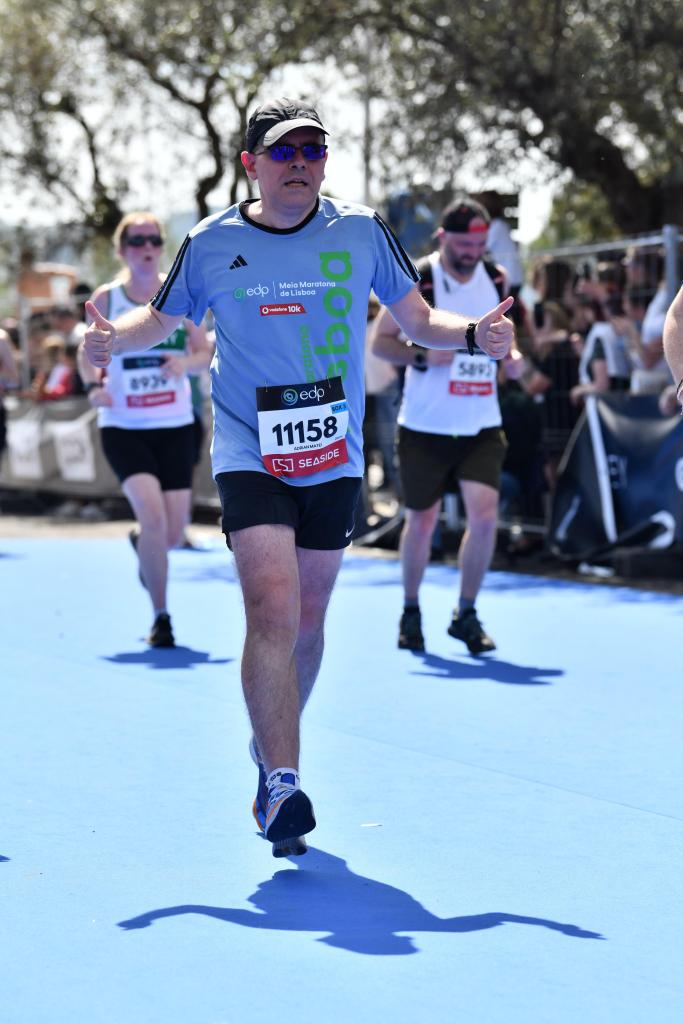
My running season this year began with the Lisbon half-marathon. Lisbon is part of Superhalfs, a series of 6 half-marathons you can complete in five years for an extra medal. Together with Bogdan, we registered for this race for a long time.

I returned to Lisbon after ten years and found the city had changed positively. Many buildings were renovated, the cost of living was good compared to central Europe, and people were very relaxed.
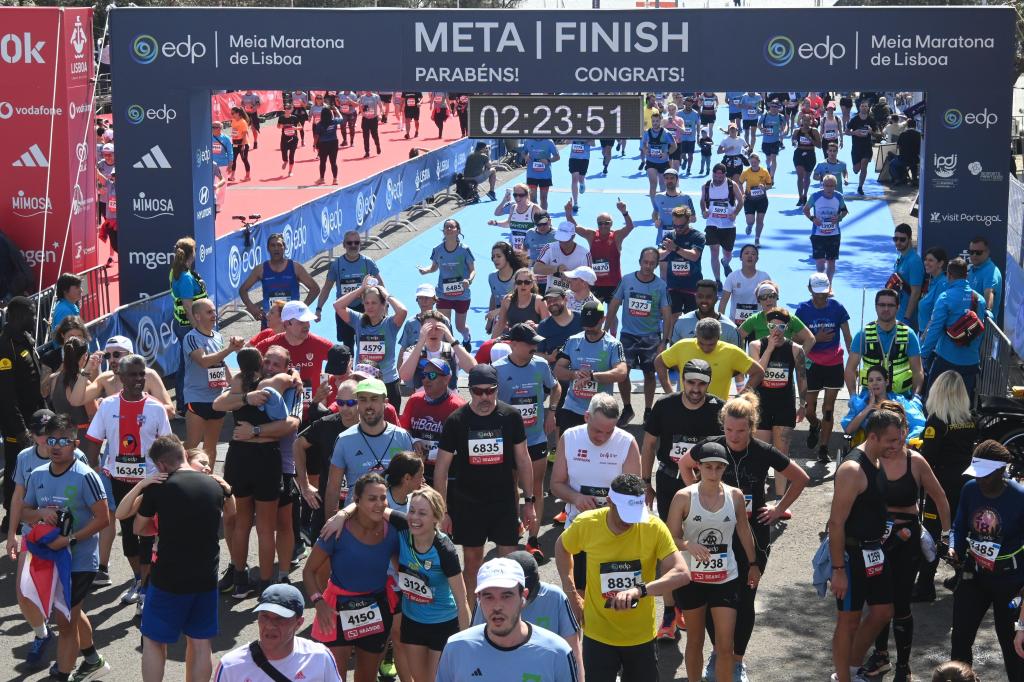
On March 17th, we took a morning train to Pragal station and followed the crowds to the start. The first negative surprise was that the organizers blocked the people from getting to the start line for a long time. The problem was that we had no space for warmup before the race. We stayed only in crowds until we went over the start line. This was the worst organization of a start to a half-marathon I have ever witnessed, and you can see I have some experience.
The run starts from Pragal, on the other side of the Tagus River from Lisbon. First, you cross the April 25th bridge. The Lisbon half-marathon is the only way a pedestrian can cross this impressive bridge. If you are afraid of heights, this might be an interesting challenge.

Then, the runners continue off the bridge in Lisbon. The first 5 km are in general descending which is appropriate for speed. From km 7 until the end, the race is flat on the shore of the Tegus River. The finish is next to Belem Tower in front of the spectacular Jeronimos Monastery.

At the start on the other side of the river Tagus from Lisbon

The second negative surprise was the temperature. That day, the weather went up to 27 degrees Celsius, but the main problem was that with a humidity of 80-90%, you feel the temperature is 35 degrees Celsius. If you don’t hydrate well, you risk not finishing the race. On a positive note, the organizers added ad hoc more hydration points towards the end of the race.

During this race, I saw at least 15 people who had fallen and were taken by ambulance or treated on the spot. This is a negative record. I’ve never seen that many people injured in a race. About 250 people abandoned the race.

At the finish lane

As for me, I wanted to finish in less than 2 hours, and after 9 km, it seemed possible. Unfortunately, at that moment, the third negative surprise happened. As I later found out, I had some food poisoning from the day before, which made me look for a toilet. After solving the problem, I continued the race at around 6’30” pace until the finish line, which I crossed at 2:19. This was my worst time ever in a half-marathon, but I am happy that I finished the race. Even in this challenging situation, I managed to be in the top 10000 from 13200 finishers.

Happy people at the finish

On a positive note, Bogdan had a perfect race in such circumstances, finishing at 1:46:46 ( a time that happens to be my personal best). It was an excellent result for him, being 3062 out of all runners or the top 23%.
All’s well that ends well. Both of us finished the race on time and got medals. Later, I underwent antibiotic treatment, and I was fine.

With Bogdan after the race

Please find some insights for people interested in running this half-marathon in the future. Register at least half a year in advance as the race is quickly sold out. Try to get to the start as early as possible. We arrived at 8:55 ( while the race was scheduled for 10:05), but it needed to be earlier. The organizers created some bottlenecks around the start, and it took a lot of work to get there. The start and finish are not on the same spot, and you can’t bring stuff to leave at the garderobe and pick it back up after the finish. If it is a hot day, please wear a cap. It makes a big difference.

They say that the more challenging the race, the longer you will remember it. This was definitely a race I’ll remember.