In the second half of June, I participated in the 35th edition of the International Chess Championship of Małopolska. It was held once again at the Galaxy Hotel in Kraków. This marked my third appearance at the tournament, following my previous participations in 2022 and 2024. The organization was excellent, just like in past editions, nothing to complain about.
The time control was classical. Each player had 90 minutes for the entire game. An additional 30 seconds was added per each move. As a result, many games stretched to four hours or even longer.
This year, the number of participants dropped to 270, compared to 390 last year. I’m not sure what caused the decrease. The playing conditions remained unchanged, and given that a tournament I attended last month in Bucharest had a record turnout, I doubt there’s a general decline in interest in chess. The dip might be connected to the recent underwhelming performances of Poland’s top chess players. This could have reduced national enthusiasm. Nevertheless, this is purely speculative.
Playing hall for tournament C
This time there were less chess players from Ukraine compared to last year. They wore the T- shirts of the Lvov chess club. They also looked more sad, the long war is influencing the lives of the young people in Ukraine.
I played in Tournament B. It consisted of seven rounds over four days. There were two games per day, except for the final day, which featured only one round. My opponents were all young Polish players aged 16 to 23. I was pleasantly surprised by their excellent command of English. It’s encouraging to see how widespread English has become among younger generations in the EU.
Tournaments A and B
I approached this year’s tournament with a relaxed mindset, aiming to enjoy the experience and create complicated, fighting positions. I started well, scoring two points in my first two games. In round three, I lost a dynamic battle against the eventual tournament winner. This was followed by a sharp draw in round four, leaving me with 2.5 points—already a better result than in my previous two participations. I added another win in round five, but unfortunately lost the final two games. The last round was particularly frustrating. I had a clear path to a draw. However, I overpressed for a win and ended up losing.
In 2022, I finished with 2 points. In 2024, I managed 2.5. This year, I scored 3.5—noticeable progress despite the fact that, generally, age doesn’t help one’s chess performance. What changed?
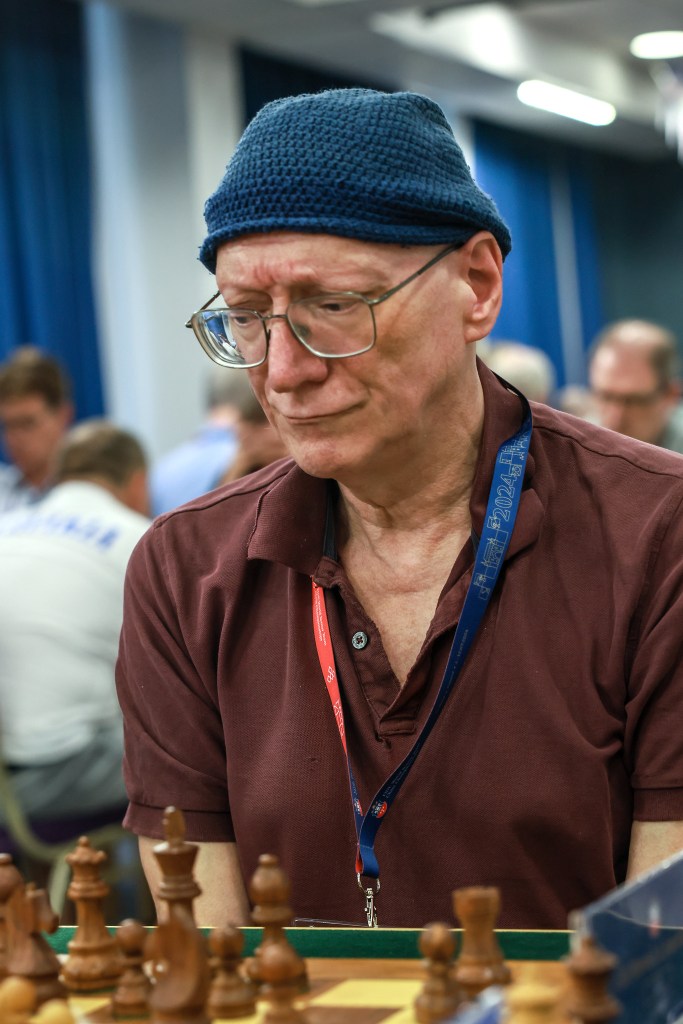
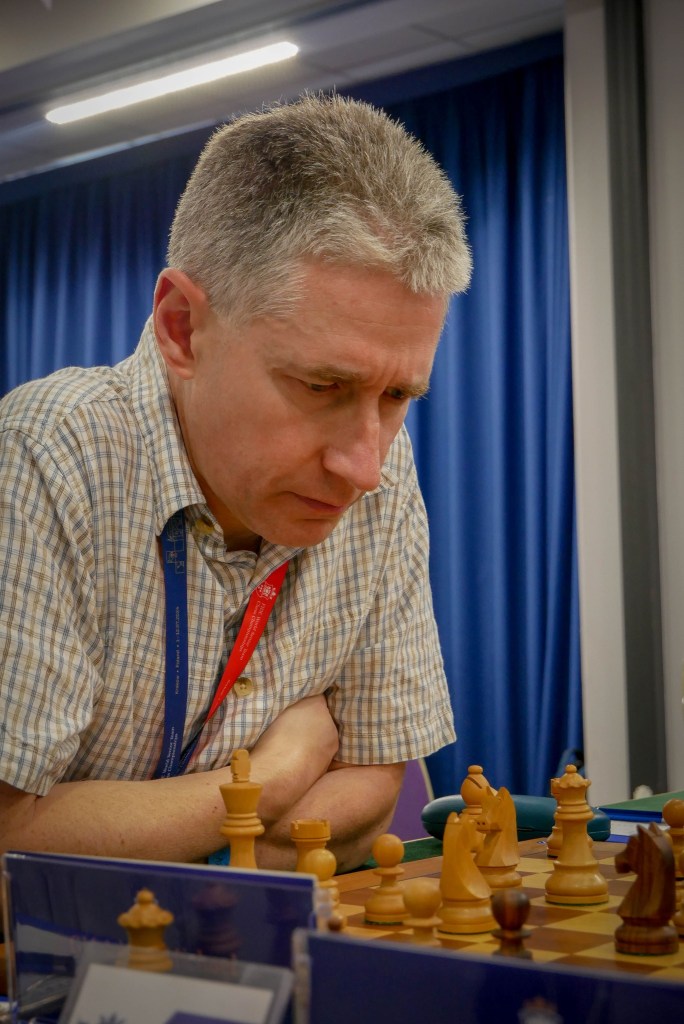
Portrait of a chess player
I didn’t train more. I didn’t exercise more. I firmly believe the difference was sleep. Over the last couple of years, I’ve found that I sleep significantly better when there’s no light in the room. I also sleep better when there’s no sound. I now sleep with an eye mask and earplugs, and the improvement in the rest has been remarkable. Chess, with its high cognitive demands, is a great way to measure mental sharpness. My performance this year supports the idea that better sleep leads to better results.
Chess has great benefits. It effectively trains the mind, much like physical exercise strengthens the body. The results of physical training are visible. Mental training is subtler, but no less important. And in my case, definitely more enjoyable than running marathons.
This May marks 10 years since I started running. A full decade of runs, finish lines, and the quiet rhythm of feet on pavement. One month earlier I crossed the 12,000 km distance. I’ve written before about other key milestones in this journey, crossing the 6,000 km and later the 10,000 km marks. Both were moments that made me stop, reflect, and appreciate how far I’ve come.
A Tale of Two Cities
The 6,000 km mark was more than just a number, it marked the end of an era. I had spent five years running in Bucharest, where this journey began. Those were the years of building a base, getting to know my limits, and discovering what running meant to me.
Since then, I’ve spent the last five years running in Krakow, a city that’s become just as meaningful. New routes, different seasons, a different pace of life and yet, the same sense of satisfaction after every run.
Racing More Than Ever
After passing the 10,000 km milestone in late 2023, I didn’t slow down. Quite the opposite. I’ve run eight half-marathons and one 10k race in the last 2,000 km alone. This has actually been the most race-filled period of my running life.
What made it even better? Every race was in a different European city. Running became an excuse to travel, a way to combine city breaks with something I love. Explore during the day, race in the morning, and leave with new memories. I’ve shared stories from those races in earlier posts, but they continue to be highlights of the journey.
The Support Behind the Scenes
A big part of what’s kept me going has been the remote coaching and encouragement from Ștefan Oprina. He’s been in my corner all this time, offering structure, insight, and motivation. Having someone experienced guiding me, even from afar, has made a big difference. So thank you, Ștefan!
Setbacks and Slower Paces
Of course, not every step has been smooth. In January 2025, I pulled a hamstring. This likely happened because I pushed too hard on a treadmill session. I was running for 30 minutes at a steady, fast pace. That was a wake-up call. It’s been my only injury, but it reminded me that rest and balance are just as important as discipline.
Lately, my pace has slowed. I haven’t gone under 1:59 in a half-marathon recently. That’s been tough to accept at times, but I’m optimistic that things will pick up again, hopefully starting this autumn.
Looking Ahead
Next up: a race in Tallinn this September. And I’m genuinely looking forward to it. It’s not just about the result. It involves showing up and exploring a new place.
Because at the end of the day, that’s the most important thing: the journey continues.
This post is split into two parts. The first part talks about my chess activity, and the second part is about the world of chess on the eve of a special celebration. The two parts are independent, and the second one is more interesting.
Part I
Recently, I played in two chess tournaments in Krakow. They were both of classical chess time controls, which lasted 3-5 hours per game. First was the 35 edition of the International Chess Championship of Malopolska. I played in the B group of this tournament, for players rated between 1750 and 2000. The venue was Galaxy Hotel on the shores of the Vistula River. Many foreigners participating in this tournament were kids from Ukraine from Lviv Chess Academy. They had T-shirts with their club name on them. They played well; of the international players, the Ukrainians were the only ones who gained ELO points. There were also two players from Romania I did not know who also played in the Grenke tournament. We chatted during those days in Krakow; they were also impressed by the Grenke tournament. We all agreed that the chess level played in Krakow was much better than in Karlsruhe at the same rating. If you want to win games, go to Grenke; if you want to play good chess, come to Krakow. My result could have been better, but my games were exciting and fun, even when losing. That made me want to play one more time.
International Chess Championship of Malopolska
The second tournament was the 12th edition of the Cracow International Chess Championship. I played the B group of players again, rated below 2200 ELO. The group consisted of 185 players from 27 countries. I was the only Romanian this time. The venue for this tournament was Hotel Premier in Krakow, situated outside of the city center but easy to reach by car or bus. The special guests of the tournament were the Botez sisters, who streamed their games online. They have a well-known Youtube channel with 1.6 million subscribers. They were born and lived in Canada, but their parents are Romanian. Also, more than 15k people were watching their games live during the tournament. They finished with 5.5 points from 9 rounds each, while my result was 5 points from 9. I will share one of their rounds below to show how difficult playing an official chess game is. Their coach’s commentary is instructive.
Live streaming from BotezLive channel
I’ve discovered a powerful connection between sleep and chess results. The nights I slept well, I ended up with 5.5 points out of 6 games, while when I did not sleep well, I got 0 out of 5 games. It is not that I was biased. I tried to play better in each game. In one of the games, I had a winning position but made a mistake and lost.
Cracow International Chess Championship
With these tournaments, my results for the 25 classical games I played in 3 tournaments this year are 13 points, a little over 50%. I won 11 games, made 4 draws, and lost 10 times. This concludes my chess games this year, as I don’t have enough vacation days left. I will focus only on running, with three half-marathons planned for autumn, the first of which is Cardiff.
Part II
On July 20, 2024, the International Chess Federation (FIDE) celebrates 100 years of existence. On that day, in 1924, 14 countries, including Romania and Poland, signed a document establishing FIDE in Paris. This part of the article is a small tribute to chess history. If you want to understand the rest of this post, please watch the documentary below. No chess knowledge is required, only a sense of humor. Stephen Fry went to Thessaloniki in 1988 and made a movie about the 28th Chess Olympiad. The chess Olympiad is played every two years and is a team event; it is the most crucial chess team event.
This was the last Olympiad before the fall of Iron Curtain in 1989. Many things have happened since. Yet, in the chess world time flows differently. Grandmaster Anand, 55 years old, who played at that event for India is rated 11th player in the world today, 36 years later.
In July 2024, in Krakow, the World Senior Team Chess Championship was held for players over 50 and 65. This tournament was played in Galaxy Hotel, the same venue as my first tournament in Part I. In chess, there are only two categories for veterans: 50+ and 65+. I’ve counted 20 to 30 players from the Thessaloniki Olympiad playing in Krakow 36 years later. Team England 65+ featured two players from Stephen Fry’s documentary: John Nunn and Jonathan Mestel. However, the rest of the players in the documentary continue to be close to chess; Jonathan Speelman plays in many chess tournaments each year, and Nigel Short plays in a chess tournament this year.
John NunnJonathan Mestel
What happened with the members of the USSR Olympic team who won in Thessaloniki? Kasparov retired from chess 20 years ago and moved to politics, being one of the most important Russian opposition leaders. Karpov also stopped playing chess about five years ago. Artur Yusupov retired for many years. Beliavsky plays for Slovenia and is an active player. Ivanchuk, at 55, is the 100th player in the world, is still very active, and plays for Ukraine. Jan Ehlvest plays for the United States at the World Senior Team Chess Championship in Krakow.
World Senior Team Chess Championship in Krakow
John Nunn and Jonathan Mestel played for the England team for the first time at the 22nd Chess Olympiad in 1976 in Haifa. That was almost 50 years ago. Nunn played on the primary team of England until 1994 and later moved to the senior teams. England won the World Chess Championship in Krakow in the 65+ category. They did not win in 1988 but continued and won in 2024. This is indeed true in a different context. As you can see in chess, playing strong for a very long time is possible.
England’s team won the World Chess Championship for seniors 65+ in 2024
Another English player has even more impressive results in time. Michael Adams played for the first time for the England team at the Chess Olympiad in 1990. He has played in the main team ever since and is expected to play even this year. At 53, rated 2672, Michael Adams is the 55th player in the world and the third player in England. However, as he is over 50, he also played in Krakow’s senior championship 50+ section.
Michael Adams in Krakow
Unlike other sports, the world of chess has changed slowly over time. These people are in their seventies, still going strong, and very sharp mentally. Studies have shown a much lower risk of mental diseases for people who play chess.
Chess is an individual game and such the history of FIDE is made of many such individual histories and dramas. It offers many lessons of life for people willing to pay attention.
Across the world, many events celebrate the anniversary of chess. In Bucharest, a special event was held at the Triumphal Arch to mark the 100th anniversary of FIDE. In Krakow, a chess photography exposition was opened. In London, in Trafalgar Square, on July 7th, more than 23000 people gathered to play chess in a special yearly event.
World Chess Torch at the Triumphal Arch in Bucharest
FIDE motto, “Gens Una Sumus,” translates to “We are one family.” FIDE has 201 state members in 2024. Another chess Olympiad, the 45th edition, will begin in September in Budapest. Chess has a history of over 1500 years but has never been as popular as it is today.
Krakow is the most popular tourist destination in Poland. Summer in Krakow is gorgeous, with perfect weather and some fun traditions. If you are in the city in June when these events occur, you should not miss them.
The Great Dragon Weekend
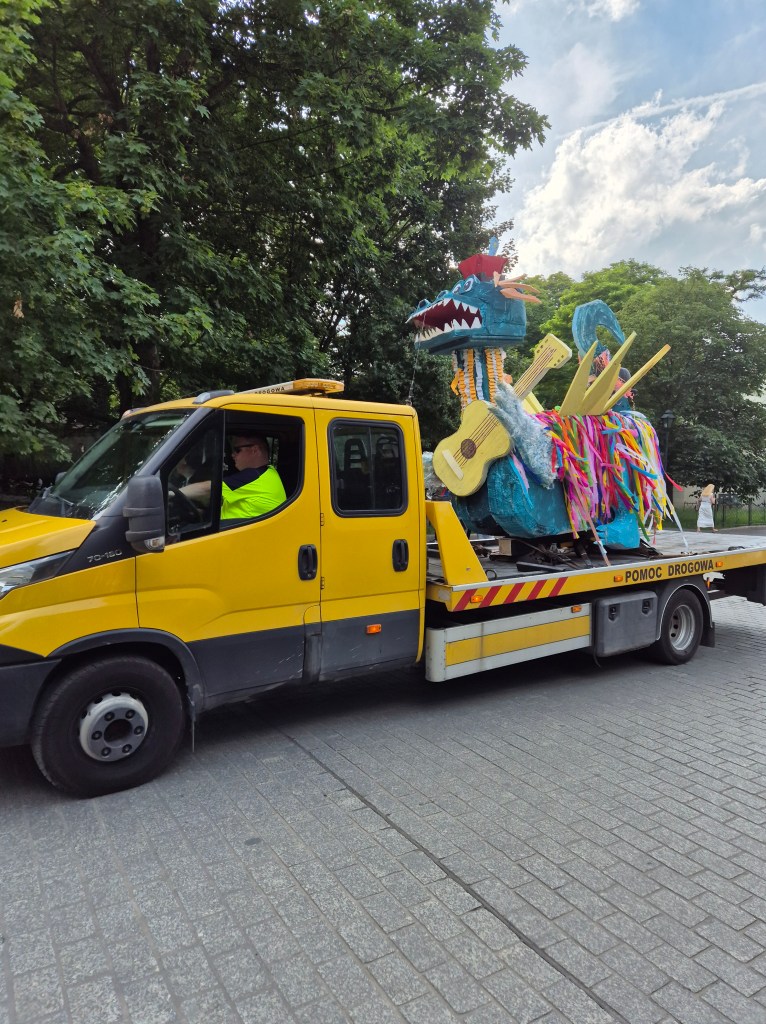
Parade of Dragons 2024
One of Kraków’s most unique and enjoyable annual events, the Great Dragon Weekend, is organized by Groteska Theatre and inspired by the city’s most famous legend. The Dragon story is about the foundation of Krakow. In 2024, on June 9th, the 24th edition of the show was organized.
Children created dragons in a parade. Kids have a lot of imagination
Over two days of colorful pageantry, large-scale puppetry, and family fun, the weekend consists of two main events: Saturday night’s light and sound spectacular, in which giant dragons float down the Wisła, followed by Sunday afternoon’s parade of colorful beasts created by children. It was a diverse parade, with lots of dragons designed by kids. I attended both events this year for the first time since I have been in Krakow. I found two video clips on YouTube covering both events and shared them here.
Singing dragon
Wianki
Wianki is not a Krakow tradition but a Warsaw custom that came to Krakow in the mid-19th century. In its modern form, as a cyclical mass event, Krakow’s Wianki has existed since 1992, when the Krakow City Hall took patronage over this event. In Poland, summer starts at the summer solstice on June 22nd. The summer solstice, known as Kupala Night, is a crucial moment of the year in Slavic tradition when all of nature – and the humans who are part of it – fully bloom. Ancient rituals and customs were intended to provide participants with purification, fertility, and happiness. Kupala Night is associated with several activities and rituals, such as collecting herbs and flowers and decorating people, animals, and houses with them, entering water, bathing, pouring water on it, sending wreaths on water, lighting bonfires, dancing, singing, jumping through fire.
Wianki in Krakow
In Polish, wianki means wreath. The wreath was an obligatory attribute of games. It was made before the holiday from wild herbs and flowers. The ceremonial use of the merchant wreath is also associated with a magical understanding of its shape.
Lajkonik
The Lajkonik is a man dressed as a warrior from the East. He rides a prancing white hobbyhorse through the city streets and, with his mace, deals out good luck blows.
Lajkonik
There are some theories about the origin of this tradition. The most reliable is that in 1287, Mongol armies arrived close to the city. They decided to spend the night by the Vistula, close to the village of Zwierzyniec, and to attack the town in the morning. They were discovered there by raftsmen, who overpowered the sleeping army, thus saving the city from ruin and plunder. They soon changed into Mongol costumes and rode into the town on the horses they had seized as trophies. They scared the whole city with fear, yet more quickly, the townsfolk came to rejoice.
This show has been happening in Krakow for over 700 years, a long tradition. Every year, it is celebrated on Thursday, one week after Corpus Christi. It is a parade of people costumed in Mongols or Polish clothes from the Middle Ages accompanied by bands playing traditional music.
Lajkonik Parade
Fascinating traditions take place in Krakow in June. If you’re here, be sure not to miss them.
PS. All the videos above I found on Youtube, they are not made by me.
For people interested in running, the Krakow half marathon offers great city center views and an excellent organization. The city hall organizes the event. During this race, you will run next to the world’s oldest mall, from the XIII century that is still open, churches 1000 years old, the Wawel castle, and finish inside the biggest arena in Poland, the Tauron Arena.
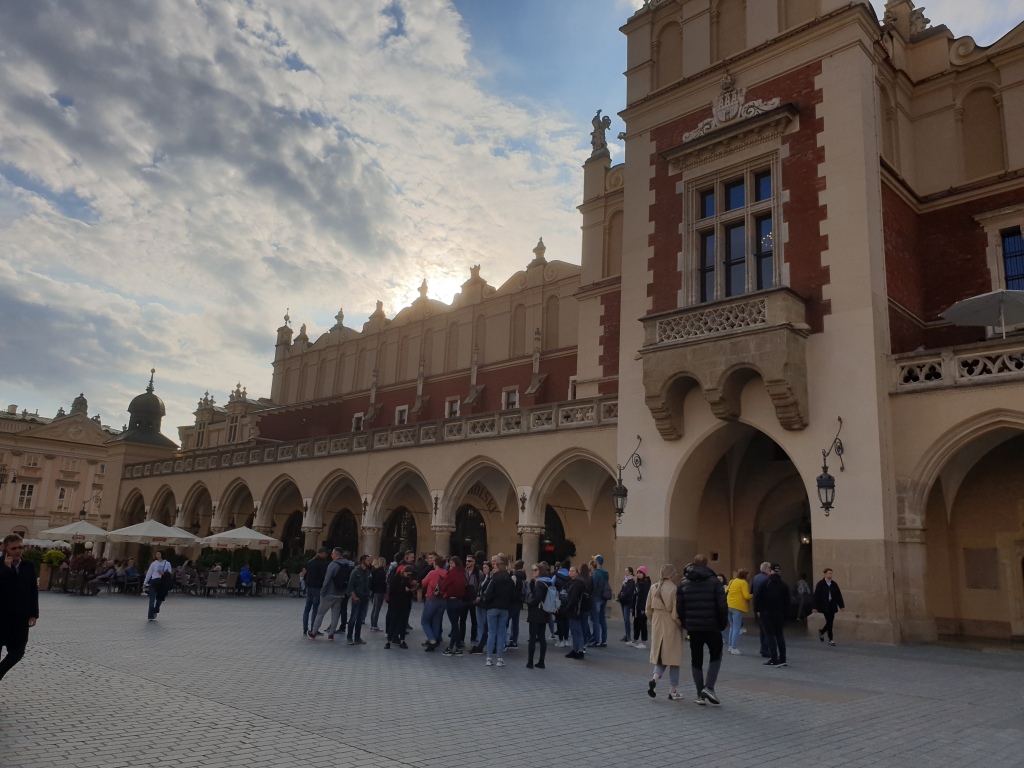
The mallThe most beautiful church in Krakow
I like that they offer the best pictures for runners, the race course is very well-guarded, and the pedestrians don’t get in front of runners like in other races. The transport in the city is free for runners that day. You also get an SMS with your time once you finish the race.
The race course is not flat as Copenhagen, and this can be seen in finishing times. One useful metric is the time of the runners at the middle of the ranking. For example, that average was 1:55 in Copenhagen and 1:58 in Krakow. The number of runners is also lower, with a limit of 7000 runners this year. Last year the maximum allowed number of participants was 5000. They could increase this limit to at least 10000 runners. There are pacemakers for all types of people from 1:25 to 2:30. Although only a few runners can keep up with 1:25 or even 1:30; for example, in Bucharest this year, precisely one person was running with the 1:30 pacemakers. As I mentioned in Bucharest, the week before this race was MIB with 1700 runners in the half marathon race with an average time of 2:04. MIB’s average time was slow as the route is flatter than in Krakow.
Usually, I don’t run with the official T-Shirt, but this one I liked
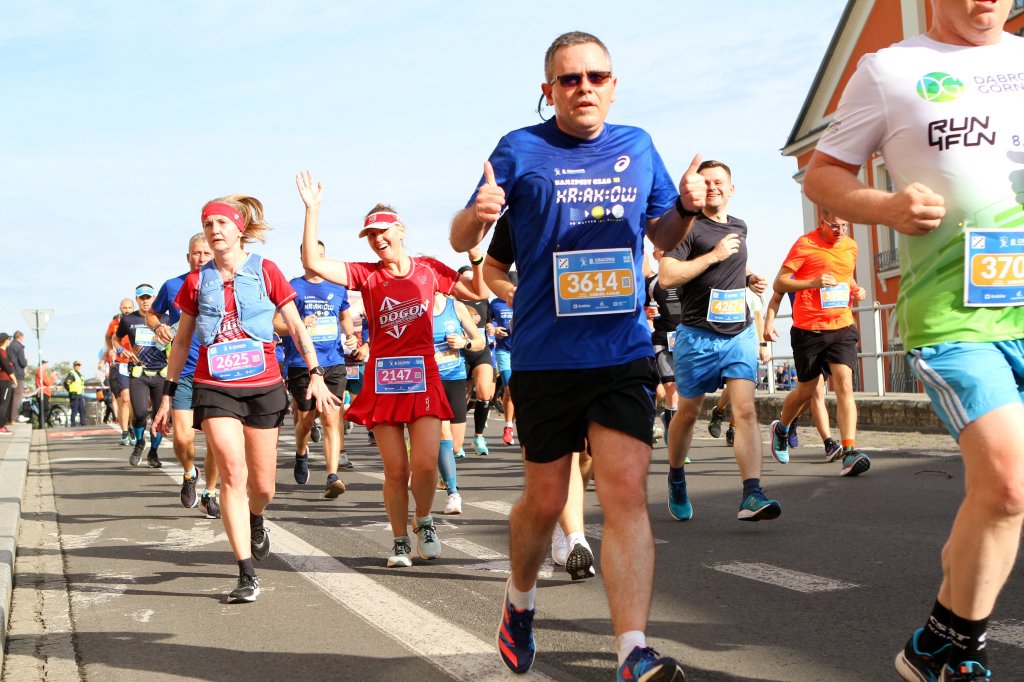
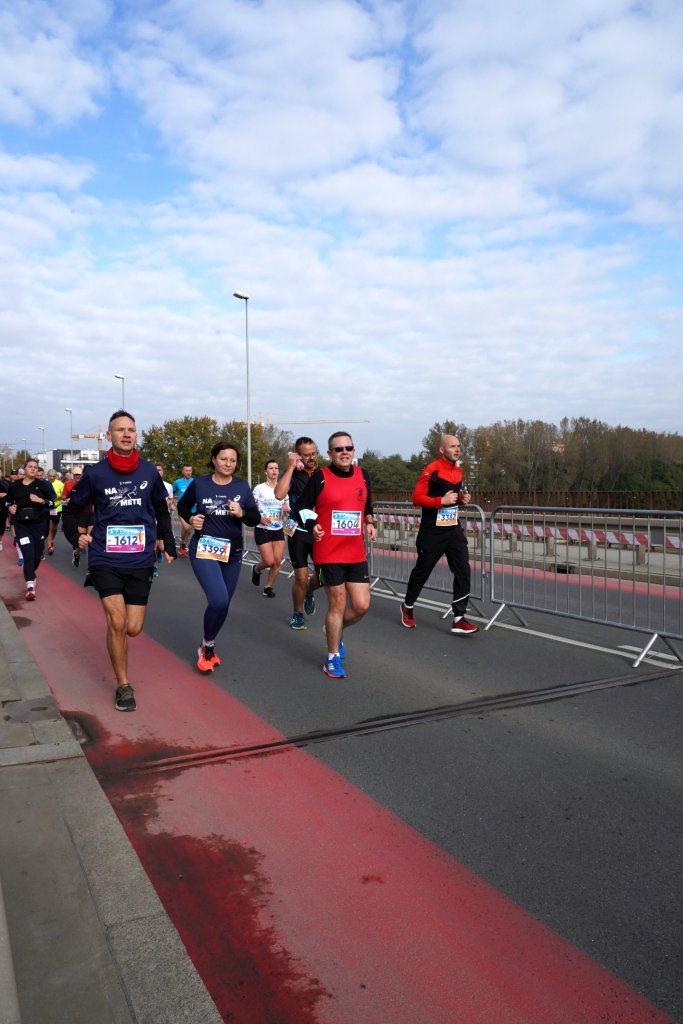
The weather was perfect on October 16, in the range of 15-19 Celsius. Many people encouraged the runners along the way, which was a positive attitude during the race. However, what surprised me was the considerable number of people injured that needed medical assistance during the running. In every half marathon I have run until now, I saw 2-3 people fall injured during the race. I saw maybe seven people lying down on the last kilometers of this run, and I don’t know why.
After 8 km, everything was ok.
Another thing that impressed me was a blind runner tied up to another runner. The other runner was also guiding him. Blind runners for long distances are rare (or I haven’t seen them). I am used to blind chess players, which is quite common in tournaments. Blind chess players can rely on their opponents to make the moves, and it’s easy. Blind runners need someone to be able or willing to run a half marathon at their speed. Training for a long-distance race might be difficult, too.
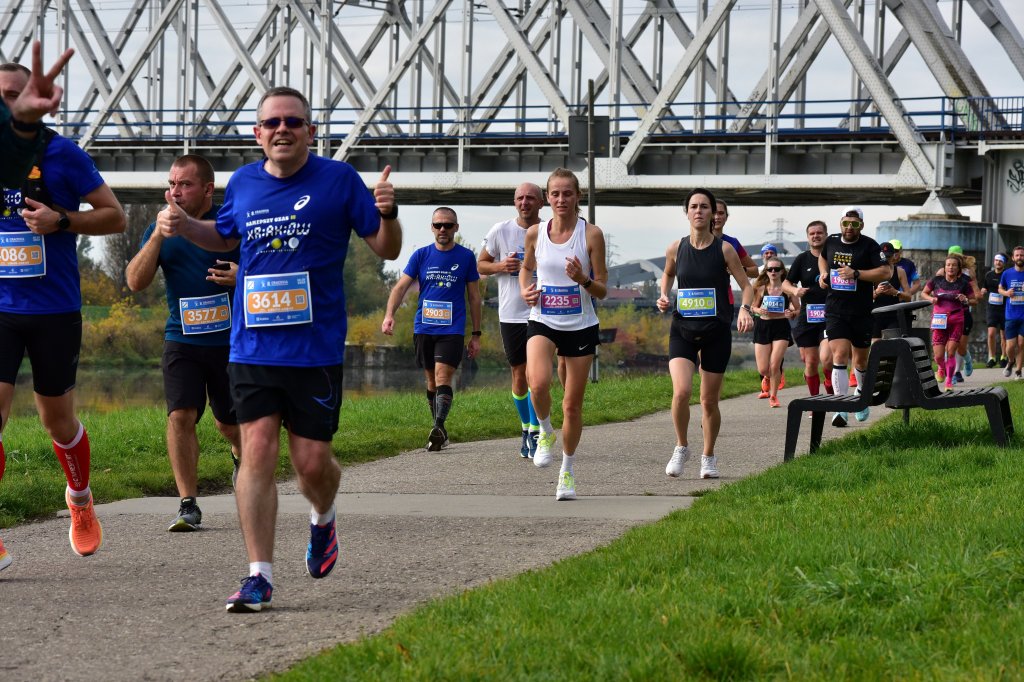
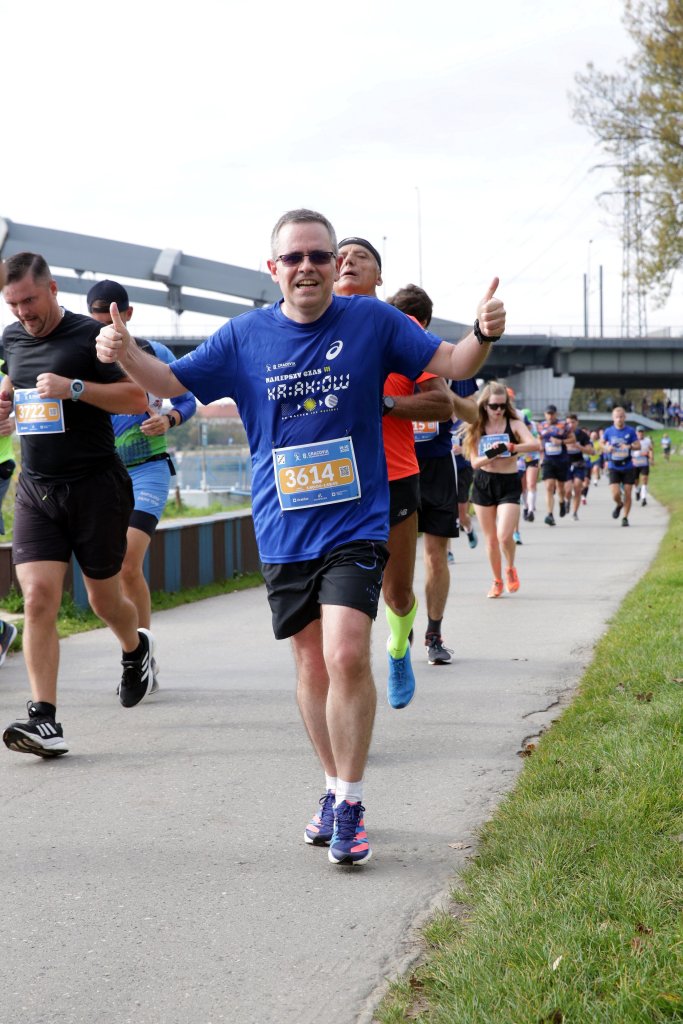
Smile though your back is aching
The October half marathon has a special meaning for me. In October 2015, I ran my first half-marathon race in Bucharest. Since then, I ran every year a half marathon distance in October. Even when injured (like this year) and even in 2020 when there was no official race because of Covid. Since 2015 I have run more than 8500 km and around 20 half marathons. It is never too late to make a change in life.
Smile even though it’s breaking
I was under an injury after Copenhagen when I started preparing for the Krakow half marathon. When you run only 12 km long runs and then you participate in a half marathon, there is a risk that you will get injured during or after the race. The reason is that the difference between 12 to 21 km run is hard to be absorbed by the body. That is why when increasing the running volume, you should do that by 10-20% every week, but not more. You run 12 km, then 14, 16, and 18, and only then are you ready for the half marathon. I knew that, but I hoped that I would be fine. It wasn’t the case. I got a muscle injury in the back area of the left kidney. After three half marathons in 1:54 this year, I wanted to finish one at a better time and pushed the limits. I made a mistake and learned from it. On a positive note, since Copenhagen, I have lost three kilograms by reducing sweets. They say that if you drop five kilograms, you could improve the half-marathon result by 10 minutes. That works until you reach the ideal weight, then the time to finish increases if you continue to lose weight.
When there are clouds in the sky, you’ll get by.
On the morning of the race, I took Nurofen, used Voltaren, and hoped for the best. Things were ok until the 16th kilometer. At that time, the race predictor estimated I would finish in 1:56. Unfortunately, the pain in my back started to grow. I decreased the pace directly proportional to the increasing pain. Around 18km, I thought to walk instead of running. From a speed of 5’20” -5’30” per km up to that point, I had to drop to 6’30″/km. At km 20, somehow, the pain was gone, but I chose not to push my luck. There was not much to do anyway. The official time was 2:00:16. Ranked 3377 from 6605 people who finished the race.
Fun section. My running club is called in Romanian “Trupa lui Fane”. In English, that translates to Fane’s group or Fane’s team. But in Polish, this reads as “Lui Fane’s corpse”. In Romanian, “trup” means body, but in Polish means dead body. The word has Slavic origin in both languages, but the meaning evolved differently. The word “trupa” is a genitive form of “trup”. All the other runners could see my club on the registrations page. In Polish, “Trupa lui Fane” sounds more like a club for pirates than for runners.
I want to thank Stefan Oprina for training me remotely this year!
This post will cover some spectacular tourist attractions close to Krakow. This is also a page of Poland’s history that resembles, in certain ways, what happens during the last months in Ukraine. The castles on the Trail of the Eagle’s Nests are located in the Polish Jura mountains, North of Krakow, and they can be reached by car in one or two hours of driving. The Polish Jura are old mountains with maximum heights under 500m, similar to the Dobrogea Mountains in Romania. The hills are not high, but the views are beautiful.
A map of the castles on the trail of eagle’s nests. The ones colored red no longer exist, and the black ones can be visited. Some are renovated while others are not.
In the XIV century, the Polish King Casimir the Great (1333-1370) built about 25 castles in these mountains between Krakow, his capital, and Czestochowa. These castles attract many tourists for the spectacular sightseeing in the present days. The area was the border between Poland and Silesia, a province of the Bohemian kingdom.
Rabsztyn Castle
View from Rabsztyn Castle
Another view from Rabsztyn Castle
Casimir the Great did more than build castles. In 1367 he founded the University of Krakow. This University is vital for the city even in the present day. Krakow owes its current growth mainly to the University. The increasing IT sector is a good example. An investment in education pays a lot in the long term.
Garden of the Scala castle
Let’s return to our topic. There is a good site with helpful information regarding castles in Poland. You can learn about the history of every building, and you can also see that many are entirely destroyed. This is because of an event that deeply impacted Polish history.
Ogrodzienec castle
The 30 Years War finished in 1648. At the end of that war, Sweden remained with a powerful army and not enough money to pay its soldiers. As often happened in history, countries with mighty armies looked for opportunities to attack their neighbors. In 1655 Sweden decided to attack Poland, which was not affected after the 30 Years’ War. Poland offered plenty of things to loot for the invaders. The Swedish troops occupied almost the entire country as Poland had problems preparing its army to defend it.
View of Ojcow park from Ojcow castle
The turning point of the events was the unexpected resistance of the Jasna Gora monastery. This monastery was and still is the most important religious site in Poland. In 1655 Polish people became highly emotional hearing about the fights for the sanctuary, and they gathered an army to start fighting the Swedes. The unsuccessful siege of the fortified monastery was lifted after more than one month. The Swedish forces eventually retreated with all the goods they could carry. One-third of the civil population of Poland died in that war.
Jasna Gora monastery
These events remained in history as “The Deluge”. Henry Sienkiewicz wrote a novel on this topic. A well-known movie, “Potop”, was made based on the book in 1974.
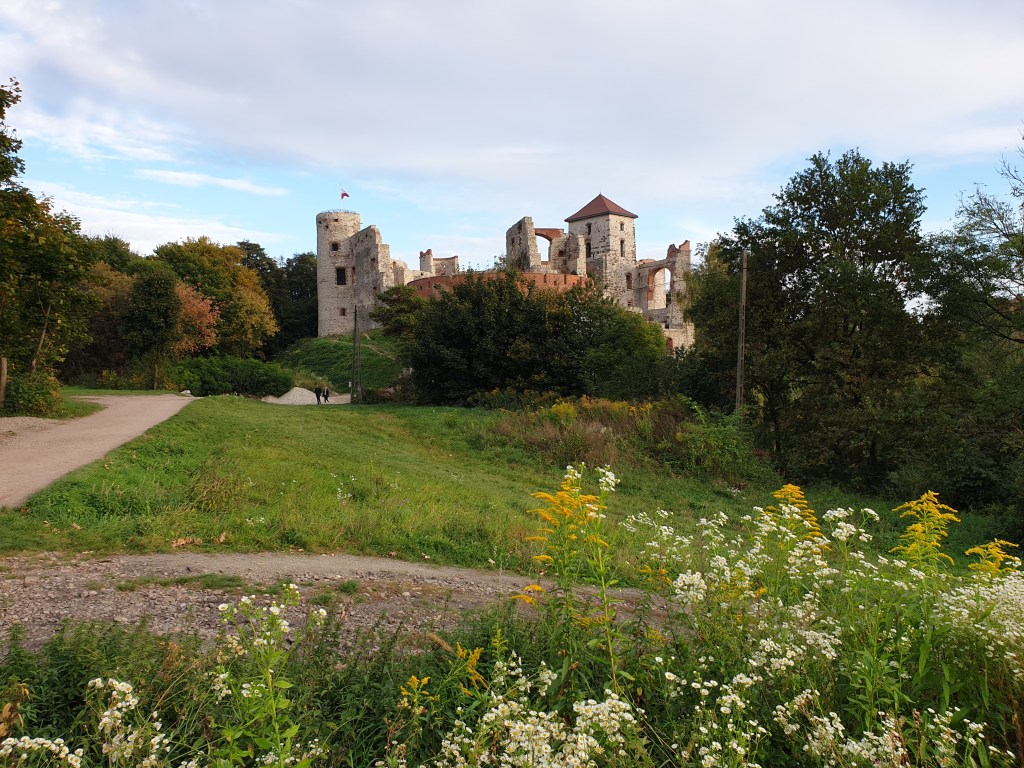
Tenczyn Castle
View next to the Tenczyin castle
The Swedish army destroyed all the castles part of the Trial of the Eagle’s Nest during the deluge. They tried to steal everything they found. The ruins remained in some cases since those events until recently. Because unfortunately, for every war, the impact and destructions last for generations after it ends.
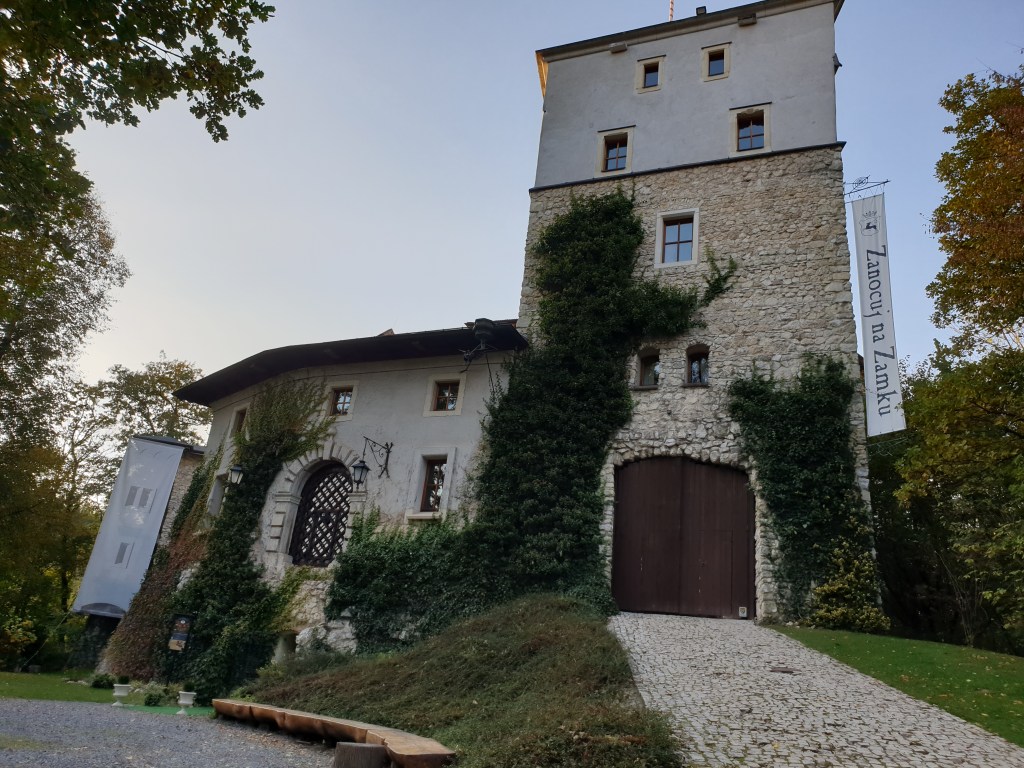
Korzkiew castle
Last decade, as Poland joined the European Union, they got funds from the union or other countries. They were able to renovate or rebuild some of these castles.
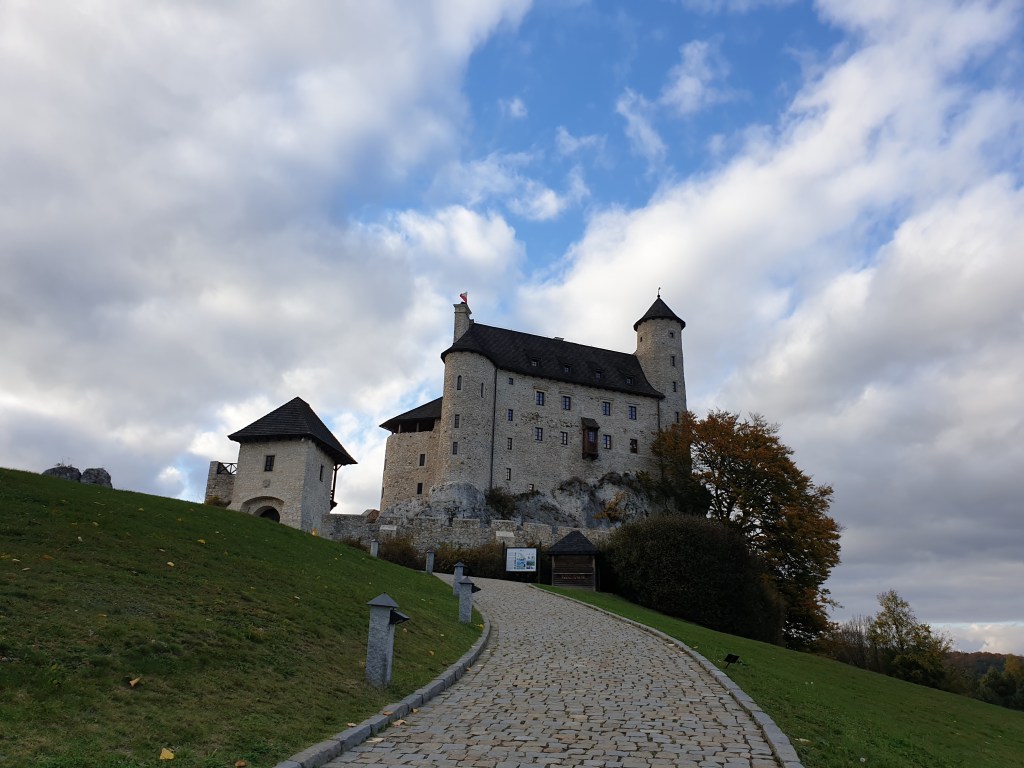
Bobolice castle
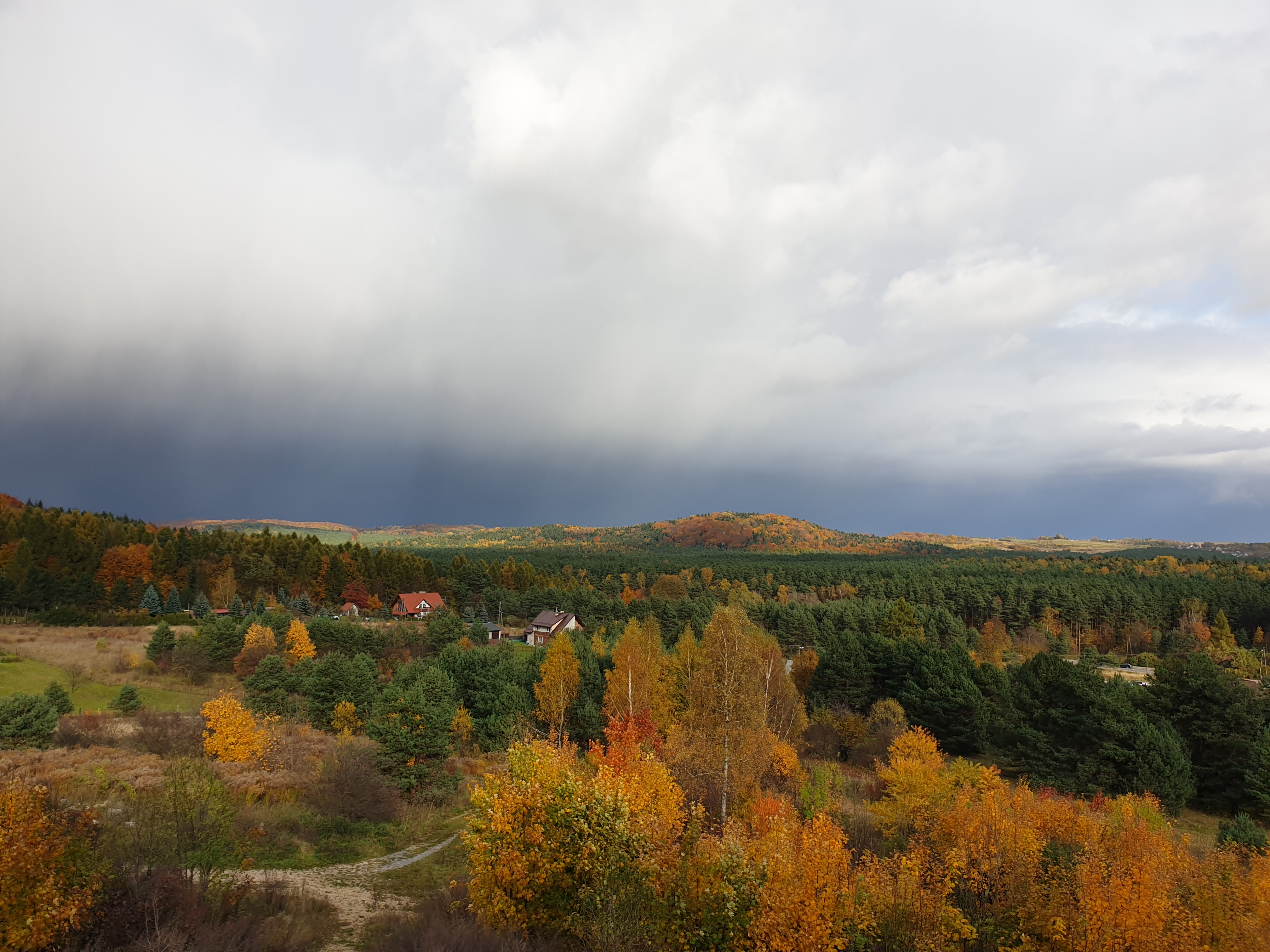
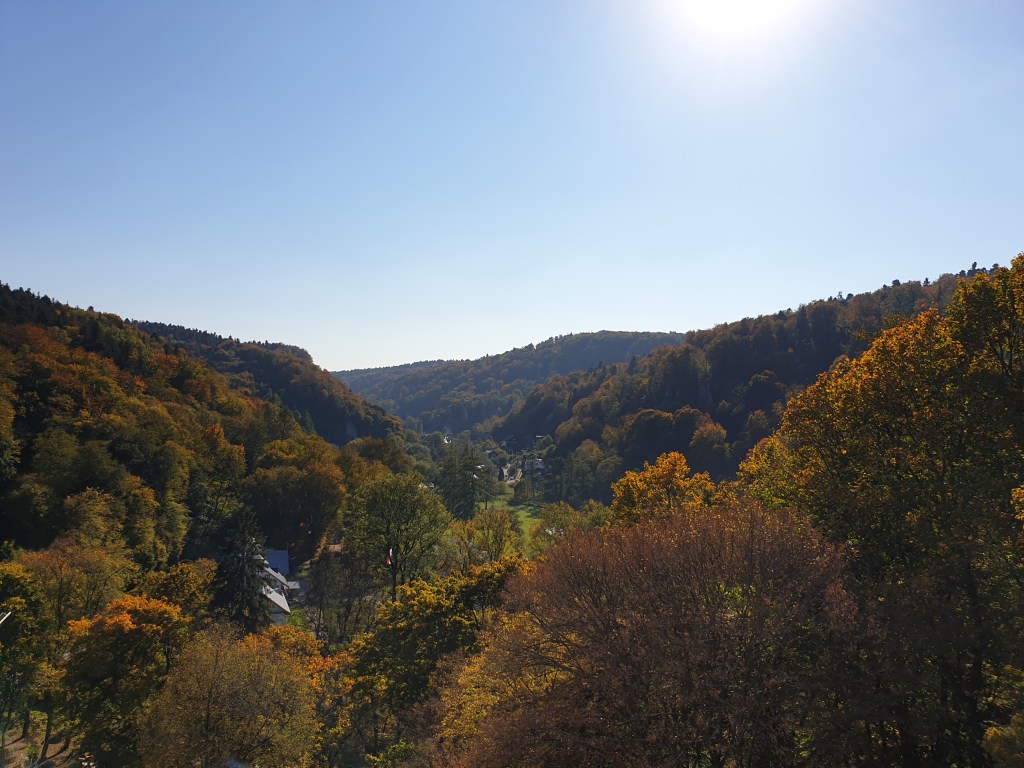
Many of the castles on the Trail of the Eagle’s Nest are open for tourists for small fees. In my opinion, the best time to visit them is in autumn when the trees from the surrounding hills are beautifully colored.
Maybe you wonder why these attractions were called Trail of the Eagle’s Nest? All of them are situated on high limestone cliffs or huge rocks, which suggests a resemblance to the eagle’s nests.
View near the Bobolice castle
Besides castles in the same Jura mountains, you can see many gates created by nature by carving big stones. Examples are the Krakow gate and Twardowski gate. These attractions combine history and nature. Maybe you’ll also find them interesting to visit someday.
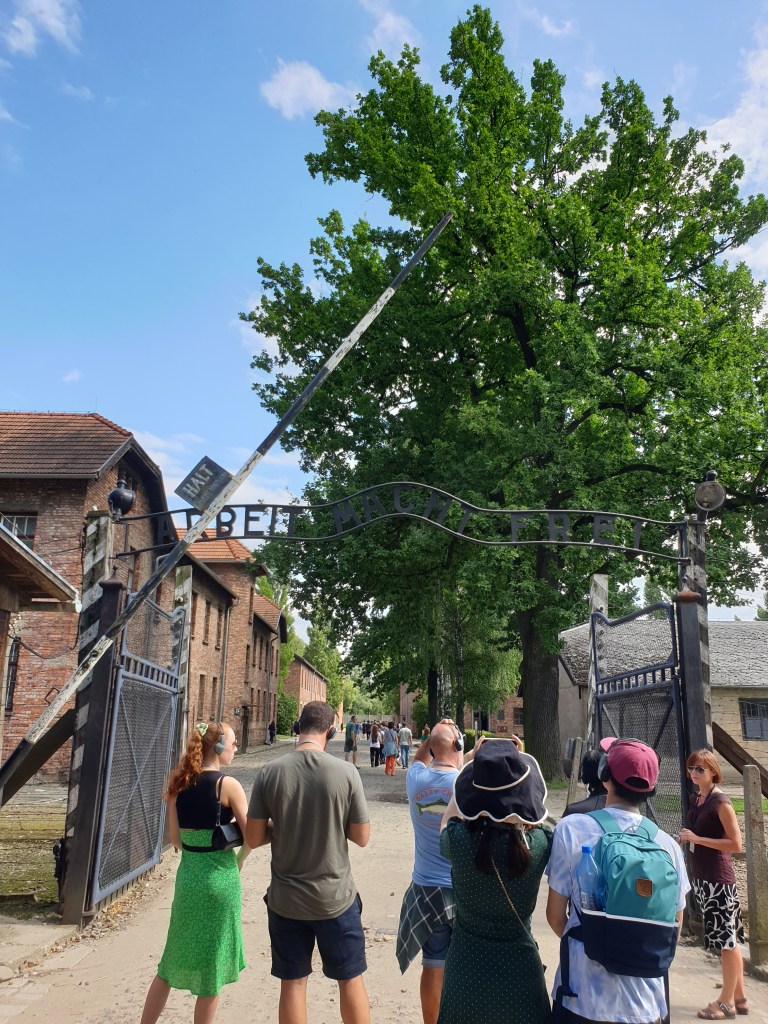
In August, before going to Bucharest, I went to visit Auschwitz. The former extermination camp is located around 70 kilometers west of Krakow. From Krakow, you have many options to visit Auschwitz. You can go by train, bus or car.
Although I have read many things about this extermination camp, it’s entirely different from being there. It is one thing to get info about the life in the death factory and a different experience to be in a chamber where hundreds of thousands of people were killed.
Entry to Auschwitz extermination camp. In front of the well-known iron gate with the message “Arbeit Macht Frei.”
The Auschwitz camp was first used as a labor camp and then, from 1942 to 1945, was an extermination camp. In January 1942, the Nazis decided to kill all the Jews from the German-occupied territories. Therefore they start moving more than one million Jews from Ghettoes to the exterminations camps by trains. Those who were not able to work were sent directly to the gas chamber. That included old people and children. It is estimated that more than 1.1 million people were killed in this camp. During the war from the six extermination camps, this was the camp with the most victims.
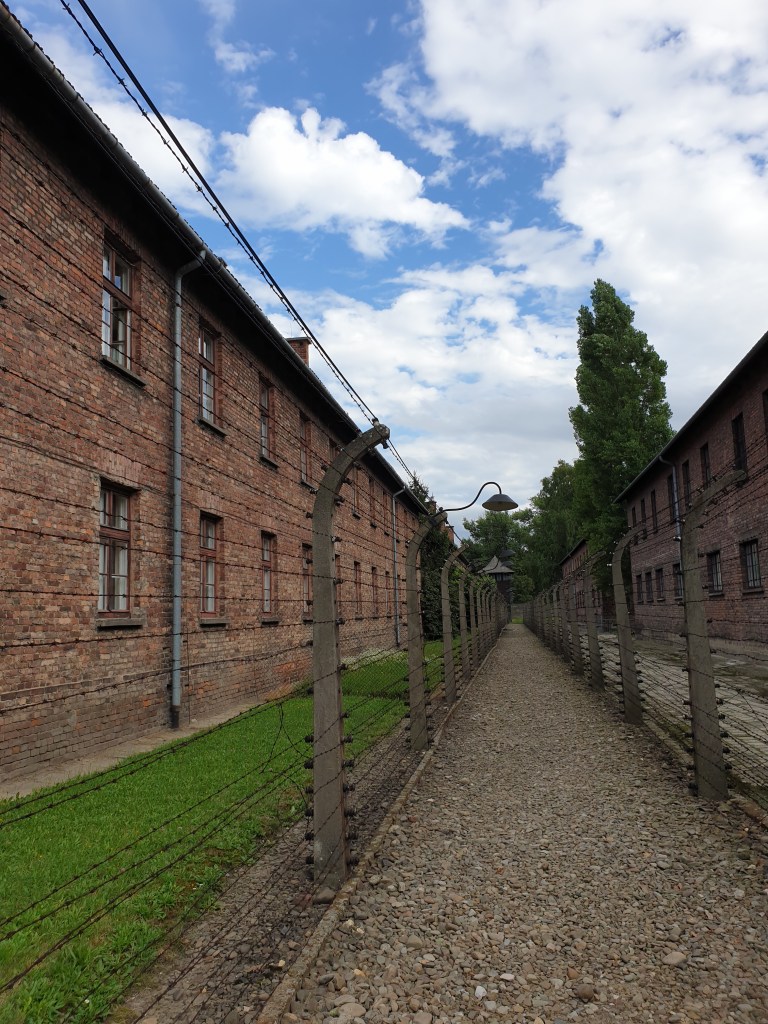
An electrified barbed-wire fence separates areas in the extermination camp.
The Nazis tried hard to hide the atrocities they did everywhere and the massacres against innocent people. Their actions to conceal facts failed. For example, in Auschwitz, they blew up the gas chambers before leaving the camp in January 1945. The Auschwitz museum was open soon after the war in 1947. Since 2016, more than 2 million people have visited the Auschwitz museum in the concentration camp each year. Having many visitors is a good sign that we learn from history not to repeat the same horrors.
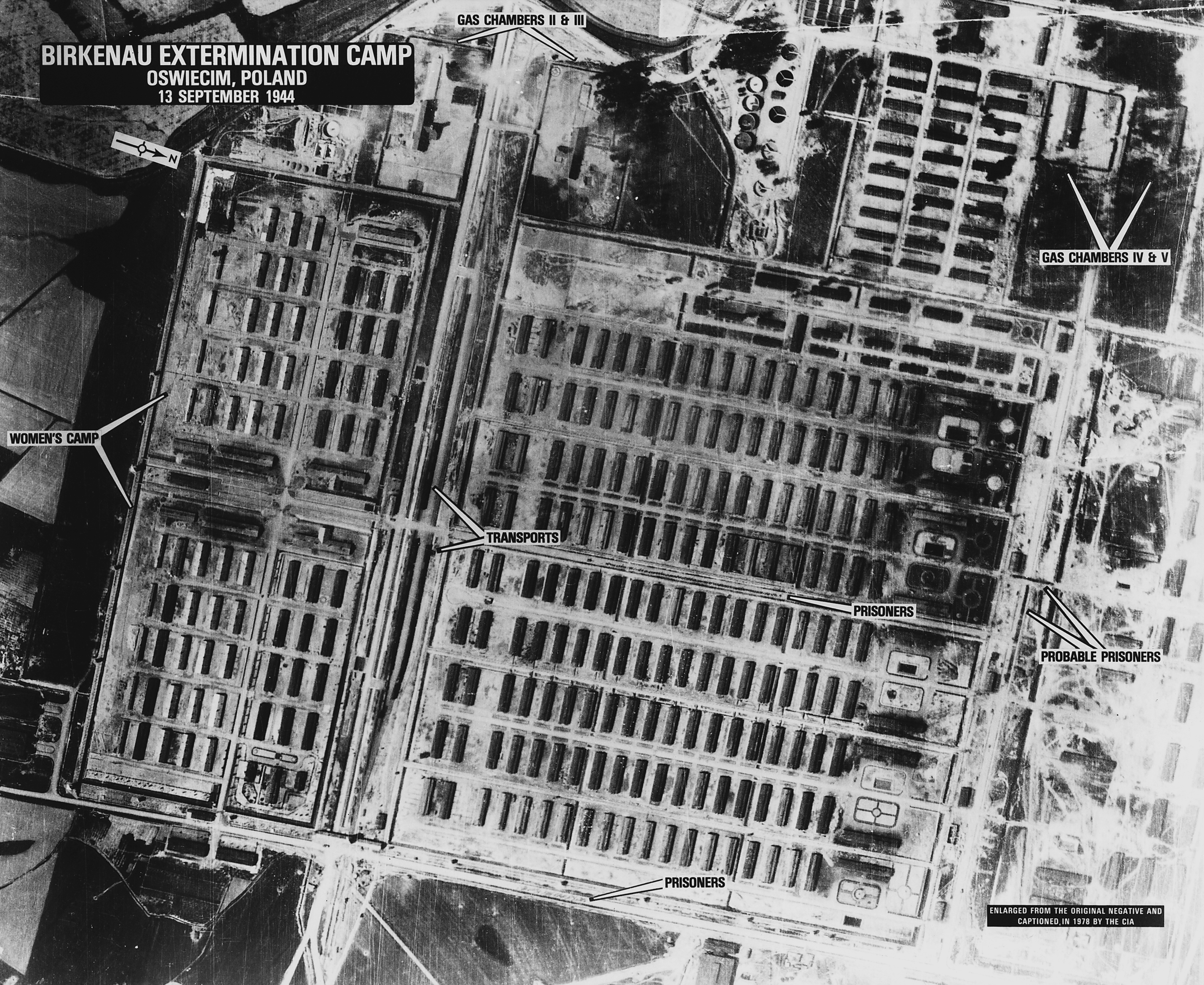
Gas chamber II was blown up by Nazis before departing the camp. There were four gas chambers in Birkenau and one in Auschwitz. The gas chamber in Auschwitz is the only one that tourists can visit.
Aerial view of Auschwitz II Birkenau extermination camp from 1944. Gas chamber II marked on this image was shown in the previous picture.
That day in August, I heard about many atrocities and impressive stories told by our guide. I won’t mention those things here as this is not the purpose of this post.
In one of the buildings, there were two long opposite walls with pictures of former inmates. On one wall, there were pictures of men while on the other of women. Under each image was written the date when they entered the concentration camp and the day they died. They were all prisoners selected for work. They had better physical condition when they arrived. The guide told us that, on average, men resisted more prolonged than women. That was not because of physical strength but because of mental differences. During that time, women were expected to marry, have children and grow them. For many being there meant the end of life, that they were prepared to live. In many cases, the death happened within weeks after the arrival in the camp. It was not dying because of hunger or physical extermination but because of giving up hope.
Auschwitz-Birkenau: a memorial plaque written in Romanian
I wanted to understand more of what was causing that. I read Viktor Frankl’s book “Man’s Searching for Meaning”. Viktor Frankl was an Austrian psychiatrist imprisoned in Auschwitz and wrote about this experience.
He said that those who had a purpose in the life lived longer. His advice for humans was not to ask “what life offered me?” but rather “what can I do for this life?”. The answer would help us find meaning in life.
Another idea from the book is that the things that happen to us are not under our control. What matters is how we respond to the things that happen to us. Seneca said this in a format of heroism: “The bravest sight in the world is to see a great man struggling against adversity.”
There was one more insight. Viktor Frankl quoted Goethe, who said: “If we treat people as they are, we make them worse. If we treat people as they ought to be, we help them become what they are capable of becoming.” I have resonated for a long time with this statement.
On my departure from Auschwitz, I looked back over the camp and saw the light coming down through the clouds over Birkenau. That light was over the place on earth where some human beings killed so many innocent humans. The ashes of so many people rose to the sky there, and human beings suffered a lot. We should not forget this.
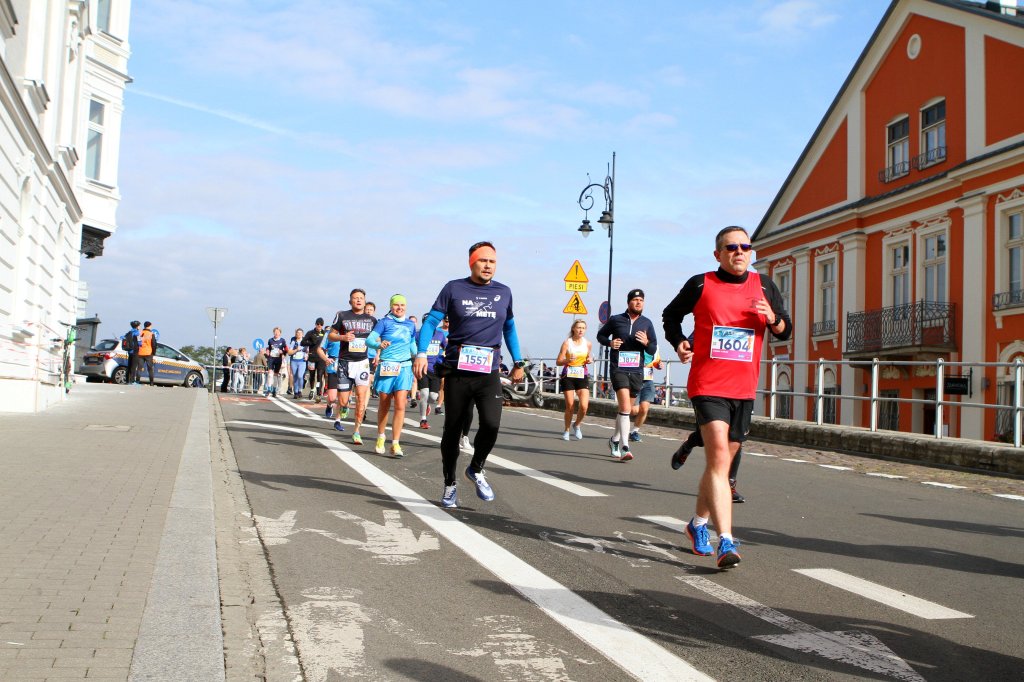
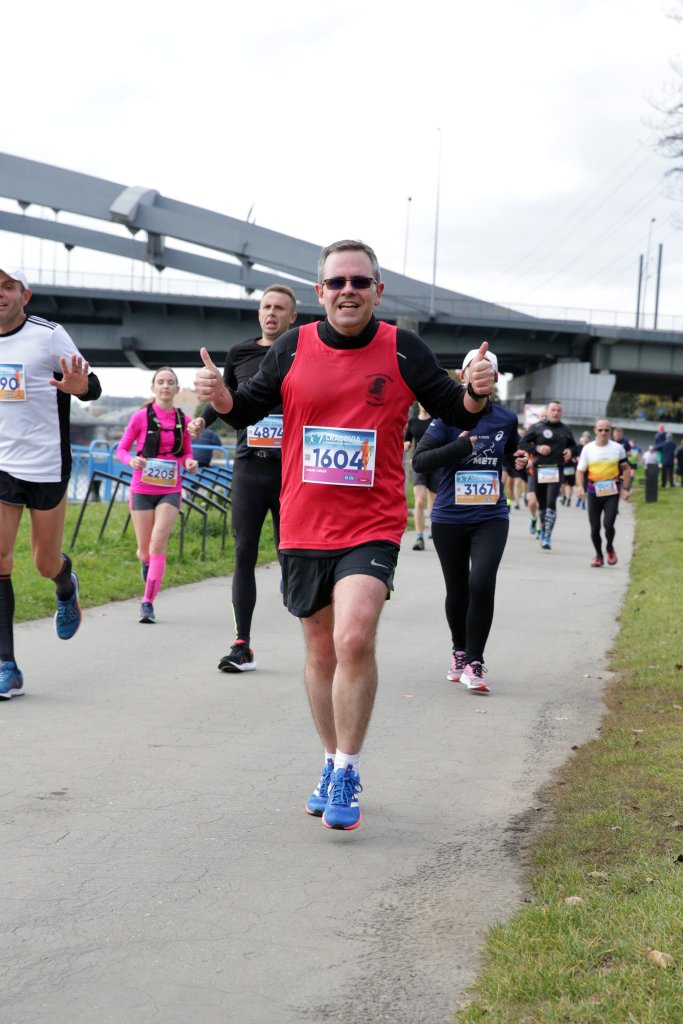
The 7th edition of the Krakow Half Marathon took place on October 17th. The Krakow Municipality organized this event. Due to Covid restrictions, this year, organizers allowed a maximum of 5000 runners at the start. They did a great job. The highlights were: running on both sides of river Vistula, in Krakow city center, and impressive finishing on Tauron Arena, the biggest arena in Poland.
We were crossing the bridge over the Vistula.
The weather was cold that morning, around 10 Celsius, but great for running. It was the 7th year in a row when I ran a half marathon in October (starting from the MIB edition in 2015). For this race, my goal was to finish in under two hours. Since I was familiar with the half marathon distance, I started slowly. According to the statistics, after 10 km, more than 3000 runners were ahead of me. From 15th km, I increased the pace to faster than 5′ 30″ per km.
On the other side of the Vistula river
For the last 2 km, my speed was above 12km/h, which means running less than 5 minutes per kilometer. Indeed the finish on Tauron Arena was spectacular. There were lights and excellent visual effects in the vast hall. During the last 5 km, I went from place 3007 to 2478. The reason was not necessarily my increased speed. It was because many people ran too fast in the beginning and got tired. That happens every time. This race made no exception.
The official time was 1:56:53. This is 10 minutes below the personal best. However, this time is much better than the result at Bucharest Half Marathon. Given the current situation and my training, I am happy.
Only 2 km to the finish. All good!
One important aspect is that one week before the race, my coach, Stefan Oprina, suggested running 15 km in less than 1 hour and 25 minutes. I told him that I couldn’t do that as this year I am not in great shape. In 2021 I could run 15 km only in 1:27 or longer. Stefan said: “That is fine. Run whatever you can and let me know how it went”. That day I ran 15 km in 1:24. That made me believe that I could run this half marathon in less than two hours.
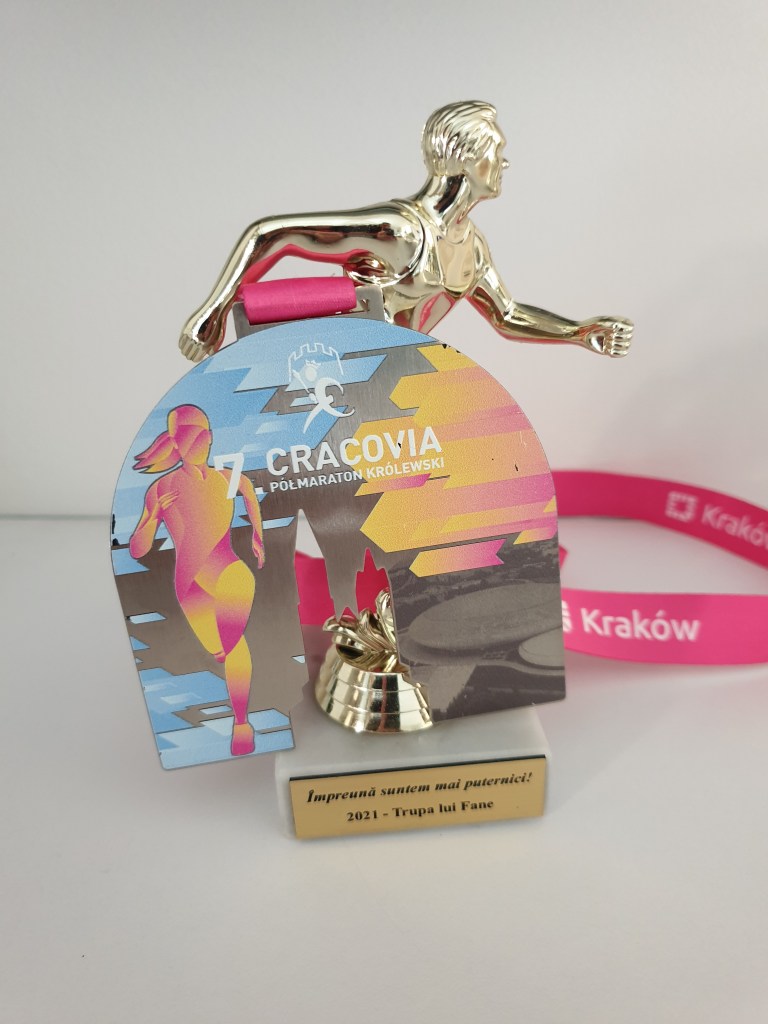
A gift from Stefan Oprina and the finisher medal from Krakow Half Marathon. The message is the motto of his running team: “Together, we are stronger!”
Stefan’s recommendation relied on the fact that I trained with him and the team for six weeks in Bucharest. During the first training, I was not able to run a kilometer in 5 minutes. Before leaving Bucharest, I managed to run 3 km in less than 5 minutes each.
I’ve learned one lesson from the Krakow Half Marathon experience. Often your brain sets the limits for you. In my case, it was 1:27 for 15km. Once you overpass that limit, you will feel free and boost your self-confidence. For example, last weekend, I ran 15 km in 1:21.
Pablo Neruda once said that “you can cut all the flowers but you cannot keep spring from coming”. Today, March 5th, beginning of spring, my intention is not to cut flowers but to write about something nice. One thing that came to my mind was to mention the beautiful and interesting things I see in Krakow when running on the shores of Vistula. The order of images listed here was chosen to make the narrative easier.
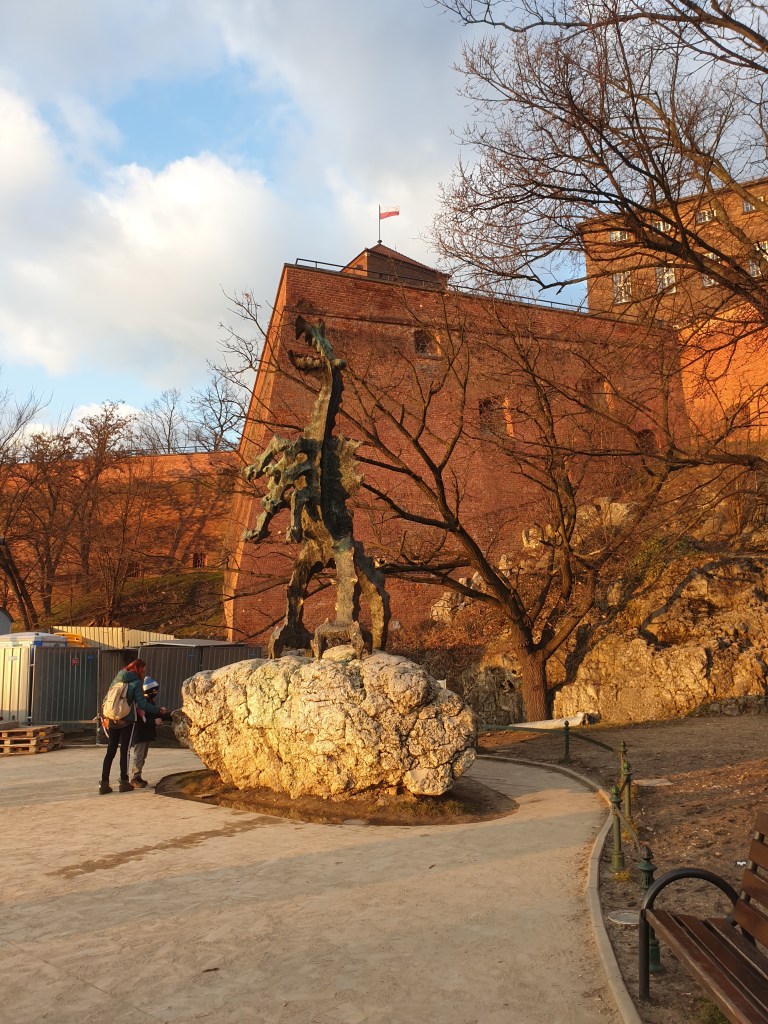
Let’s start with the symbol of the city, the Wawel Dragon. These days many kids take pictures in front of the legendary mighty dragon. To make it look more real, the dragon spits fire every few minutes. A dragon guarding a castle is a fairytale image.
The Wawel Dragon
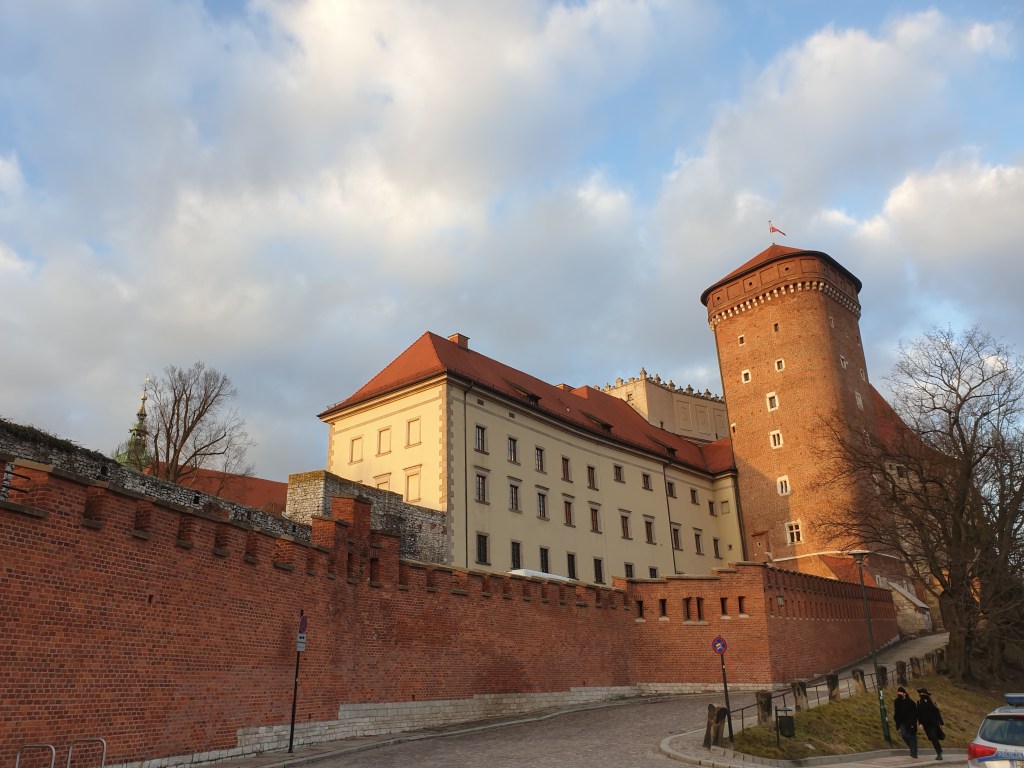
Guarded by the dragon is the famous Wawel Castle. The former residence of Polish Kings before 1596 when the capital moved to Warsaw. The big castle and cathedral form an architectural complex similar to the one in Prague. In fact, Prague is the city with the most similarities compared to Krakow. Probably it is because both cities were for many years under Habsburg Monarchy domination.
A wing of the Wawel Castle
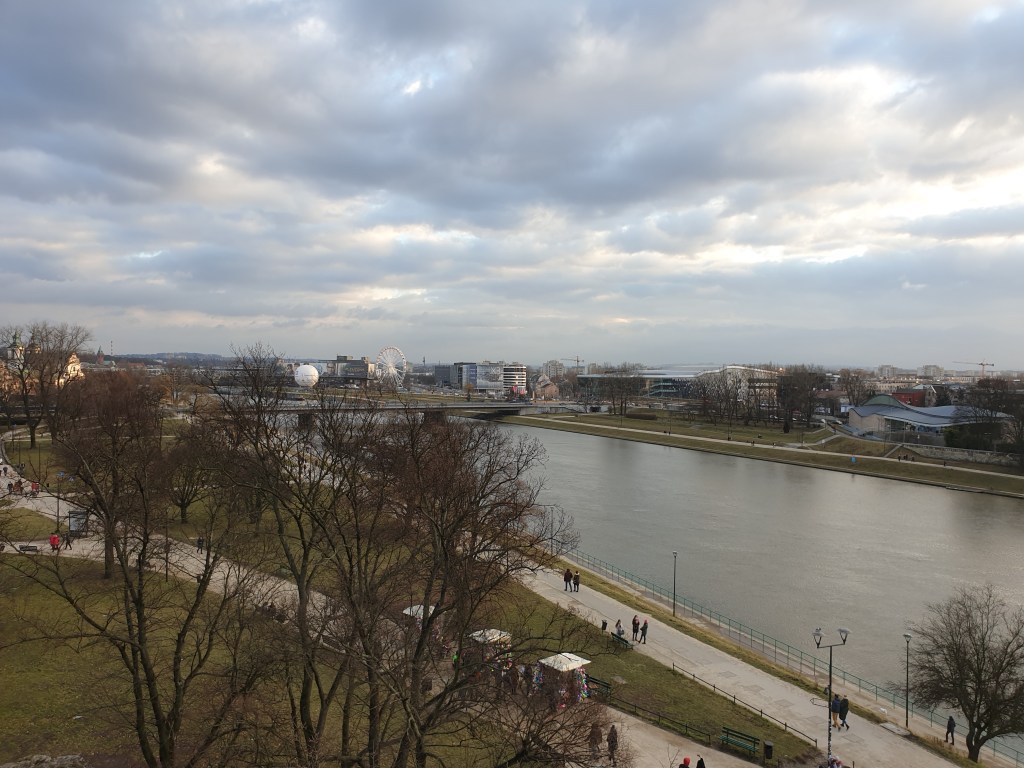
From the castle, the running path follows the Vistula river until the foot of the hill that can be seen far away in this picture. There are a large park and a big forest. It is impressive to see a forest on a hill in a city. The highest peak that can be seen in the picture below is the Kościuszko Mound. That is a human-made mound to honor the memory of Polish national hero Tadeusz Kościuszko. As a fun fact, I remember in school learning at Geography that the highest peak in Australia is Mount Kosciuszko. At the time, I did not understand why. The internet was not available to search for the answer. I had to come to Krakow to find the answer. For the explorer who first climbed that mountain, it looked like the mound with the same name in Krakow.
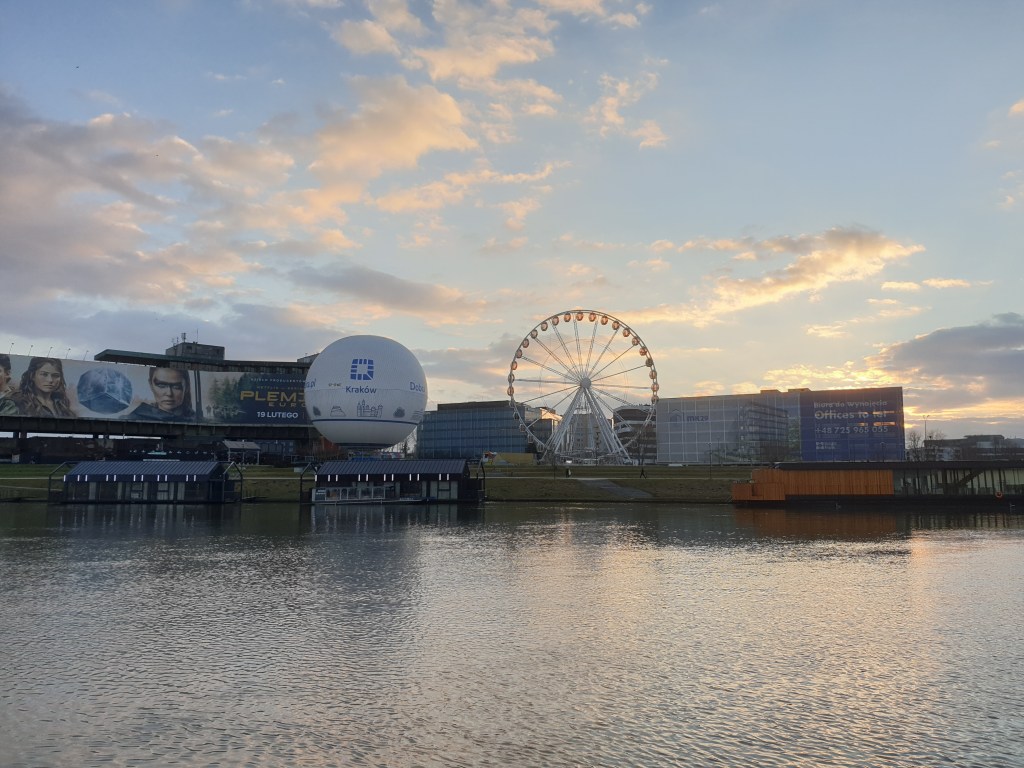
The other way of the running path leads to the Kazimierz neighborhood. Far on the right side, you can see a wheel and a balloon.
The balloon and the Krakow’s Ferris Wheel. Unfortunately, the ballon was not flying when I took the picture. For me flying the ballon is not an option as I am afraid of heights.
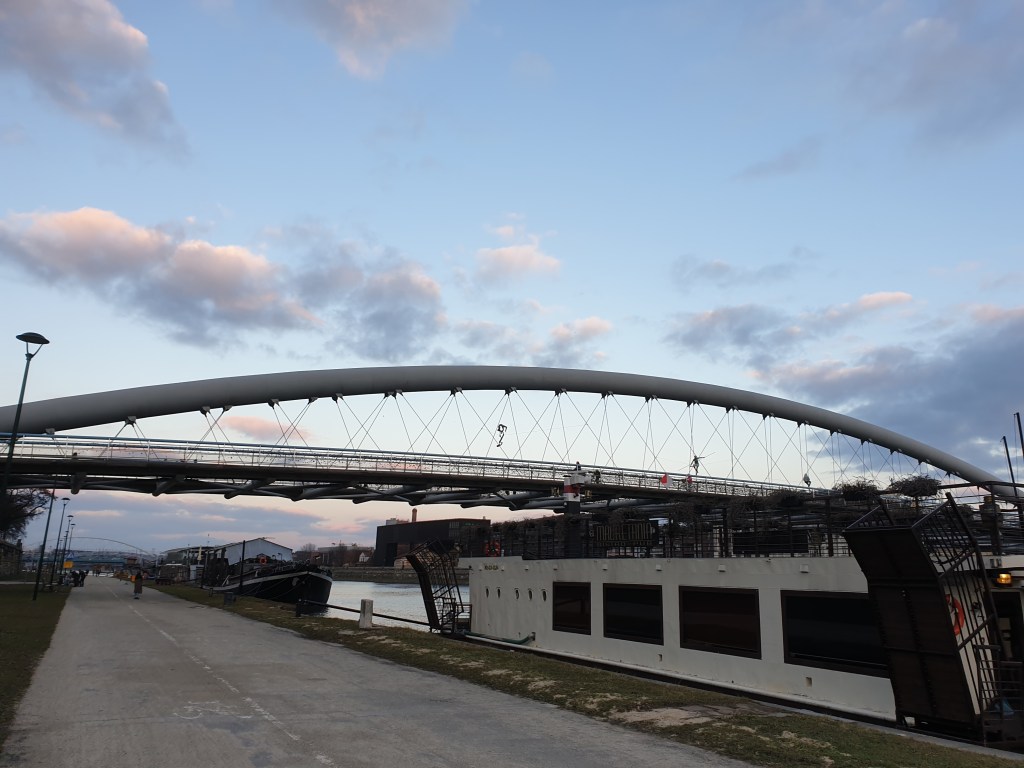
Another nice bridge is Father Bernatek Footbridge adorned with sculptures. This bridge makes the connection with the Jewish neighborhood. Kazimierz is the bohemian part of the city, with a different atmosphere than in the city center. Under the bridge, a few ships were transformed into restaurants. Some ships make cruises on the Vistula river.
Bernatek Footbridge
As mentioned above, Krakow reminds me mostly of Prague. I couldn’t resist adding a picture of this modern art symbol from Krakow similar to the ones from Prague. It is always funny to admire such examples of modern art. A theory is that the pig, set in a position to be lit ablaze, signifies renewal.
Running in a fairytale environment makes the experience more pleasant. Hoping that you enjoyed the pictures above, I wish you a great year ahead! Despite all the difficulties, life goes on!
Since all the pictures were near a river, I thought it appropriate to end with a song on a river
Last summer, I decided to resume my professional career in Krakow. Living alone in a city where I knew no one was not easy but not that hard as anticipated. The fact that the office is open, respecting anti-Covid norms, was very helpful. I could meet face to face many colleagues. The company assisted me with all the formalities needed to work from Poland.
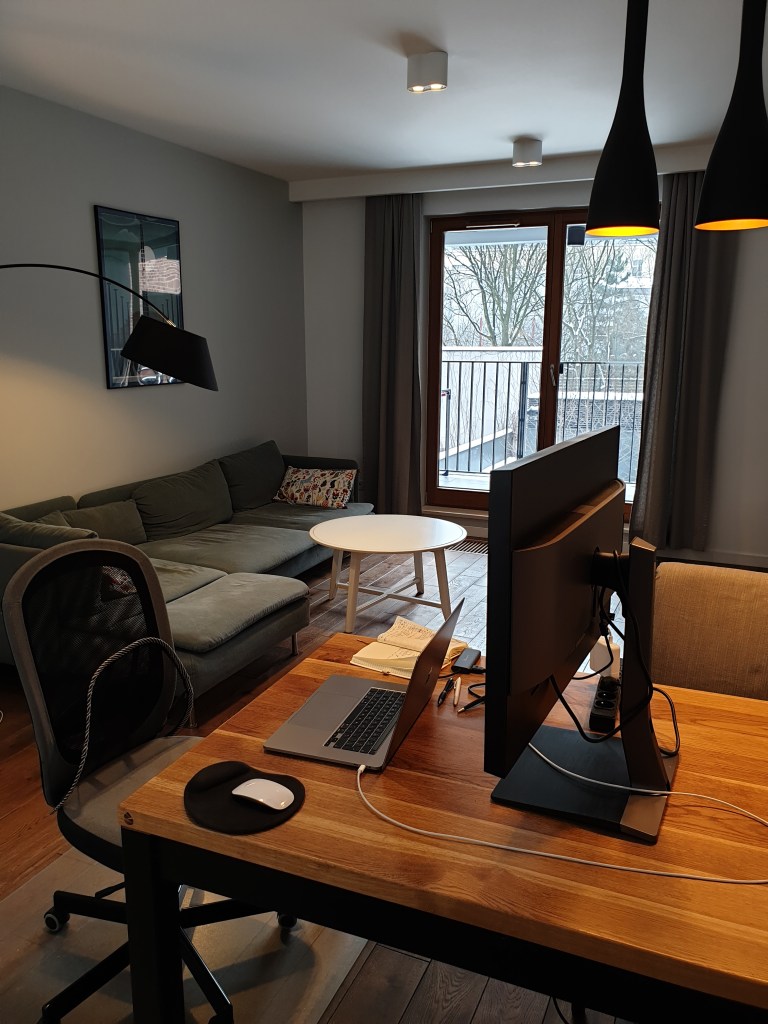
My improvised office while working from home in Krakow
Running helped me a lot. I continued my training under indications from my coach, Stefan Oprina. In Krakow, I ran 540 km, three times per week, before I had to stop in December. The reason was that it was too cold outside. I had a sour throat after running while the outside temperature was under 0 Celsius. The gyms were closed due to Covid. My only option was to run at home with two dumbbells. I did that three times every week. I hope that I will be able to resume running outside starting from March. At the end of 2020, I still ran 1500 km in total.
Generally, I was running at a slower speed because the area for my training was where other people use to walk. In most cases, my runs were on the shores of Vistula. For example, in October, I ran a half marathon in two hours and thirteen minutes. Almost thirty minutes slower than the previous year. Still, running helps a lot both physical and mental health.
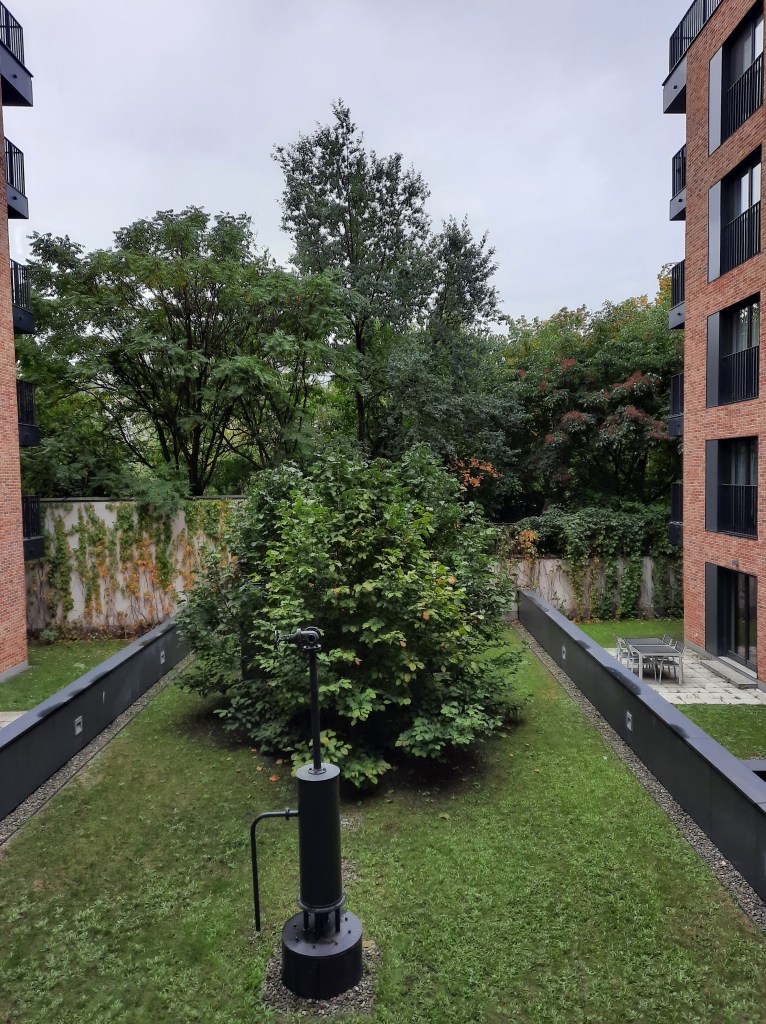
Last October. View from my window in Krakow center.
Krakow is the most popular tourist destination in Poland, with 14 million visitors in 2019. The city looks great, full of medieval buildings and the biggest old center in Europe. Most of the people speak English as they are used to interact with tourists. That is important for someone who doesn’t speak Polish. Coming here last July was a good thing. All the museums and restaurants were open. For example, visiting Shindler’s factory, I understood the plot from “Schindler’s List” movie. Laying on the hills the city has many spectacular landscapes. A must-see is the Wawel cathedral and castle, the residence of Polish kings before 1596. Then Warsaw became the capital of Poland.
View from Wieliczka Salt Mine
Close to the city, there are many other attractions, the Carpathian mountains with the famous resort Zakopane situated about 110 km to the south. There are hills, small towns, lakes, and nice sightseeings. Other cities in proximity are Katowice with wide-open spaces reminding of US cities, Częstochowa and Ostrava in Czechia.
View of Zakopane from surrounding mountains
Other positive things? The food tastes better and is cheaper than in Romania. Big malls and better roads.
What are the shortcomings? The winter is colder here than in Bucharest. Also, for me, the Polish language is hard to understand, but my colleagues are friendly.
Coming to Krakow was a great decision. A great life experience so far. Maybe I will post later some tourist experiences around Krakow.























 Adrian Matei's blog
You must be logged in to post a comment.