Valencia half-marathon 2025

The best proof that what I wrote last year about the Valencia Half-Marathon was true is the fact that I decided to run it again this year.

With limited race options, I have to choose carefully where to compete. The Valencia Half-Marathon makes that decision easy, it’s one of the best-organized and most enjoyable races in Europe. For returning runners, registration is even smoother: the organizers give priority to those who ran in the previous edition.

If you’re trying to run Valencia for the first time, you’ll need to enter a ballot in November. If you don’t get in, there’s still hope. Several official travel agencies offer guaranteed race entries as part of their packages.

This post isn’t about repeating what I said last year. It’s about sharing what was new. I also want to share what I learned this time around.

What Was New This Year

The Wardrobe Service

This year, I paid 6 EUR to leave my luggage at the start area wardrobe. It was absolutely worth it. Not having to run with my phone or other items made the experience much more comfortable.

Slippery Grids on the Course

After kilometer 10, the route passes along a street full of metal grids covering subway vents. When it rains (as it did this year and last), these grids can get very slippery. Tip: stay on the left side of the road, where the surface is safer.

The Energy of the Drummers

One of the things I love most about Valencia is the number of live drumming bands along the course. The beat of the drums has an incredible effect. It pushes you forward in a way that no playlist ever could.

My Race

I learned from last year’s mistakes. This time, I didn’t eat too much before the race. I made sure to finish my breakfast more than two hours before the start.

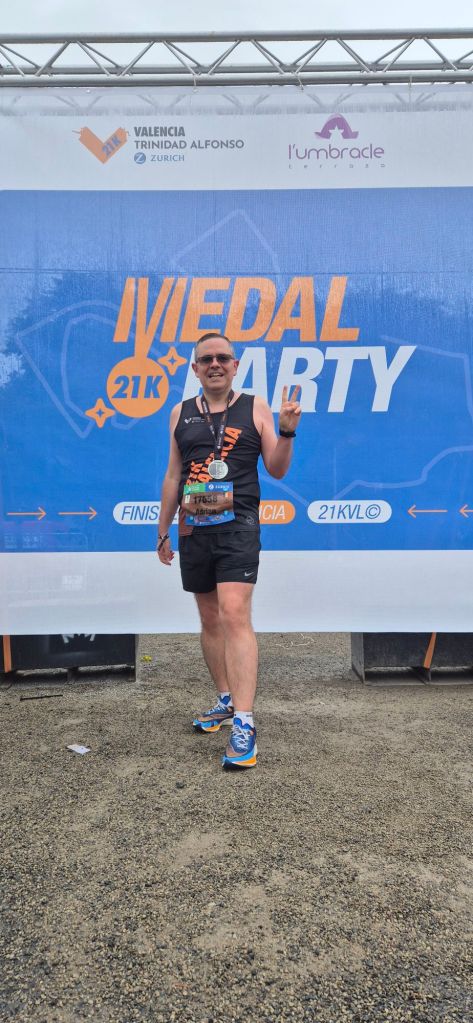
I started in wave 7 at 9:01 a.m. and took it easy at first, running the first 5 km at around 6:00 min/km. I planned to pick up the pace later. However, by kilometer 15, I realized I wasn’t going to finish under two hours. At that point, I decided not to push too hard. Whether it’s 2:02 or 2:03 doesn’t make a huge difference. I crossed the finish line in 2:04:11, an average result, but still 22 minutes faster than in Tallinn!

After the race

Our Team – “Trupa lui Fane” in Valencia

This year, five of us from Trupa lui Fane ran in Valencia. That made the whole experience even better. We shared the excitement, compared strategies, and celebrated together after the race.

“Trupa lui Fane” in Valencia

Everyone had a strong performance, close to their personal bests:

  • 🥇 Mihai1:24:54, our fastest runner, finishing among the first 2,000 participants
  • 💪 Andreea1:34:52, the only one to set a new personal best
  • 👟 Bogdan1:44:24, two minutes slower than last year
  • 🔥 Sorin1:56:06, at his first SuperHalfs race, very close to his PB

Congratulations to all of them for their fantastic results!
And a big thank you to our coach, Ștefan Oprina, for helping us become better runners over time!

Valencia remains, without question, my favorite half-marathon in Europe.

Later that day in Valencia I met someone who didn’t look quite happy with his result.

Not everyone looked happy that day

Valencia 2025 reminded me once again why I love running. It’s the rhythm, the people, and the stories. These moments stay with you long after you cross the finish line.

PS.1 A Seagull and a Song

On race morning, I woke up early, opened the window, and saw a lonely seagull flying above the hotel. It reminded me of a Joe Dassin song I’ve always loved:

“Moi, de temps en temps, je me sens pareil
À cet éternel exilé
Lui, qui ne sait pas replier ses ailes
Moi, qui ne sais pas m’arrêter.”

A small, poetic moment before the adrenaline of the start line.

PS.2 Remembering the Floods of 2024

The day before the race, Valencia held a large protest. It was in memory of those who lost their lives during the 2024 floods. Last year, we left the city on Monday after the half-marathon. The next day, torrential rain caused devastating flooding that claimed 224 lives in the province. One year later, people are still unhappy with how the authorities responded.
It’s a sobering reminder that life is unpredictable. Every race, every trip, and every day, is something to be grateful for.

PS.3 Goodbye, Mihai Suba

On Sunday, October 26, the day of the race, Grandmaster Mihai Suba (1947–2025) died near Valencia in Spain. Before 1990, Romania had only three chess grandmasters — and Suba was one of them, a true original. He made significant contributions to chess, particularly in middlegame theory and the Hedgehog system. I’ve read a few of his books; Dynamic Chess Strategy was a particular favorite. He was admired worldwide for his creativity and deep understanding of the game. May he rest in peace — and may his ideas continue to inspire players for generations.

Valencia half-marathon

This year edition of Valencia half-marathon was a real success. It was a perfect organization, the best from all the races I ever ran. During the race a new world record was established by Yomif Kejelcha from Ethiopia with 57:30. The weather and environment were perfect for running.

Runners warming up

There are countless positive aspects to highlight about this event. I recommend that every major marathon organizer send a representative to run in Valencia and take notes. For runners, the course is flat with ample space for warm-ups, and it never felt overcrowded. Organizers provided water in bottles, gels, and isotonic drinks along the route. If you’re aiming for a personal best, Valencia is the place to be, the true city of running.

Before the race

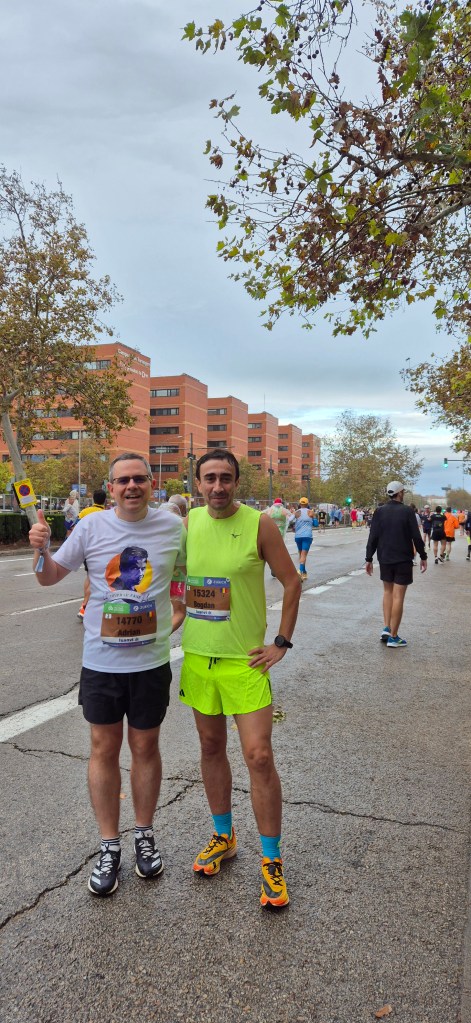
I traveled from Bucharest to Valencia with my colleague Bobo, and we stayed in a hotel conveniently located near the start and finish lines. We warmed up before the race began and started together.

At the finish

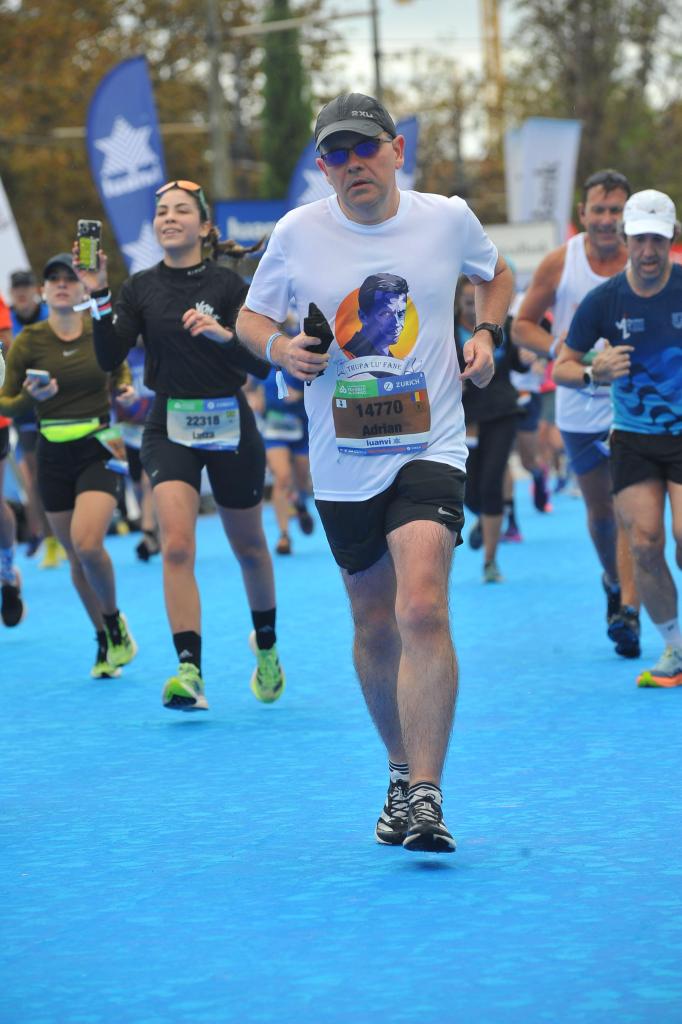
My race was going well until the 15-kilometer mark. I clocked 10 km in 55:40 and 15 km in 1:23:17, maintaining a pace of 5:33/km. For context, I passed 15 km in Cardiff in 1:25:56. Unfortunately, I experienced stomach issues that slowed me down significantly, forcing me to walk the last kilometer, which took me a frustrating 10 minutes. My official finish time was 2:07:47- not ideal, but I persevered, received my medal, and added another super half-marathon to my list.
Over 24,000 participants finished the race, and the support along the route was phenomenal. I had heard before the event that they were aiming to break the world record and bring it back to Valencia, and I could feel the positive energy during the race. Light rain helped keep us cool as we ran.
Bobo had an outstanding race, running a negative split and gradually increasing his pace. He achieved his personal best of 1:42:05. Congratulations to him on a fantastic performance!

Bobo achieved a personal best in Valencia

Bobo’s achievement wasn’t a surprise; he dedicated a lot of time to training this year. I logged 1,200 km, while he ran a third more and incorporated various exercises. In running, results stem from hard work. There’s no substitute for proper training.

After the race

My T-shirt for this race was from “Trupa lui Fane”, a gift from Stefan just before leaving Bucharest. Runners from Trupa lui Fane have recently excelled, with four finishing under three hours at the Bucharest Marathon and winning multiple medals at the Balkan Championships. Bobo’s progress is another testament to the effectiveness of Stefan’s coaching. I also want to thank Stefan for training me remotely in the last years!

Valencia half-marathon is part of Superhalfs. You need to finish all six half-marathons to get the special medal. This was my 5th race with only Berlin left to finish the circuit. In Valencia the first Romanian to ever finish Superhalfs was Cosmin Gabinat. We congratulate him for this achievement! Here you can find a list with all Romanians participating in Superhalfs , 111 people registered at the end of 2024. Given the statistics, the next Romanians to finish Superhalfs circuit will be in Berlin.

Despite my challenges and results, I had an amazing time in Valencia and highly recommend this race to anyone looking to achieve great results!

Cardiff half-marathon

Cardiff half-marathon is part of Superhalfs which makes it one of the most attractive races in England. Initially my thought was to run there because it’s one of the 6 half-marathons you need to finish to complete the Superhalfs series. I didn’t know much about Cardiff or the race before going there; hence, this half marathon was a pleasant surprise for me.

By the time I wanted to register for the event in Cardiff, the registration was already closed. Generally, such races sell out more than six months before the event date, so you need to plan your participation well ahead of time. For example, by October 10, 2024, the Cardiff Half Marathon for 2025 was sold out. According to the organizers, all spots were sold within 12 hours of the registration opening.

If you are late and still want to run there, you can get help from a sports travel agency. Such agencies guarantee your participation and accommodation for a fee. They may also organize training sessions and a pasta party for their clients. This time, I went with Interair, a German sports travel agency, and I was happy with their services; everything was great.

Before the race

On October 6th, it was a good time to run in Cardiff, with temperatures around 12 degrees Celsius and light drizzle at the start. There was enough space to warm up before the race. The runners were organized in waves, as is normal for a half marathon with 28,000 participants.

The start is at Cardiff Castle, and the route winds through the city, including the bay area, before returning to the center and the castle. The first part of the race is either descending or flat; from kilometer 15, it starts to ascend, with some hills around kilometer 18, and towards the end, there is a significant difference in altitude.

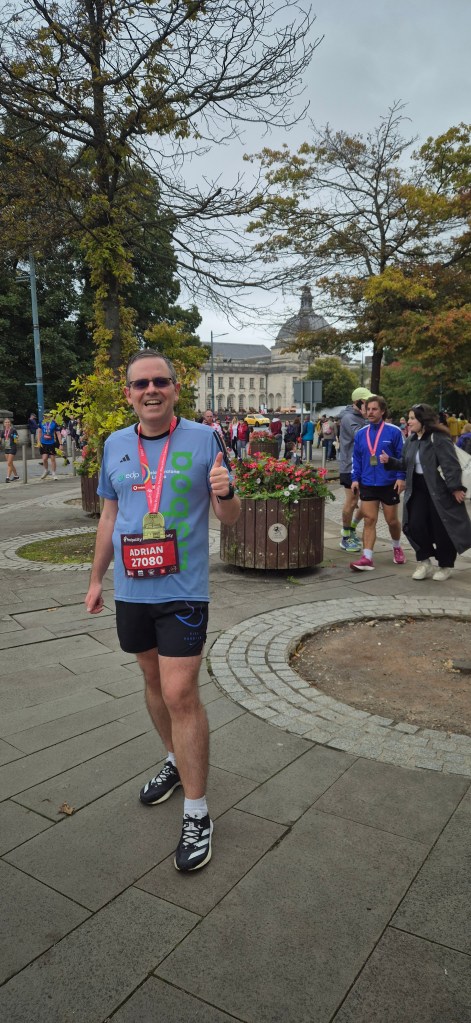
I started with a pace of around 5:40 per kilometer and maintained that until kilometer 10 when the two-hour pacers went ahead of me. I made an effort to keep them in sight for as long as I could. By the 18th kilometer, I was confident that I could finish in under two hours. Then the small hills came, and I thought there was no way I would finish in less than two hours. Fortunately, with a final burst of energy, I finished in 1:59:58!

After the race

During the race, I used two GU gels and drank water twice, at kilometers 10 and 15. Water stations were available every 5 kilometers and also at kilometer 18.

One must remember that in England, races are marked in miles—13.1 miles as opposed to 21.1 kilometers in the rest of Europe. In this context, it’s useful to have an accurate GPS watch or to keep pace with the pacers if achieving a specific time is important to you.

As you can see, I’ve run many races in Europe, and I have never seen so many supporters encouraging runners as I did in Cardiff. The respect for runners is high in the UK compared to elsewhere. There were thousands of people spread over the half marathon distance, showing support for the runners. This can significantly boost one’s motivation to finish the race. I believe this played an important role in my success in finishing under two hours for the first time this year.

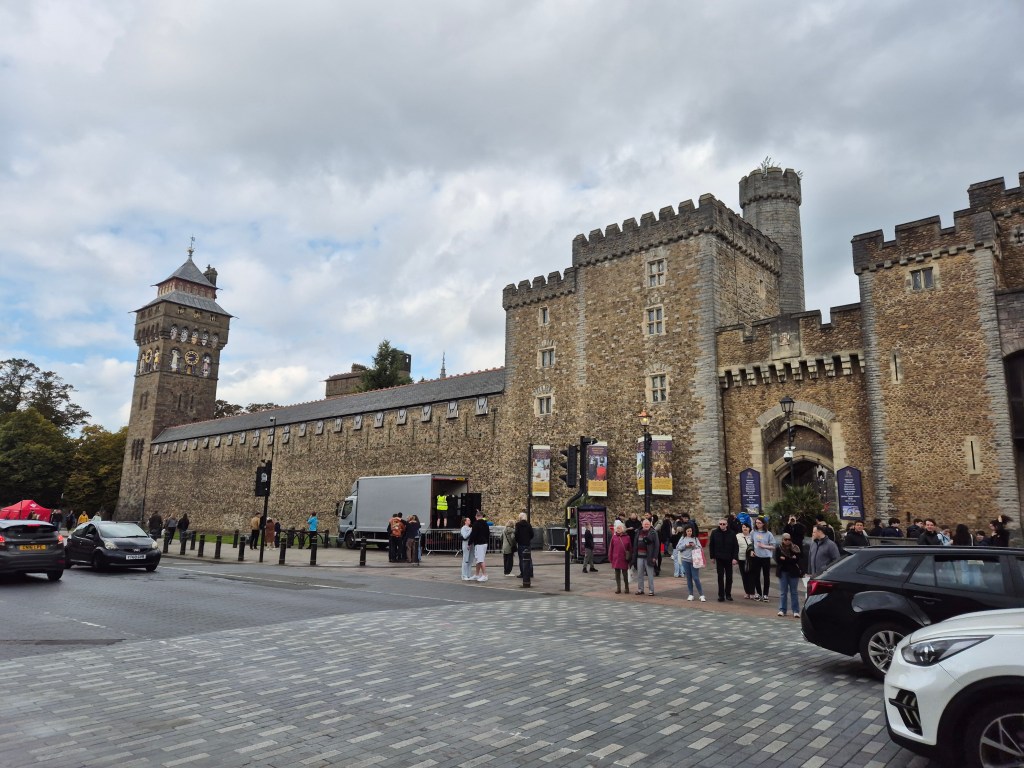
Cardiff Castle

The other pleasant surprise was the city of Cardiff. The capital of Wales has a beautiful, typical British castle worth visiting. You can explore the bay area, the old market, and the city center. There is a village museum outside the city and a cathedral, but I did not have time to see them. There are nice restaurants and many people partying during the weekend.

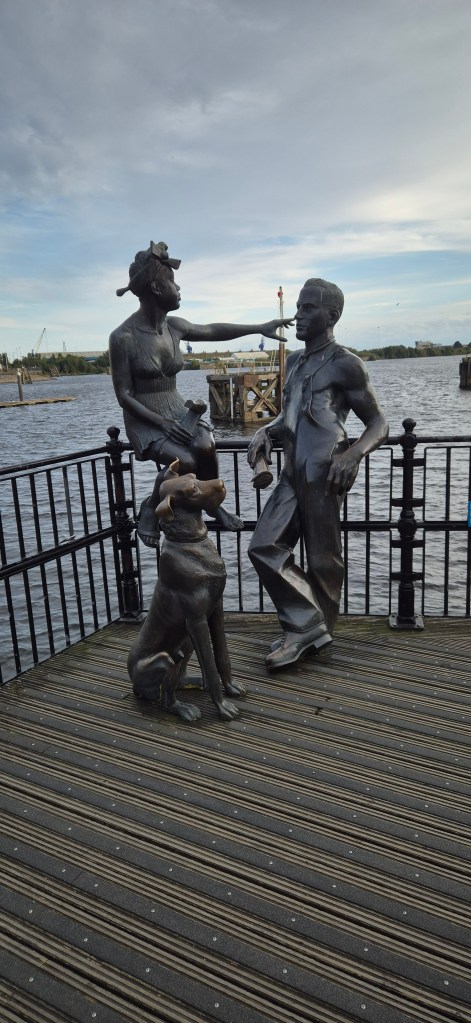
Cardiff bay area

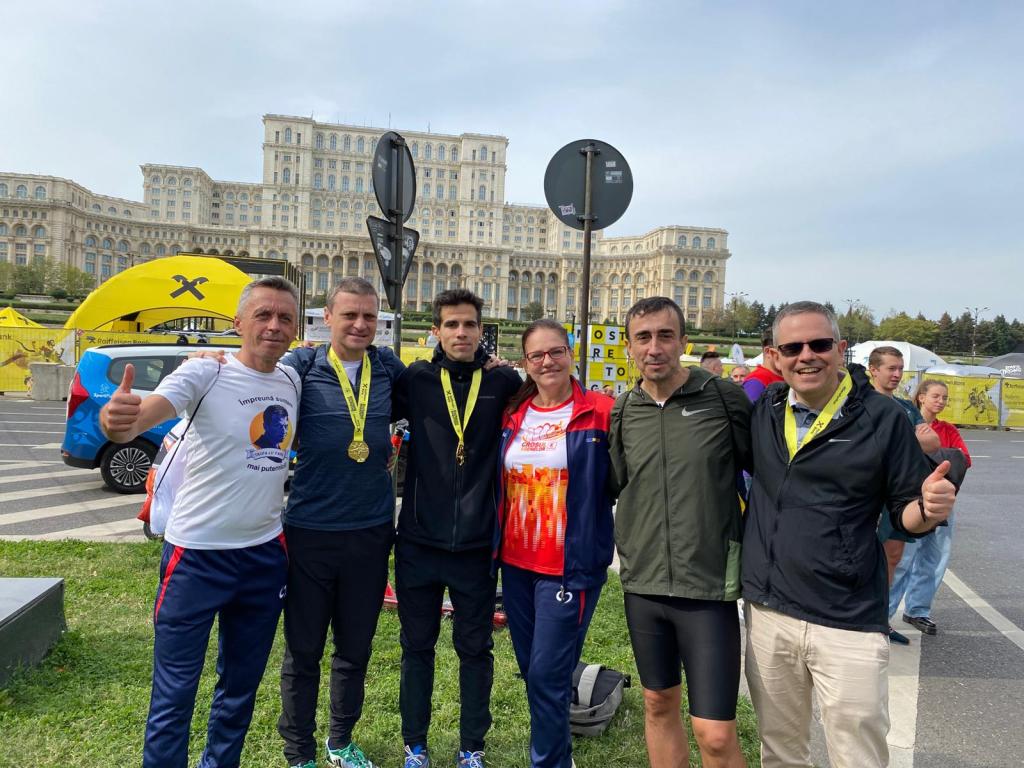
The weekend after Cardiff, I traveled to Bucharest to watch the Bucharest Marathon and encourage my colleagues from “Trupa Lui Fane”. They achieved great results, with four of them finishing the marathon in less than three hours! That reflects a lot of hard work and training. There were also good results in the 10K, half marathon, and relay races. Many thanks to our coach, Stefan Oprina, who has been training me remotely for the last four years!

With colleagues and coach after their race in Bucharest

Cardiff was a great experience, and I encourage you to try it; it will be fun!

Helsinki half-marathon

Helsinki offers three half-marathons over the summer, but the most interesting is the one during City Running Day. The main attraction of this half-marathon is finishing inside the stadium that hosted the 1952 Summer Olympic Games. There are not many races in the world inside an Olympic stadium. Another attraction is that most of the route is on the seaside of Helsinki, in nature, around lakes, and inside forests. It is not a typical city marathon.

Sightseeing from Helsinki route

The event was very well organized and had many positive aspects. Many volunteers were on the route, ensuring things were okay—this was a record number of volunteers for a race. They served water and isotonic every 4-5 km. People started in waves every 10 minutes, so it was not crowded at the start, and you could run faster if you wanted to and were able to.

During the race

I would have preferred that they don’t have hills. Also, about 5 km of the total distance is not on asphalt but on gravel. You will definitely end up with pebbles inside your shoes. These are not good conditions for me, but they might be suitable for other runners. For people who like to run in the mountains, this is much better than running only on asphalt.

The race day was perfect, with temperatures of about 13 degrees Celsius. The only problem was the wind. The Marathon started at 9:30 AM, and the half-marathon was held in the afternoon from 2:20 PM, similar to in Gothenburg.

On the Olympic Stadium

My race went according to plan for the first 3 km until I stopped to drink isotonic water. The hills came, and I went from a race mindset to a mood of enjoying nature and the moment and not focusing on the time to finish the race. I stopped and drank isotonic water at each post. Running on pebbles was also not fun.

Upon entering the stadium, I removed my cap as a sign of respect for the history of this temple of athletics. The finish was lovely, with many spectators encouraging the runners in the Olympic stadium. The organizers made the most of this attraction by charging a 50 euro entry fee for the Half-marathon and a 60 euro price for the pictures.

Prize giving for marathon runners

My friend Bogdan had an interesting number at the start. Compared with me, he is better trained and was able to focus on the race and finish in 1:47. If it wasn’t for the climbing and descending, he would have achieved a personal best at this race.

With Bogdan before the start

My main reason for choosing this race was the finish at the Olympic stadium. It was in this place, at the 1952 Olympic Games, that Emil Zatopek won gold at 5000m, 10000m and Marathon. No other athlete ever done that and very likely no one else will ever be able to achieve the triple win at an Olympics Game. I consider Zatopek the most remarkable human in athletics, not only for his results but also for the courage to always do what is right. In Czechia, they recently made a movie about his sports career.

Footage from the 1952 Olympic Marathon

Prague half-marathon

In 2024, Prague set a record for participants, with over 13,500 people at the finish. The previous editions had about 10,000 finishers, so there was a significant increase this year. More importantly, 57% of the participants were foreigners. The fact that the race is part of the SuperHalfs helps increase the number of participants.

On April 6th, the day of the race, it was hot in Prague. The temperatures reached 28 Celsius, and the sun was shining. These are not the best conditions for running a long distance.

The race route goes along the Vltava River and crosses five bridges between both sides of Prague. It continues in the old center through Venceslas Square and next to the famous astronomical clock. I am not a big fan of running on cobblestone. I prefer running on asphalt and visiting tourist attractions slowly and not during a run. The finish was in the same place as the start in Bubenské nábř. area.

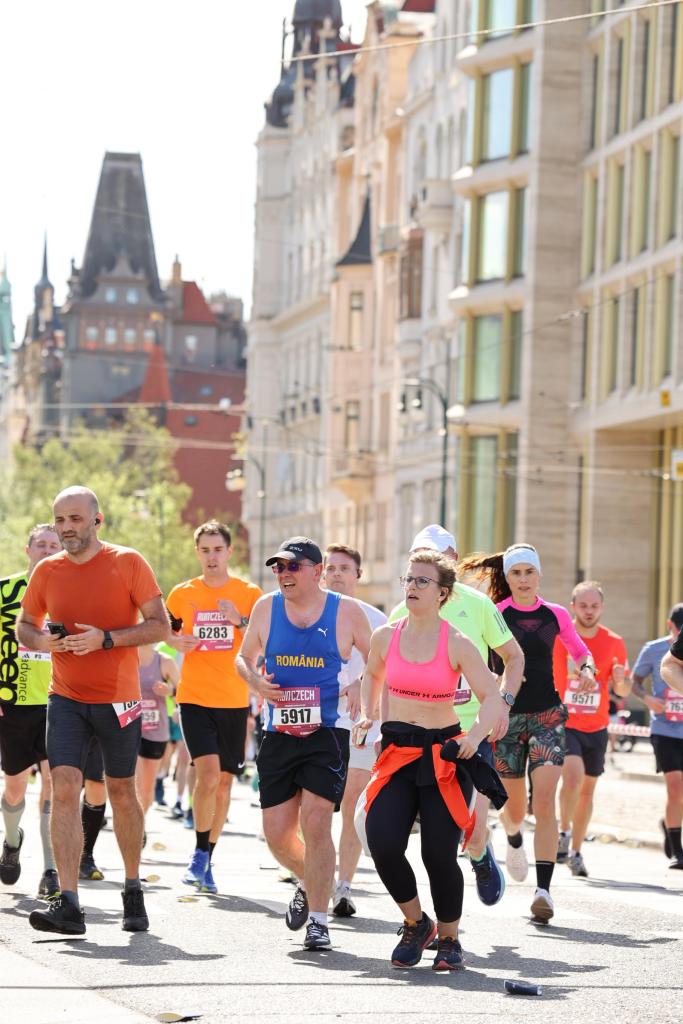
During hot weather, it is essential to choose carefully how you dress

My race went okay in these circumstances, as I know how to run safely in hot weather. If you want to survive a race in hot weather, you need to do a few things: stop and drink water or isotonic at every hydration point, wear a cap, wear a tank top (not a T-shirt), keep the pace in the safe zone, have a couple of gels with you.

I finished at 2:14 without any incident. It was my third-worst time ever, but that did not matter as I checked my third super half race and did not focus on time.

I am very serious about the weather problem while running. In Prague, 102 people fell on the street during the race for different reasons. Of these runners, 36 went to hospital. The authorities declared a trauma plan (a local form of a disaster plan). There was a campaign hospital called Golem at the finish line in a huge tent with air conditioning and ambulances driving people there and into the hospital. I lost the count of fallen runners I saw during this race. It was much worse than in Lisbon. In fact, the sound I heard most during the race was the sound of ambulances. The medical help was very well organized. As a kid in the 80s, I remember watching a Czech serial called “Sanitka” ( The Ambulance) on TV. It was like seeing scenes from those series in Prague that Saturday.

Muj cas

There are many news articles about the problems at the Prague half-marathon, all in the Czech language. I found this post by a Cardiologist, Hanka Štefaničová, who, as a participant, described what happened during the race very well.

What I learned. At the end of the race, there was a problem. The runners who finished had to go on a tight corridor guardrail by fences for 200 meters to get the medals, and then they would get water, bananas, and other refreshments from the organizers. A few volunteers handled medals to racers at the end of these fences. But too many people finished simultaneously, and the queue of racers waiting because of this bottleneck was very long. Imagine the situation: you run under the sun for more than 2 hours, then you have to stop under the sun for 10 minutes or more to wait for the medal. If you get no water, you will collapse.

After getting the medals, some runners understood the gap, took water bottles, and gave them to the people in the queue. I drank 2 such bottles until I got the medal. That saved the other runners and me while waiting in the queue. I know those were ad-hoc volunteers because they all had finishers’ medals on their chests. They were not organizers. At the time, I took the medal and was happy to get the baggage and talk to Bogdan after the race. It didn’t cross my mind to stay and become one of the ad-hoc volunteers to give water to people waiting in the queue. In my mind, I was a participant who finished the race and not an organizer. Sometimes, you need to get out of your role, become human, and do what it takes to help others, even if no one has asked you or is not expecting you to do that.

With Bogdan, after the race. He had a good race in these circumstances, finishing in 1:50

Some statistics are relevant to what happened. For races with many runners, I look at the time of the runner who finished precisely in the middle of all the runners. If the race has 10k finishers, I look at the time of the runner who finished exactly at 5k at the finish. The table below clearly shows how external factors influence race results.

CityDateFinishersMiddle time
Warsaw18.03.2024134221:55:20
Lisbon18.03.2024132472:02:40
Prague06.04.2024135572:03:40
There are considerable differences in time when the weather is hot. The route in Warsaw is more difficult than the other 2. I can say that as I ran all 3 half-marathons (Warsaw in 2022).

I have some suggestions for the organizers. For example, they could give runners bottles of water instead of glasses. The volunteers were overwhelmed and did not have enough time to pour water into glasses to give to runners. At the finish, they could have more people to handle medals. Also, if possible, provide water to people once they finish and don’t let them wait under the sun. Set the check time posts in the farthest areas of the route, where people need to turn around. This is a simple mechanism to avoid cheating.

Despite the problems mentioned above, the organizers did a good job overall. A positive note for the area to leave and pick up baggage: it was the best organized I have ever witnessed. The rest of the nice things are expected for major half-marathons: SMS with your result, pictures after the race, refreshments during and after the race.

As for my plans, I traveled by plane four out of five consecutive weekends in March and April for events covered in this blog. It is time to rest and train before my next half-marathon in Helsinki in May.

Trupa lui Fane’s motto: “Together we are stronger!”

Lisbon half-marathon

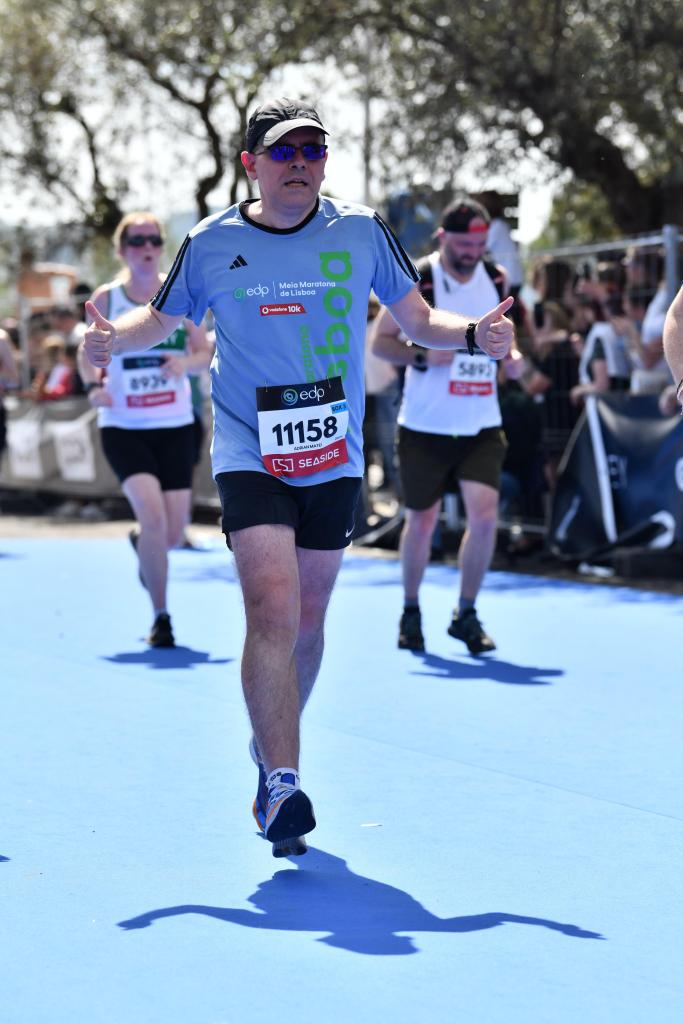
My running season this year began with the Lisbon half-marathon. Lisbon is part of Superhalfs, a series of 6 half-marathons you can complete in five years for an extra medal. Together with Bogdan, we registered for this race for a long time.

I returned to Lisbon after ten years and found the city had changed positively. Many buildings were renovated, the cost of living was good compared to central Europe, and people were very relaxed.
On March 17th, we took a morning train to Pragal station and followed the crowds to the start. The first negative surprise was that the organizers blocked the people from getting to the start line for a long time. The problem was that we had no space for warmup before the race. We stayed only in crowds until we went over the start line. This was the worst organization of a start to a half-marathon I have ever witnessed, and you can see I have some experience.
The run starts from Pragal, on the other side of the Tagus River from Lisbon. First, you cross the April 25th bridge. The Lisbon half-marathon is the only way a pedestrian can cross this impressive bridge. If you are afraid of heights, this might be an interesting challenge.

Then, the runners continue off the bridge in Lisbon. The first 5 km are in general descending which is appropriate for speed. From km 7 until the end, the race is flat on the shore of the Tegus River. The finish is next to Belem Tower in front of the spectacular Jeronimos Monastery.

At the start on the other side of the river Tagus from Lisbon

The second negative surprise was the temperature. That day, the weather went up to 27 degrees Celsius, but the main problem was that with a humidity of 80-90%, you feel the temperature is 35 degrees Celsius. If you don’t hydrate well, you risk not finishing the race. On a positive note, the organizers added ad hoc more hydration points towards the end of the race.

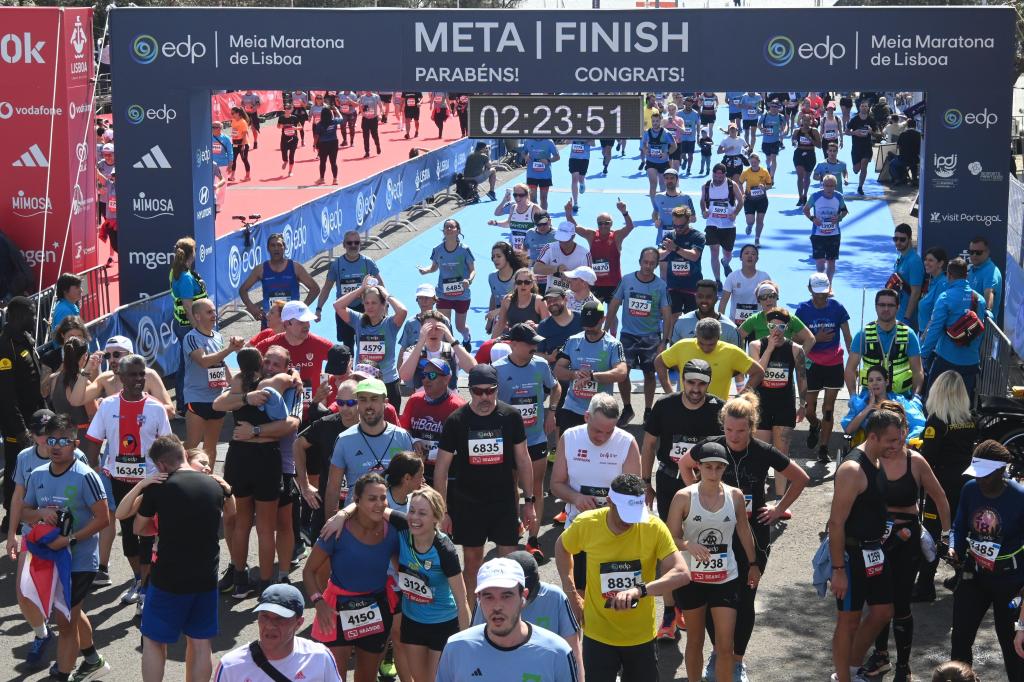
During this race, I saw at least 15 people who had fallen and were taken by ambulance or treated on the spot. This is a negative record. I’ve never seen that many people injured in a race. About 250 people abandoned the race.

At the finish lane

As for me, I wanted to finish in less than 2 hours, and after 9 km, it seemed possible. Unfortunately, at that moment, the third negative surprise happened. As I later found out, I had some food poisoning from the day before, which made me look for a toilet. After solving the problem, I continued the race at around 6’30” pace until the finish line, which I crossed at 2:19. This was my worst time ever in a half-marathon, but I am happy that I finished the race. Even in this challenging situation, I managed to be in the top 10000 from 13200 finishers.

Happy people at the finish

On a positive note, Bogdan had a perfect race in such circumstances, finishing at 1:46:46 ( a time that happens to be my personal best). It was an excellent result for him, being 3062 out of all runners or the top 23%.
All’s well that ends well. Both of us finished the race on time and got medals. Later, I underwent antibiotic treatment, and I was fine.

With Bogdan after the race

Please find some insights for people interested in running this half-marathon in the future. Register at least half a year in advance as the race is quickly sold out. Try to get to the start as early as possible. We arrived at 8:55 ( while the race was scheduled for 10:05), but it needed to be earlier. The organizers created some bottlenecks around the start, and it took a lot of work to get there. The start and finish are not on the same spot, and you can’t bring stuff to leave at the garderobe and pick it back up after the finish. If it is a hot day, please wear a cap. It makes a big difference.

They say that the more challenging the race, the longer you will remember it. This was definitely a race I’ll remember.