Reflections on the SuperHalfs Series: My Experience and Insights

The SuperHalfs program has grown rapidly in popularity. With increasing demand and limited slots available for each race, the organizers have removed the time limit to complete all six events in the series. This move allows more runners to gradually work toward finishing the series over time.

As of May 2025, only 1,113 runners have completed the entire series. This is an impressively small number. Nearly 100,000 people have participated in at least one of the six races. Given these numbers, I thought it might be helpful to share my personal journey and offer some insights for aspiring SuperHalfs finishers.

While you can find the list of finishers on the official SuperHalfs website, gathering deeper data requires some effort. I used ChatGPT to generate code that helped me analyze the number of finishers by country. Here are the results:

CountryNumber of finishers
Spain193
Great Britain185
Germany136
Denmark100
Portugal92
Italy74
Czechia42
France38
Poland28
Netherlands26
Brazil22

The numbers are interesting. Not a surprise that Spain and Great Britain are on top. In Spain people run fast, they have half-marathons with 2.5 hours time limit to finish, while in the rest of Europe is 3 hours. The UK, meanwhile, has a rich running culture and offers wonderfully organized races. I highly recommend racing in the UK for an unforgettable experience. The first 5 countries from the list are also organizing races from series. Italy is the first country that has many finishers but doesn’t have a race in the program. Interesting Brazil is the only non European country that has many finishers.

Before the Berlin Half-Marathon this spring, only about 480 people had completed the series. Berlin added nearly 700 new finishers in one go, largely because it was newly included in the program just last year.

The SuperHalfs calendar includes three spring races—Lisbon, Prague, and Berlin—and three autumn races—Copenhagen, Cardiff, and Valencia. Since 2025, demand has surged, and most events now use a lottery system to allocate entries.

If you’re not lucky in the lottery, there’s an alternative: official travel agencies offer guaranteed race entries. I used one of these agencies—Germany’s Interair—for the Cardiff Half-Marathon when I joined the event late and couldn’t find an open spot. Their service was excellent.

If you are not lucky winning the lottery, you can use one official travel agency. This agency will guarantee your participation in the race. I had used a travel agency only once during my campaign for the Cardiff half-marathon. I decided to join this race too late and there were no available spots. I used the services of the German travel agency Interair and I was very happy with them.

I’ve written posts about my experiences in each of the six races. Here are a few personal impressions:

  • Top Picks: For me, the best races are Valencia and Berlin. Both offer outstanding organization and scenic, fast courses—ideal races to conclude your series on a high note.
  • Cardiff: A very well-organized race with amazing crowd support. However, the course is not flat. It is less ideal if you’re chasing a personal best.
  • Copenhagen: The course is flat, but I had some concerns when I ran it in 2022. The start was chaotic because there were no wave starts. The course became crowded. Pedestrians were crossing in front of runners, especially in the city center. The finish area was also quite congested. Hopefully, these issues have since improved.
  • Lisbon: Be mindful of the weather—it can get hot. The course begins with a downhill section, then transitions into rolling terrain before flattening out from kilometer 7 onward.
  • Prague: My least favorite race. The course includes cobblestone sections in the city center, which can be tough on the legs. Weather can also be unpredictable. A simple way to improve the course would be to extend the riverside sections and avoid the city center altogether. Interestingly, Prague also has the smallest field of runners among the six races.

Here are some highlights of Superhalfs races. Best finish is in Berlin. Valencia has the best atmosphere. It also has the best organization at the start. Cardiff boasts the best public. The best routes are in Valencia and Berlin.

The SuperHalfs program is a fantastic way to combine travel, fitness, and personal achievement. Running a half-marathon isn’t about proving anything to others – it’s a personal journey. And this series makes that journey unforgettable.

If you’re considering joining, act fast. As the series continues to gain traction, getting a spot will only become more challenging.
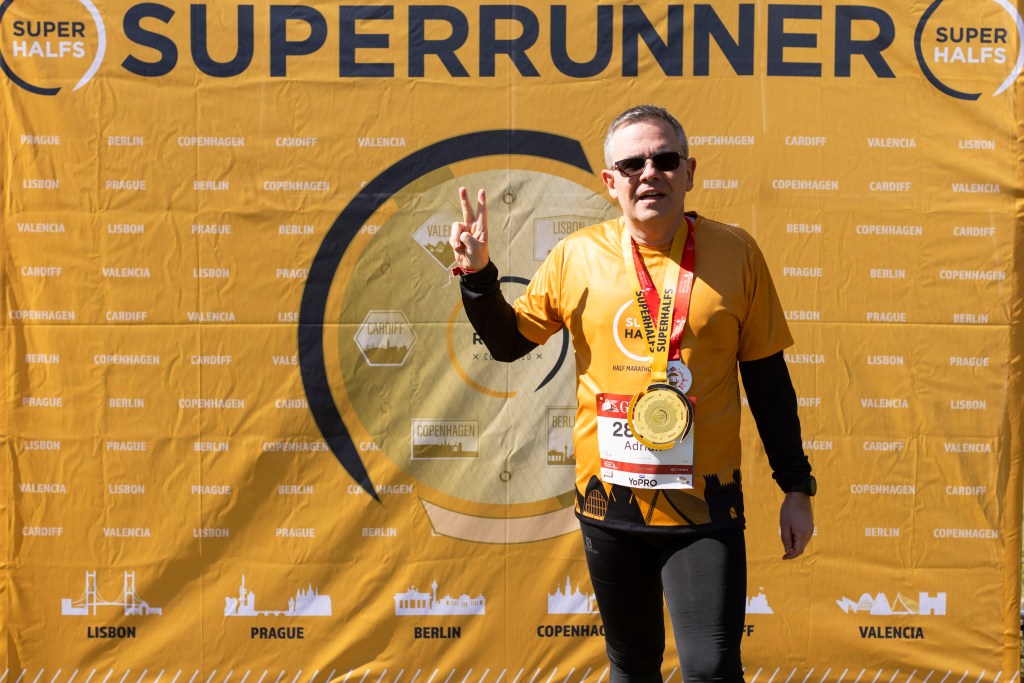
Superhalfs, a mission accomplished

Prague half-marathon

In 2024, Prague set a record for participants, with over 13,500 people at the finish. The previous editions had about 10,000 finishers, so there was a significant increase this year. More importantly, 57% of the participants were foreigners. The fact that the race is part of the SuperHalfs helps increase the number of participants.

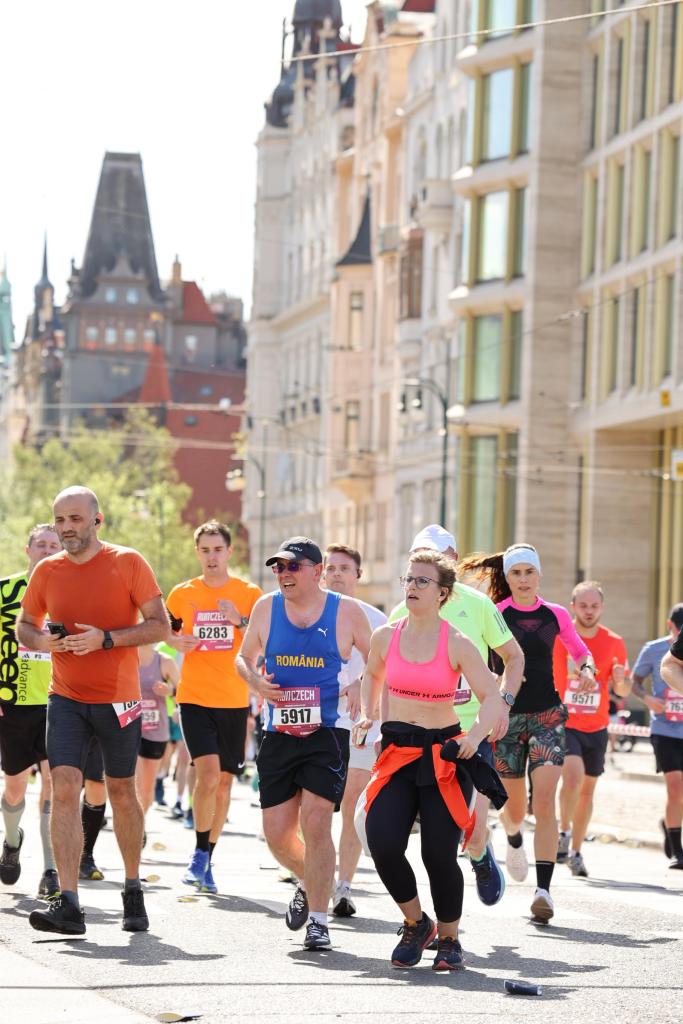
On April 6th, the day of the race, it was hot in Prague. The temperatures reached 28 Celsius, and the sun was shining. These are not the best conditions for running a long distance.

The race route goes along the Vltava River and crosses five bridges between both sides of Prague. It continues in the old center through Venceslas Square and next to the famous astronomical clock. I am not a big fan of running on cobblestone. I prefer running on asphalt and visiting tourist attractions slowly and not during a run. The finish was in the same place as the start in Bubenské nábř. area.

During hot weather, it is essential to choose carefully how you dress

My race went okay in these circumstances, as I know how to run safely in hot weather. If you want to survive a race in hot weather, you need to do a few things: stop and drink water or isotonic at every hydration point, wear a cap, wear a tank top (not a T-shirt), keep the pace in the safe zone, have a couple of gels with you.

I finished at 2:14 without any incident. It was my third-worst time ever, but that did not matter as I checked my third super half race and did not focus on time.

I am very serious about the weather problem while running. In Prague, 102 people fell on the street during the race for different reasons. Of these runners, 36 went to hospital. The authorities declared a trauma plan (a local form of a disaster plan). There was a campaign hospital called Golem at the finish line in a huge tent with air conditioning and ambulances driving people there and into the hospital. I lost the count of fallen runners I saw during this race. It was much worse than in Lisbon. In fact, the sound I heard most during the race was the sound of ambulances. The medical help was very well organized. As a kid in the 80s, I remember watching a Czech serial called “Sanitka” ( The Ambulance) on TV. It was like seeing scenes from those series in Prague that Saturday.

Muj cas

There are many news articles about the problems at the Prague half-marathon, all in the Czech language. I found this post by a Cardiologist, Hanka Štefaničová, who, as a participant, described what happened during the race very well.

What I learned. At the end of the race, there was a problem. The runners who finished had to go on a tight corridor guardrail by fences for 200 meters to get the medals, and then they would get water, bananas, and other refreshments from the organizers. A few volunteers handled medals to racers at the end of these fences. But too many people finished simultaneously, and the queue of racers waiting because of this bottleneck was very long. Imagine the situation: you run under the sun for more than 2 hours, then you have to stop under the sun for 10 minutes or more to wait for the medal. If you get no water, you will collapse.

After getting the medals, some runners understood the gap, took water bottles, and gave them to the people in the queue. I drank 2 such bottles until I got the medal. That saved the other runners and me while waiting in the queue. I know those were ad-hoc volunteers because they all had finishers’ medals on their chests. They were not organizers. At the time, I took the medal and was happy to get the baggage and talk to Bogdan after the race. It didn’t cross my mind to stay and become one of the ad-hoc volunteers to give water to people waiting in the queue. In my mind, I was a participant who finished the race and not an organizer. Sometimes, you need to get out of your role, become human, and do what it takes to help others, even if no one has asked you or is not expecting you to do that.

With Bogdan, after the race. He had a good race in these circumstances, finishing in 1:50

Some statistics are relevant to what happened. For races with many runners, I look at the time of the runner who finished precisely in the middle of all the runners. If the race has 10k finishers, I look at the time of the runner who finished exactly at 5k at the finish. The table below clearly shows how external factors influence race results.

CityDateFinishersMiddle time
Warsaw18.03.2024134221:55:20
Lisbon18.03.2024132472:02:40
Prague06.04.2024135572:03:40
There are considerable differences in time when the weather is hot. The route in Warsaw is more difficult than the other 2. I can say that as I ran all 3 half-marathons (Warsaw in 2022).

I have some suggestions for the organizers. For example, they could give runners bottles of water instead of glasses. The volunteers were overwhelmed and did not have enough time to pour water into glasses to give to runners. At the finish, they could have more people to handle medals. Also, if possible, provide water to people once they finish and don’t let them wait under the sun. Set the check time posts in the farthest areas of the route, where people need to turn around. This is a simple mechanism to avoid cheating.

Despite the problems mentioned above, the organizers did a good job overall. A positive note for the area to leave and pick up baggage: it was the best organized I have ever witnessed. The rest of the nice things are expected for major half-marathons: SMS with your result, pictures after the race, refreshments during and after the race.

As for my plans, I traveled by plane four out of five consecutive weekends in March and April for events covered in this blog. It is time to rest and train before my next half-marathon in Helsinki in May.

Trupa lui Fane’s motto: “Together we are stronger!”

Kafka

At the time of my registration for the Prague Chess Festival there was no option of accommodation at Hotel Don Giovanni, the playing venue. I made a reservation at Hotel Villa, 700 meters walk from Hotel Don Giovanni. Looking on Google Maps I noticed that my itinerary from the chess tournament place to the hotel where I would stay passed by Franz Kafka’s grave in the nearby Jewish cemetery. I started to read about Kafka and discovered that when he died of tuberculosis in 1924, he had the exact age I have now, 40 years and 11 months. This was a coincidence that further increased my curiosity on his life and work.

The cemetery had a fence but near Kafka’s grave there was a gate. This picture is taken from the street and is the image I ‘ve seen every day and night when I passed by his grave

The chess tournament playing venue seen from Kafka’s grave

If I count the times I went by Franz Kafka’s grave, in the 10 days I stayed in Prague, including two 12km runs around the graveyards, I am sure that I’ve never seen someone’s grave for so many times in my life. I guess it sounds quite Kafkaesque: in Prague, for ten nights a chess player passed by Kafka’s grave after each chess game. The only funny event was that one night a hare showed up in front of me at the cemetery corner then quickly disappeared on an alley. I’ve tried without success to find out if it’s common to meet hares in Prague other than on restaurants menu’s.

Kafka was born in a mid-class Jewish family in Prague in 1883. His father was authoritative and had a negative influence on his son who was shy and introvert. The writer’s drama came from the fact that he was never able to separate emotionally from his parents. However, he moved alone for the first time when he was 31 years old.

During the World War I, Kafka stayed for a while in this small house on Golden Line street behind the Prague Castle. You can buy a ticket to visit this street with a very interesting history

His entire creation and life were influenced by the relation he had with his father. When the father expressed his opposition to his son’s marriage in 1919, Kafka wrote a 45 page letter to his father expressing his frustrations and the emotional abuse he suffered as a child. It seems that the letter did not reach to his father. Unfortunately for him, Franz Kafka was not able to break free from this relation. His sister Ottla, for example, did marry a year later despite her father’s opposition.

A moving head of Kafka created by David Cerny. It might symbolize the metamorphoses of the author and the haunting thoughts that were running through his head.

For those interested, I recommend the visit to Kafka’s museum in Prague. It is a museum created in the spirit of his work. There I was moved when I saw his last letter addressed to his parents one day before he died. He was very weakened and did not have the energy to end that letter which was completed by his girlfriend Dora Diamant.

In my opinion, a very important idea from Kafka’s writings is that we create our own inner universe and it is up to us with what emotions we fill that world. Seneca said it better: “a man is as miserable as he thinks he is”.

Anthropoid

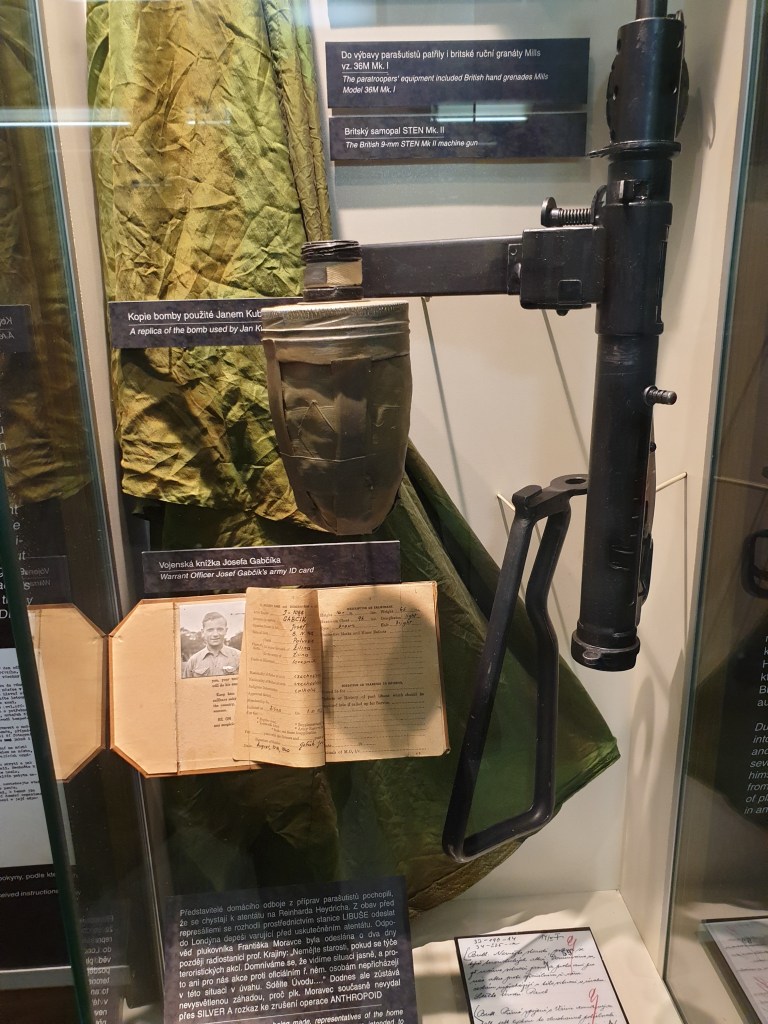
Visiting the Heydrich Terror Memorial in Prague had a deep impact on me. “Anthropoid” was the code name for the assassination of Reinhard Heydrich the Reich Protector of Bohemia and Moravia in May 1942 by soldiers of the Czechoslovak army in exile. I knew the details of the operation before I came to Prague, but being in the crypt where the last showdown took place was a profound experience.

In the morning of May 27th, 1942, Heydrich was heading by car towards Prague Castle, his office. He had no personal guards and was alone with his driver. When the car slowed down in a street hairpin turn, Jozef Gabčík went in front of it and tried to shoot the Nazi leader with his machine gun but the weapon jammed. Heydrich asked the driver to stop the car and chase Gabčík. This gave time for Jan Kubiš to throw the modified hand grenade at the open roof car. Although the grenade exploded outside the car, shrapnel went through the door into Heydrich’s body wounding him. The attackers managed to run from the scene without being caught. Heydrich died from the infected wounds in a hospital eight days later.

German’s reprisals were very violent. It is estimated that 5000 Czechs were killed to revenge this assassinate. Thousands of people were arrested. Gestapo falsely thought that Lidice was the hiding place of the attackers so the Germans did a massacre in that village. A bounty of 1 million Reichsmarks was announced for information leading to the capture of the soldiers who killed Heydrich. No matter how many threats and how many people were shot for three weeks nobody revealed anything to the Germans. But on June 16th a Czech paratrooper who was separated from the main group came to the Gestapo office and gave them all the information he had on the Anthropoid operation and the families helping the soldiers. Once their mission was done, the Czech soldiers hid in the “Saints Cyril and Methodius” Orthodox church in Prague together with five other paratroopers who were sent from England with different missions in Czechoslovakia. In the morning of June 18th, 750 SS soldiers surrounded the church and did everything they could to capture the Czechs alive. The battle took six hours. The men inside the church fought to the last bullet which they used to commit suicide. Three of them died in the church chorus and the other four in the crypt below the altar. The traitor was judged by the Czechoslovak authorities after the war in 1947 and he was hanged.

What impressed me was the fact that the soldiers fought in the church until the end, even if they knew there was no other chance of survival than surrender. While three of them were fighting in the chorus the other four were digging for a way out of the crypt.
By their choice to fight until the end and exit from life only when there was nothing left they sent a very strong message. It was a message of courage and determination that still inspires people after all this time.

There was one more thing that had a deep impact on me. In the museum, there are many pictures of people who helped the paratroopers hid during their six months stay in Prague. All of them knew that when the Germans will find out about their collaboration with the exile army they will be shot together with their families. It was not a question if this will happen but when. They knew this meant their death and the death of loved ones and yet they helped the soldiers. However, once the killing attempt happened in May, for three weeks nobody said anything to Gestapo, despite threats and executions. Once the traitor talked, the Germans took care to torture and execute all the civilians involved as well as their families. Most of them were shot in October of the same year. By their sacrifice, they sent a message to posterity that humans should fight for what they think is right even when this means to pay the highest price.

The facts are that Heydrich was killed and around 5000 Czechoslovaks were executed as reprisals. Was this worth it?

Heydrich was a main architect of the Holocaust. He was in command of the units that committed killings behind the front lines and he was a very effective leader. He wanted to Germanize the Czechs while acting as Reich Protector in Bohemia and Moravia. If he would have lived longer I am sure that his units would have killed much more people than they did after his death. The Anthropoid operation was an important milestone in the Czechoslovak fight for liberation and showed that they weren’t willing to accept Germanization.

For those who want to read more about Anthropoid I recommend an interesting article which clarified many of the questions I had.

Prague Spring

It was a cold weather during the 10 days I spent in Prague at the beginning of March. Such a major difference to the sunny Rochefort that I visited in February. For the tourists interested in city attractions there are many articles on what to visit in the Czech capital so I won’t talk about that. I will cover only the out of the box things. I appreciate the sense of humor of the Czech people although it’s quite different from the Romanian’s sense of humor.

Let’s start with the history first. In the Wenceslas square there is an imposing statue of the former Duke of Bohemia from the tenth century – Wenceslaus I. A few hundred meters from this place, in the Lucerne passage, there is another representation of the same ruler only that this time is riding on a dead horse. This statue is the creation of the sculptor David Černý.

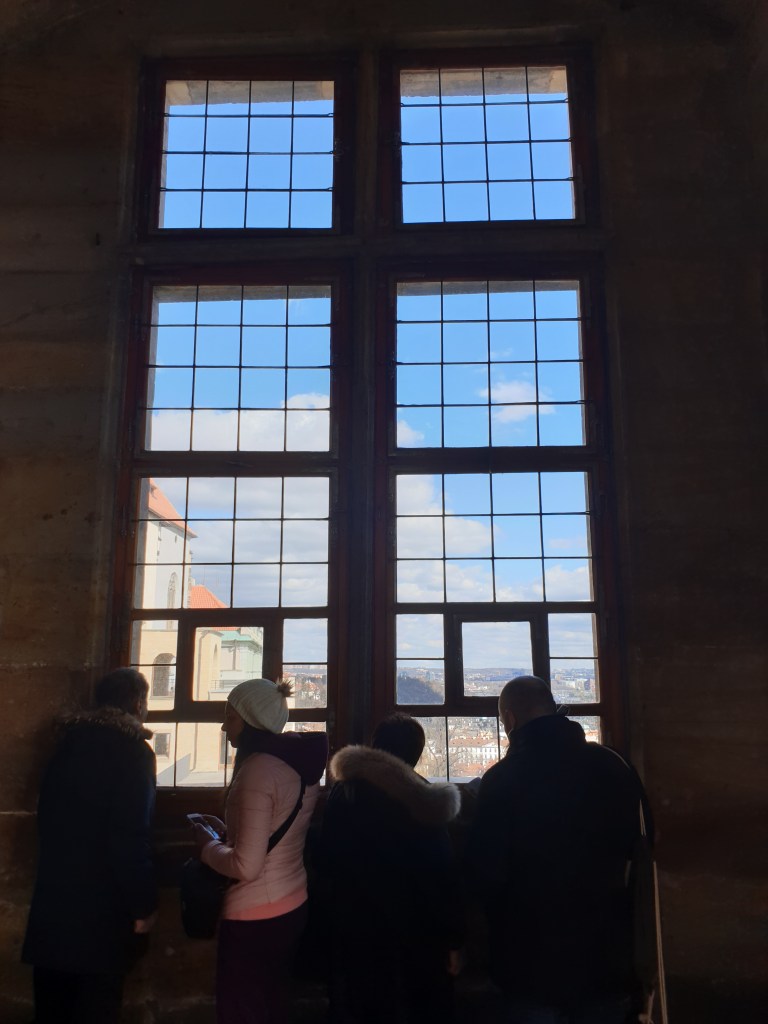
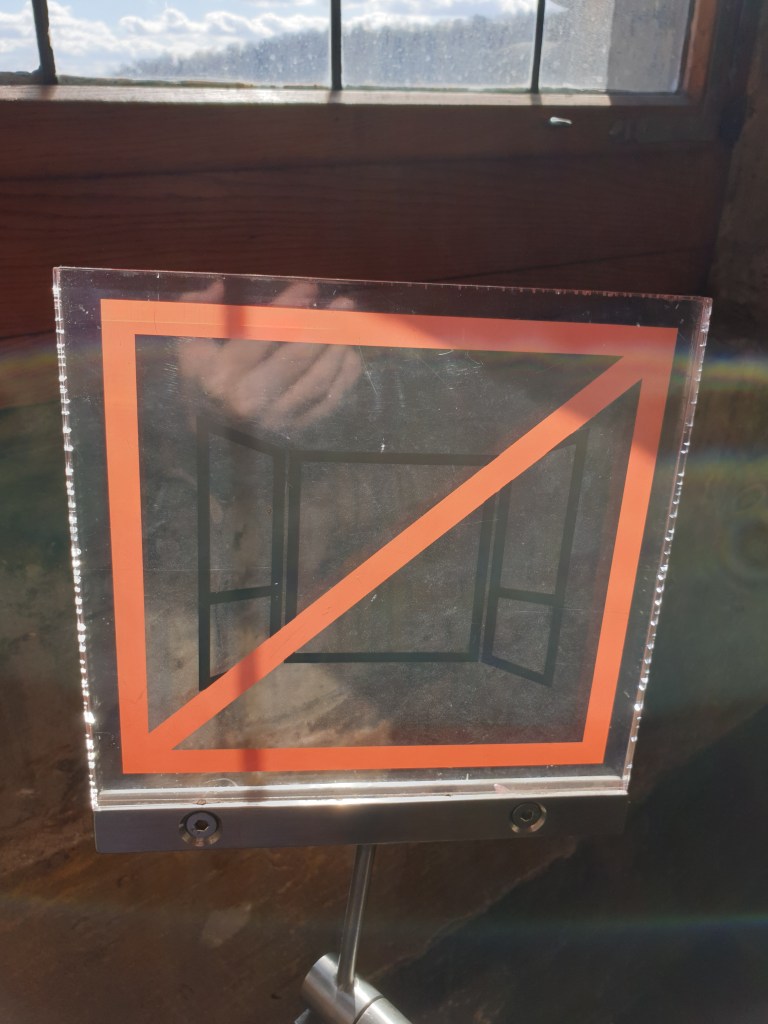
The next stop is the Prague castle, the biggest castle in Europe. There is a famous window the scene of the Defenestration of Prague in 1618. This led to the Thirty Years’ War in our continent. It was a tragic event, but it was somewhat funny to see next to that window a note that asked the visitors not to open the window. Last time that window was opened a war that lasted for thirty years ravaged Europe. We should better keep that window closed. As a side note, although the distance from that window to the ground is 21 meters all the three people thrown out of the window in 1618 survived the impact. This was considered a miracle at the time.

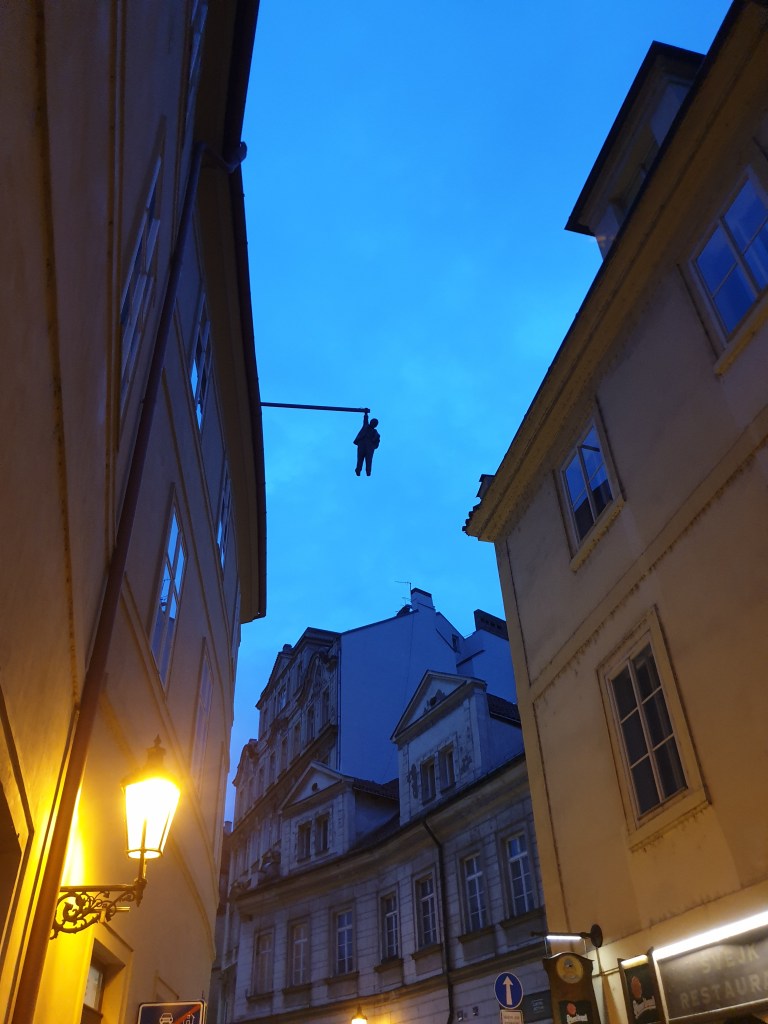
Let’s return to more modern times. Below are two similar sculptures. While I don’t know where the man with an umbrella in the first picture was heading to, the second man is the creation of David Černý mentioned above. It is a statue of Sigmund Freud attached with one hand to a flagpole. It is an inner struggle for Freud whether he should let it go or not.

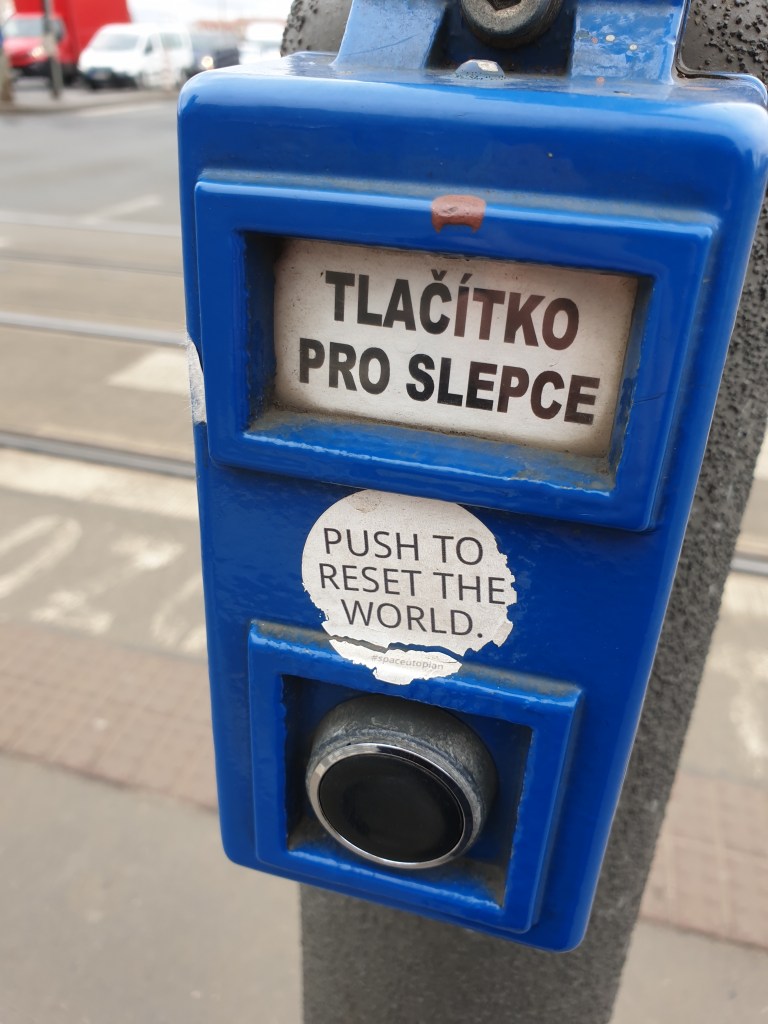
In recent times, in 1996, they built a dancing house in Prague nicknamed “Ginger and Fred”, which can be seen as a modern symbol of an old city. Near the house, I saw the text in the second picture at a traffic light pole and I … did push the button.

These were a few things that caught my eye, amused me and made me think during my visit to Prague. I invite you to search for other out of the box cultural elements in Prague. This way you will understand more of the Czech spirit and way of thinking.