Prague half-marathon

In 2024, Prague set a record for participants, with over 13,500 people at the finish. The previous editions had about 10,000 finishers, so there was a significant increase this year. More importantly, 57% of the participants were foreigners. The fact that the race is part of the SuperHalfs helps increase the number of participants.

On April 6th, the day of the race, it was hot in Prague. The temperatures reached 28 Celsius, and the sun was shining. These are not the best conditions for running a long distance.

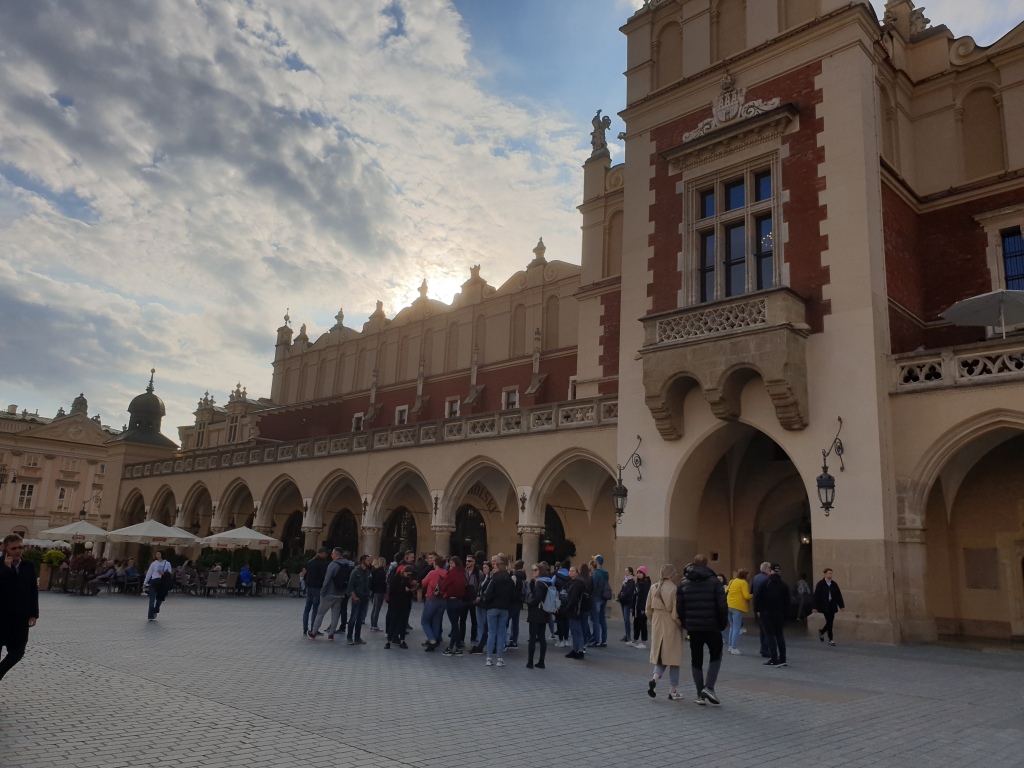
The race route goes along the Vltava River and crosses five bridges between both sides of Prague. It continues in the old center through Venceslas Square and next to the famous astronomical clock. I am not a big fan of running on cobblestone. I prefer running on asphalt and visiting tourist attractions slowly and not during a run. The finish was in the same place as the start in Bubenské nábř. area.

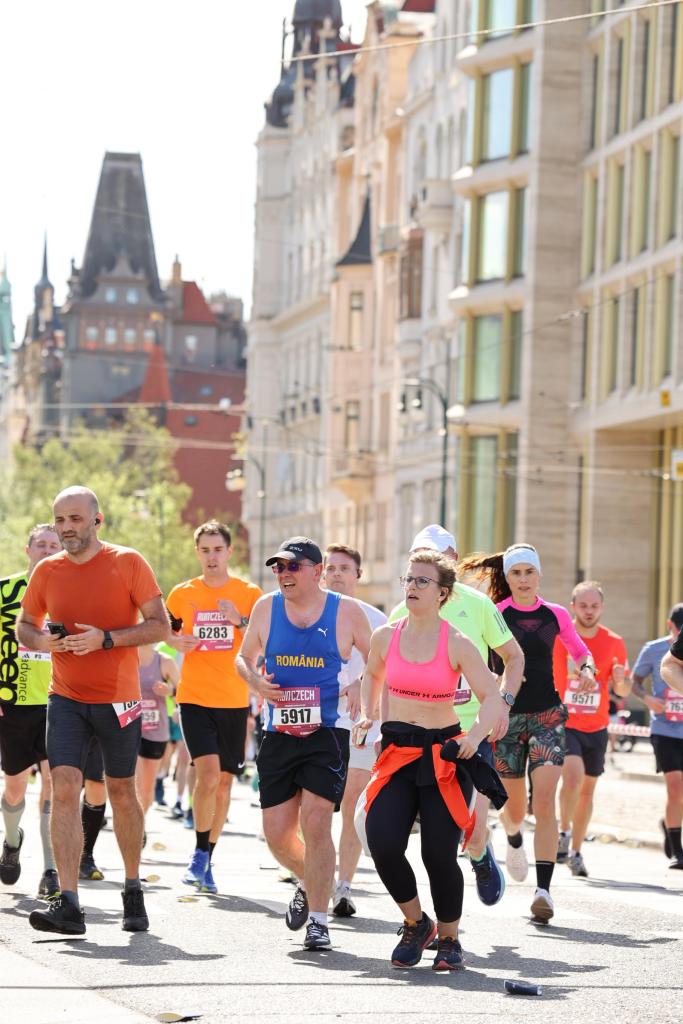
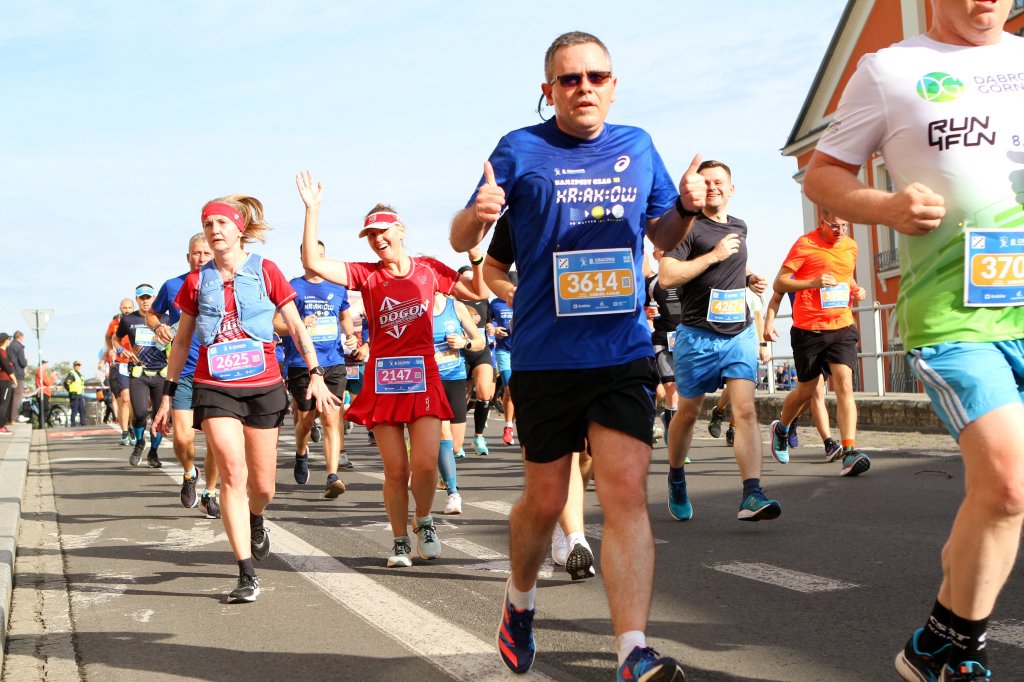
During hot weather, it is essential to choose carefully how you dress

My race went okay in these circumstances, as I know how to run safely in hot weather. If you want to survive a race in hot weather, you need to do a few things: stop and drink water or isotonic at every hydration point, wear a cap, wear a tank top (not a T-shirt), keep the pace in the safe zone, have a couple of gels with you.

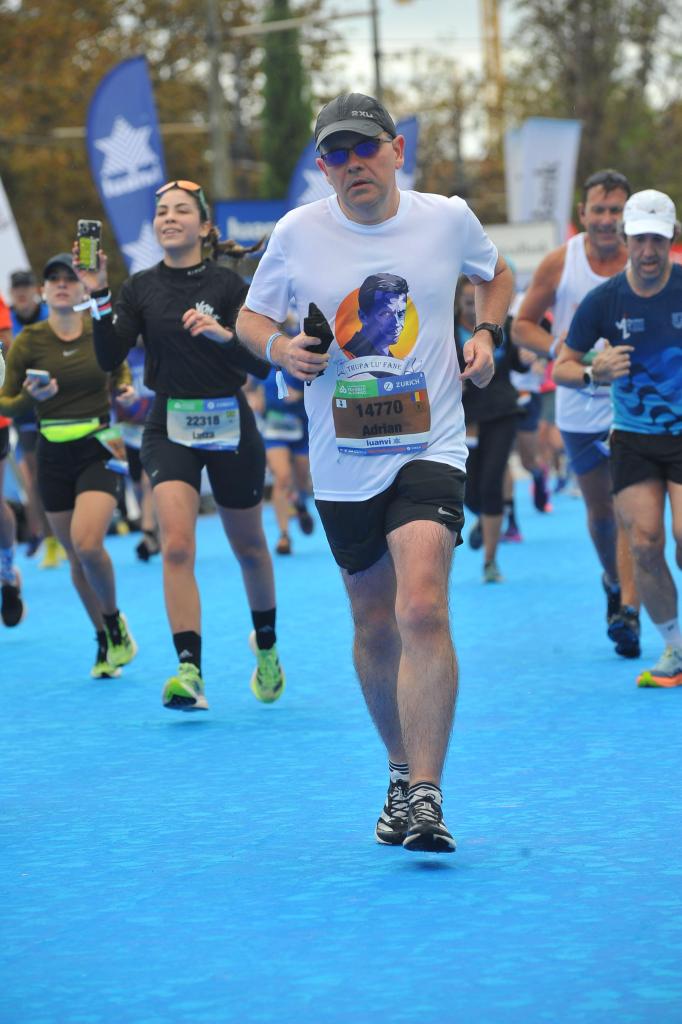
I finished at 2:14 without any incident. It was my third-worst time ever, but that did not matter as I checked my third super half race and did not focus on time.

I am very serious about the weather problem while running. In Prague, 102 people fell on the street during the race for different reasons. Of these runners, 36 went to hospital. The authorities declared a trauma plan (a local form of a disaster plan). There was a campaign hospital called Golem at the finish line in a huge tent with air conditioning and ambulances driving people there and into the hospital. I lost the count of fallen runners I saw during this race. It was much worse than in Lisbon. In fact, the sound I heard most during the race was the sound of ambulances. The medical help was very well organized. As a kid in the 80s, I remember watching a Czech serial called “Sanitka” ( The Ambulance) on TV. It was like seeing scenes from those series in Prague that Saturday.

Muj cas

There are many news articles about the problems at the Prague half-marathon, all in the Czech language. I found this post by a Cardiologist, Hanka Štefaničová, who, as a participant, described what happened during the race very well.

What I learned. At the end of the race, there was a problem. The runners who finished had to go on a tight corridor guardrail by fences for 200 meters to get the medals, and then they would get water, bananas, and other refreshments from the organizers. A few volunteers handled medals to racers at the end of these fences. But too many people finished simultaneously, and the queue of racers waiting because of this bottleneck was very long. Imagine the situation: you run under the sun for more than 2 hours, then you have to stop under the sun for 10 minutes or more to wait for the medal. If you get no water, you will collapse.

After getting the medals, some runners understood the gap, took water bottles, and gave them to the people in the queue. I drank 2 such bottles until I got the medal. That saved the other runners and me while waiting in the queue. I know those were ad-hoc volunteers because they all had finishers’ medals on their chests. They were not organizers. At the time, I took the medal and was happy to get the baggage and talk to Bogdan after the race. It didn’t cross my mind to stay and become one of the ad-hoc volunteers to give water to people waiting in the queue. In my mind, I was a participant who finished the race and not an organizer. Sometimes, you need to get out of your role, become human, and do what it takes to help others, even if no one has asked you or is not expecting you to do that.

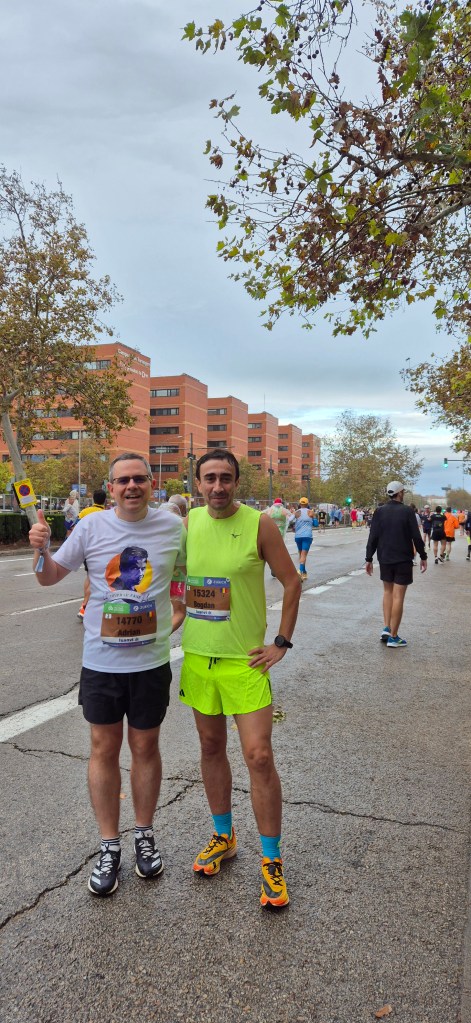
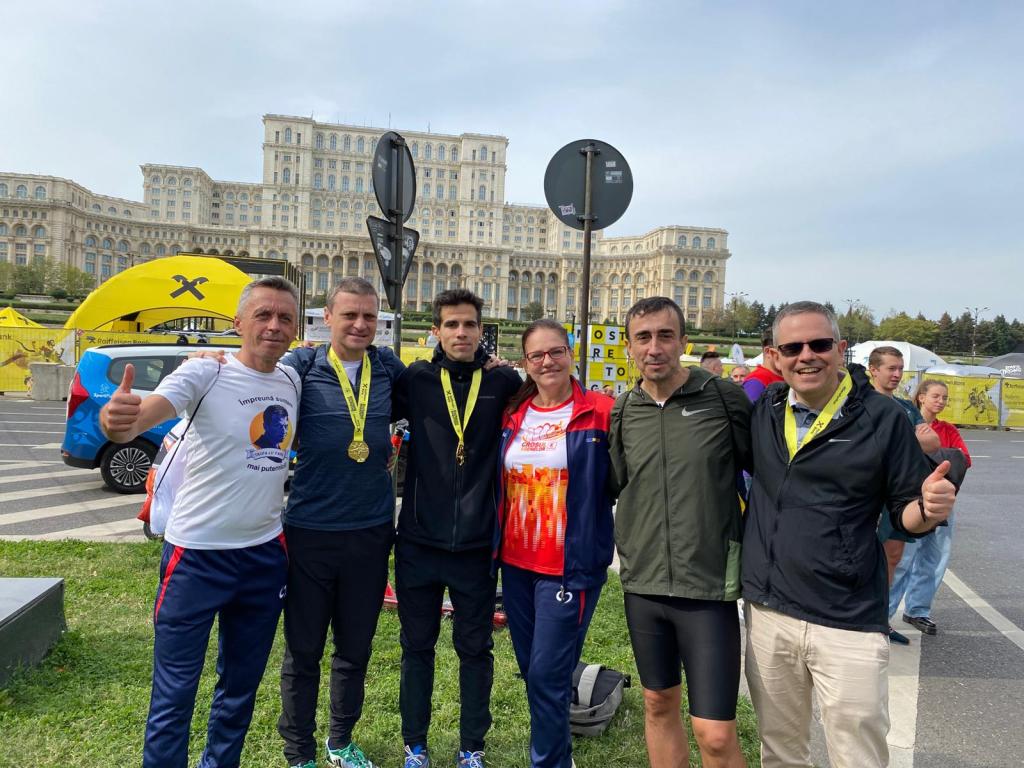
With Bogdan, after the race. He had a good race in these circumstances, finishing in 1:50

Some statistics are relevant to what happened. For races with many runners, I look at the time of the runner who finished precisely in the middle of all the runners. If the race has 10k finishers, I look at the time of the runner who finished exactly at 5k at the finish. The table below clearly shows how external factors influence race results.

CityDateFinishersMiddle time
Warsaw18.03.2024134221:55:20
Lisbon18.03.2024132472:02:40
Prague06.04.2024135572:03:40
There are considerable differences in time when the weather is hot. The route in Warsaw is more difficult than the other 2. I can say that as I ran all 3 half-marathons (Warsaw in 2022).

I have some suggestions for the organizers. For example, they could give runners bottles of water instead of glasses. The volunteers were overwhelmed and did not have enough time to pour water into glasses to give to runners. At the finish, they could have more people to handle medals. Also, if possible, provide water to people once they finish and don’t let them wait under the sun. Set the check time posts in the farthest areas of the route, where people need to turn around. This is a simple mechanism to avoid cheating.

Despite the problems mentioned above, the organizers did a good job overall. A positive note for the area to leave and pick up baggage: it was the best organized I have ever witnessed. The rest of the nice things are expected for major half-marathons: SMS with your result, pictures after the race, refreshments during and after the race.

As for my plans, I traveled by plane four out of five consecutive weekends in March and April for events covered in this blog. It is time to rest and train before my next half-marathon in Helsinki in May.

Trupa lui Fane’s motto: “Together we are stronger!”

Lisbon half-marathon

My running season this year began with the Lisbon half-marathon. Lisbon is part of Superhalfs, a series of 6 half-marathons you can complete in five years for an extra medal. Together with Bogdan, we registered for this race for a long time.

I returned to Lisbon after ten years and found the city had changed positively. Many buildings were renovated, the cost of living was good compared to central Europe, and people were very relaxed.
On March 17th, we took a morning train to Pragal station and followed the crowds to the start. The first negative surprise was that the organizers blocked the people from getting to the start line for a long time. The problem was that we had no space for warmup before the race. We stayed only in crowds until we went over the start line. This was the worst organization of a start to a half-marathon I have ever witnessed, and you can see I have some experience.
The run starts from Pragal, on the other side of the Tagus River from Lisbon. First, you cross the April 25th bridge. The Lisbon half-marathon is the only way a pedestrian can cross this impressive bridge. If you are afraid of heights, this might be an interesting challenge.

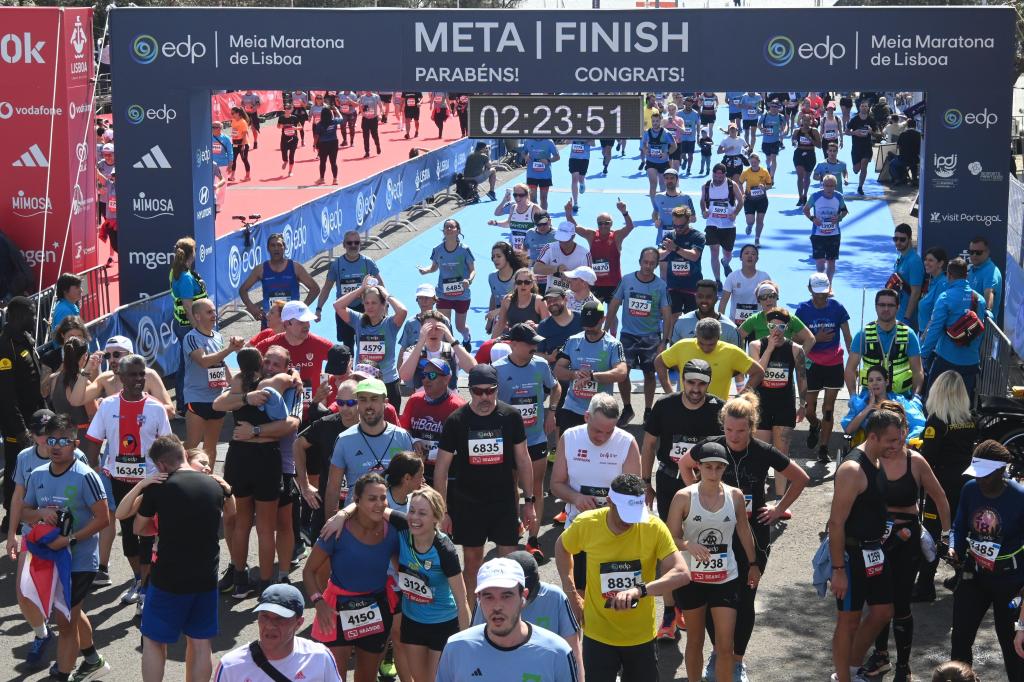
Then, the runners continue off the bridge in Lisbon. The first 5 km are in general descending which is appropriate for speed. From km 7 until the end, the race is flat on the shore of the Tegus River. The finish is next to Belem Tower in front of the spectacular Jeronimos Monastery.

At the start on the other side of the river Tagus from Lisbon

The second negative surprise was the temperature. That day, the weather went up to 27 degrees Celsius, but the main problem was that with a humidity of 80-90%, you feel the temperature is 35 degrees Celsius. If you don’t hydrate well, you risk not finishing the race. On a positive note, the organizers added ad hoc more hydration points towards the end of the race.

During this race, I saw at least 15 people who had fallen and were taken by ambulance or treated on the spot. This is a negative record. I’ve never seen that many people injured in a race. About 250 people abandoned the race.

At the finish lane

As for me, I wanted to finish in less than 2 hours, and after 9 km, it seemed possible. Unfortunately, at that moment, the third negative surprise happened. As I later found out, I had some food poisoning from the day before, which made me look for a toilet. After solving the problem, I continued the race at around 6’30” pace until the finish line, which I crossed at 2:19. This was my worst time ever in a half-marathon, but I am happy that I finished the race. Even in this challenging situation, I managed to be in the top 10000 from 13200 finishers.

Happy people at the finish

On a positive note, Bogdan had a perfect race in such circumstances, finishing at 1:46:46 ( a time that happens to be my personal best). It was an excellent result for him, being 3062 out of all runners or the top 23%.
All’s well that ends well. Both of us finished the race on time and got medals. Later, I underwent antibiotic treatment, and I was fine.

With Bogdan after the race

Please find some insights for people interested in running this half-marathon in the future. Register at least half a year in advance as the race is quickly sold out. Try to get to the start as early as possible. We arrived at 8:55 ( while the race was scheduled for 10:05), but it needed to be earlier. The organizers created some bottlenecks around the start, and it took a lot of work to get there. The start and finish are not on the same spot, and you can’t bring stuff to leave at the garderobe and pick it back up after the finish. If it is a hot day, please wear a cap. It makes a big difference.

They say that the more challenging the race, the longer you will remember it. This was definitely a race I’ll remember.

10000 km run in 8 years

I started running in 2015. After 8 years, I recently crossed a distance of 10k km running. I am happy with my motivation to continue running for 8 years at an average of 2 miles (3.2 km)/day. The 10k km is not a long distance for 8 years. People who want performance in running should aim for at least twice as much as I did. A professional runner covers a distance four times longer than I did within the same time, so 10k km in just two years!

Statistics say I ran, on average, over 100 km each month. The total time spent on running is 41 days, or 1.5% of 8 years. It was the best time invested in one activity as it gave me much health in return. My average pace was 5’52” per km. I ran alone for 6 out of the 8 years.

Of great help for me was running with the running group “Trupa lui Fane”. Although I moved to Krakow in 2020, we continued the collaboration remotely all these years. Many thanks to Stefan Oprina and “Trupa lui Fane” members for their support!

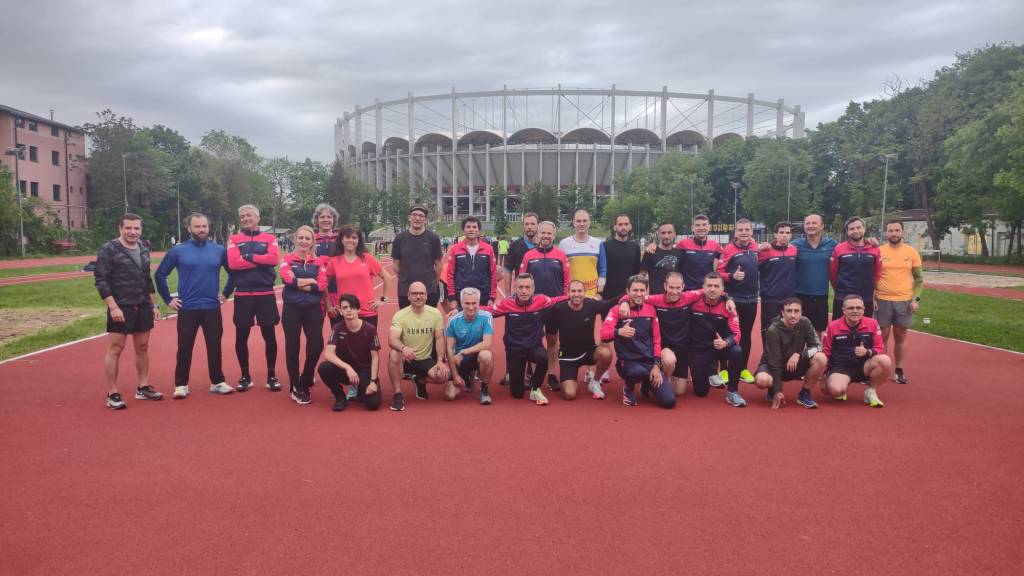
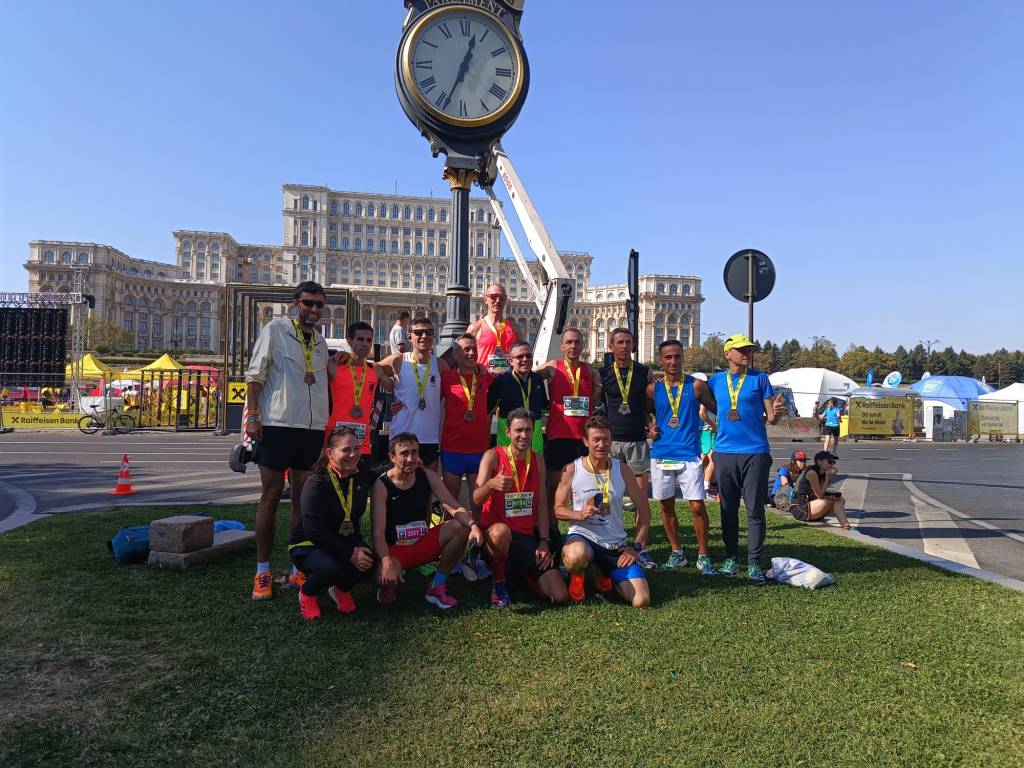
With “Trupa lui Fane” in May 2023

I crossed the 10k km mark at the last training before running the half-marathon in Bucharest. This way, the first and the last of the 10k km were run in the same stadium (the one in the picture above).

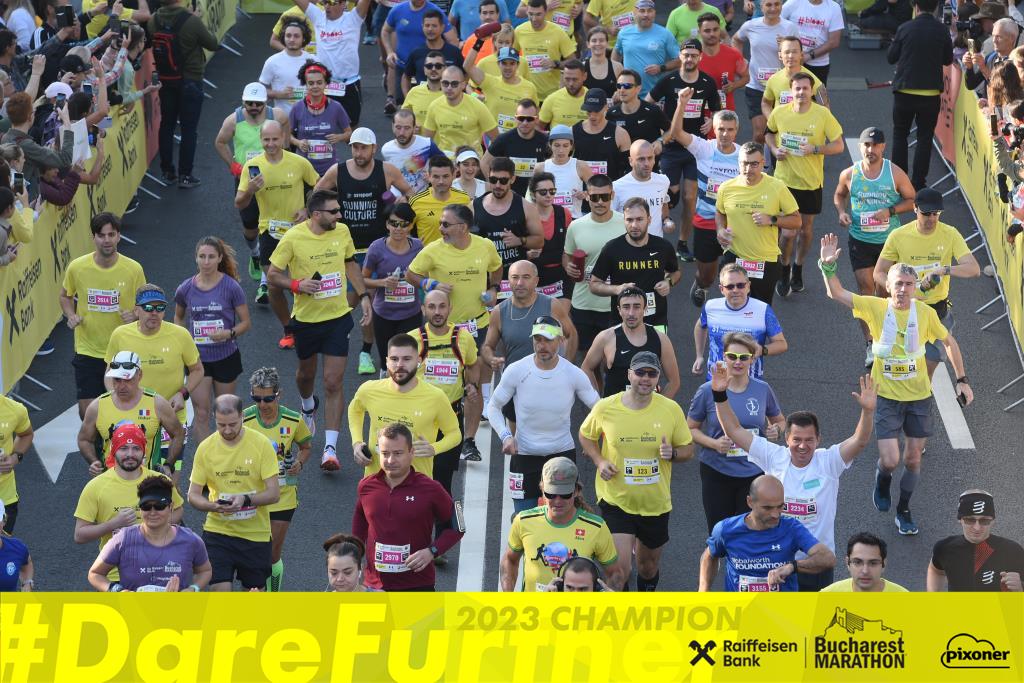
My first half-marathon was 8 years ago at Bucharest MIB. As mentioned in a previous post, to celebrate this distance milestone, I chose to run this year’s edition of the same half-marathon in Bucharest on October 15th. I participated in 6 of the last 8 editions of MIB.

With Bobo at the start. He finished 12 minutes ahead of me. Great run!

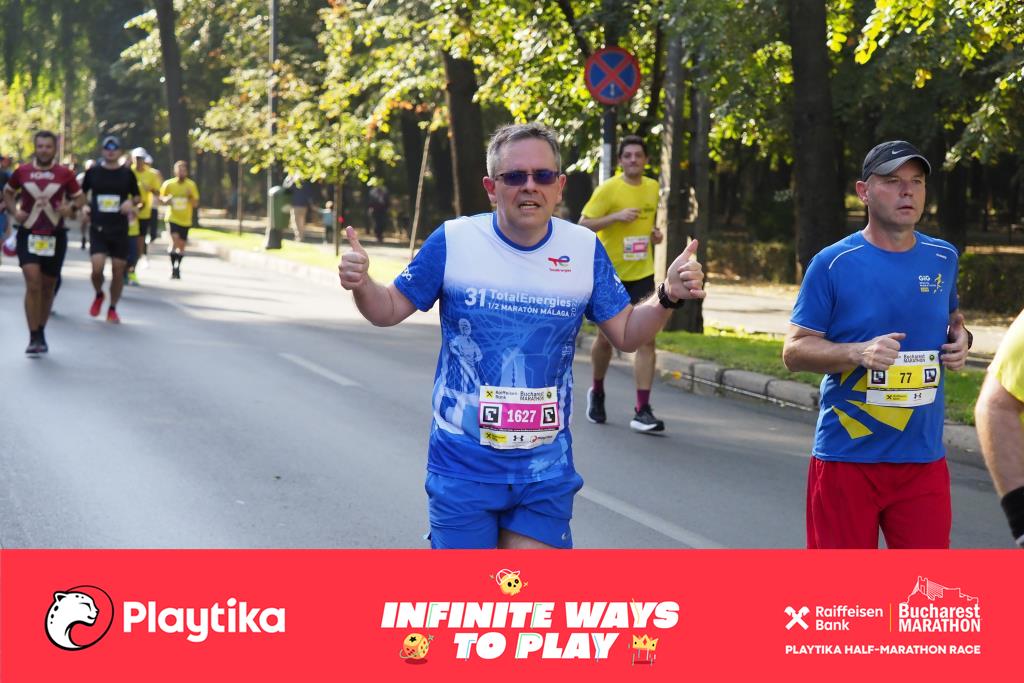
The organization for this event was amazing, as usual. Music bands, water and isotonic, pacemakers, and many volunteers make it a great event. The only thing I would like to see improved is the opportunity for runners to buy their photos at a good resolution and without a watermark. The pictures are free now but with a watermark, as shown above and below.

I wasn’t in good shape for this half-marathon, but I know my limits well. It was also hot that day, not ideal for running.

About the half of a half-marathon

I kept my pace around 5’30” for most of the race, with the last 2 km being the most difficult, and ran harder for the final straight line. My official time was 1:57:40.

I met many people I knew before or during the half-marathon. This was cool and makes MIB my favorite race. You get in line with someone you know, exchange a few words, and continue the race. Precisely like in life, only at a different pace.

Crossing the finish line

I registered for 3 half-marathons in the spring 2024 to celebrate this achievement. Lisbon on March 10th, Prague on April 6th, and Helsinki on May 11th. Lisbon and Prague are part of the “super halves”, while Helsinki has a unique story. Superhalfs are a series of 6 essential half-marathons in Europe. You get an additional medal if you finish all 6 in 5 years or less.

Celebrating with colleagues after the finish

Running shaped my personality and helped me deal with many things in life. I met great people while running. It is a walk of life that you can do at a slower or faster pace, how you like it. During the first years, it was hard to motivate myself to go outside in cold weather and run. I had no coach at the time and did everything alone. Today, I am happy I chose to continue running those days despite the hardships.

I had no talent for running and no experience before I started to run. It is never too late to change your life and run, even if this is not your strength. If I could do it, everyone can.

“I’m learning to fly, but I ain’t got wings.” – I saw running as a way to learn to fly.

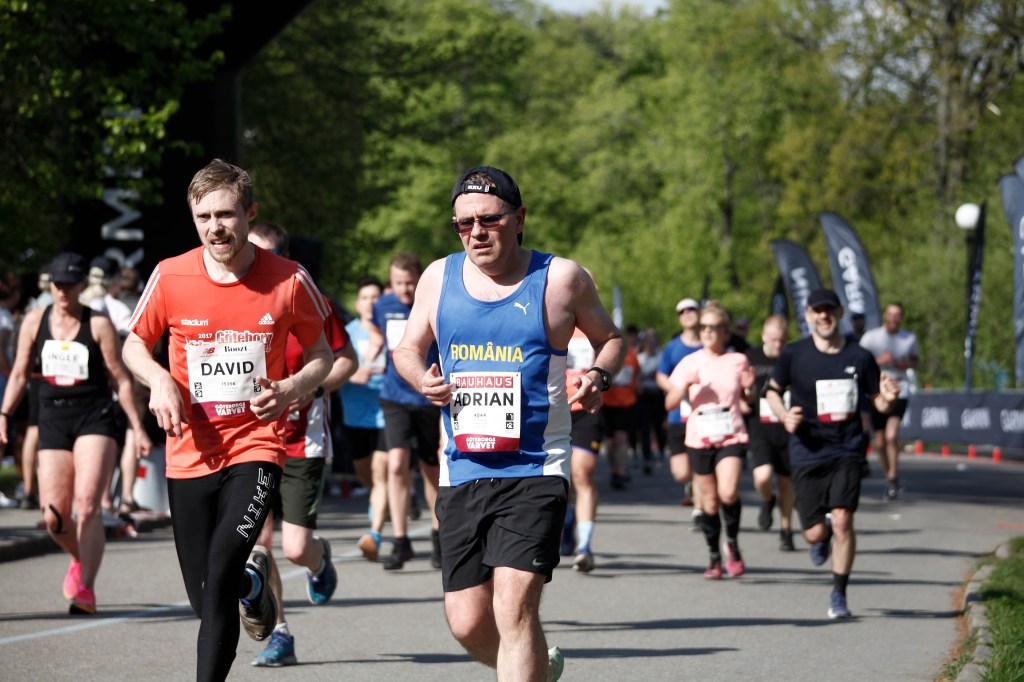
Gothenburg half-marathon 2023

Gothenburg has a long tradition of organizing running competitions. The first edition of the Gothenburg half-marathon was in 1980. Before the pandemic, there were over 60000 runners in some years participating in this famous race.

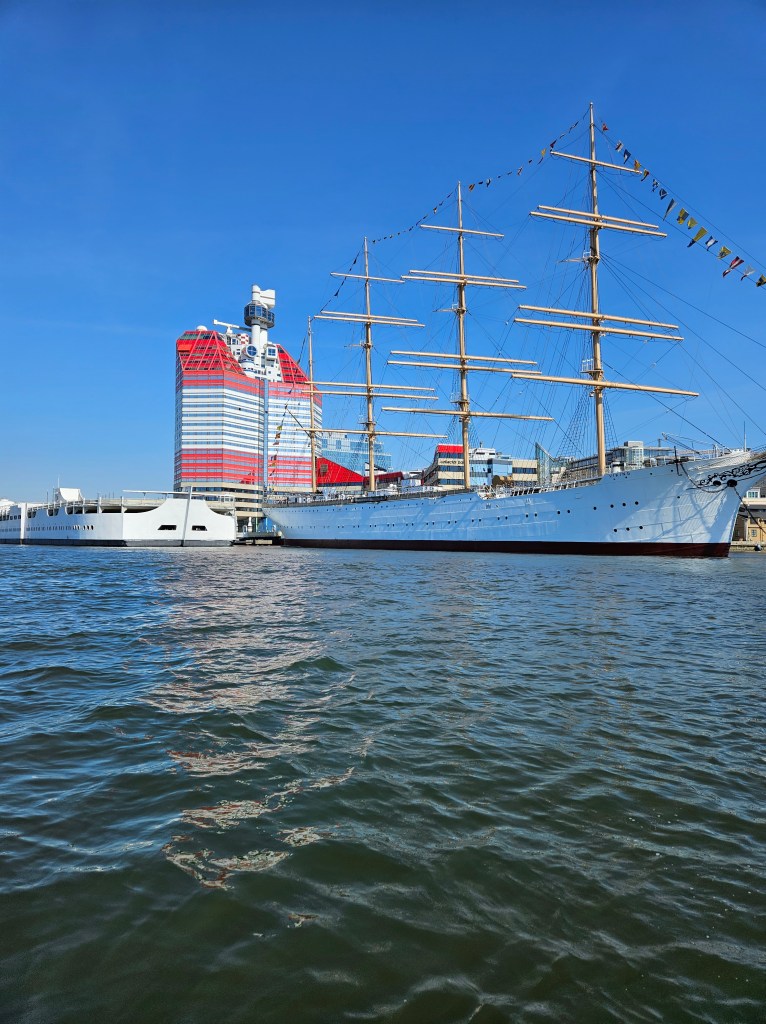
This building is called “The Lipstick” because of its shape. It is considered the ugliest building in Sweden. You have excellent views from the top of it because you don’t see “The Lipstick” building.

This year there were only 38000 people registered as the race is growing again after the first post-pandemic edition last year. Some things make this race unique. It happens on Saturday, while most marathons and half-marathons happen on Sunday. Another thing is that the race starts at 1 PM in contrast with other races that begin in the morning. People are grouped in 25 chunks, departing one after another based on their expected finishing time. Due to the grouping of people, the start lasts for 3 hours ( from 1 PM to 4 PM). If we add that the last people pass the finish line sometime after 7 PM, that makes it a full-day event in Gothenburg from the morning until evening.

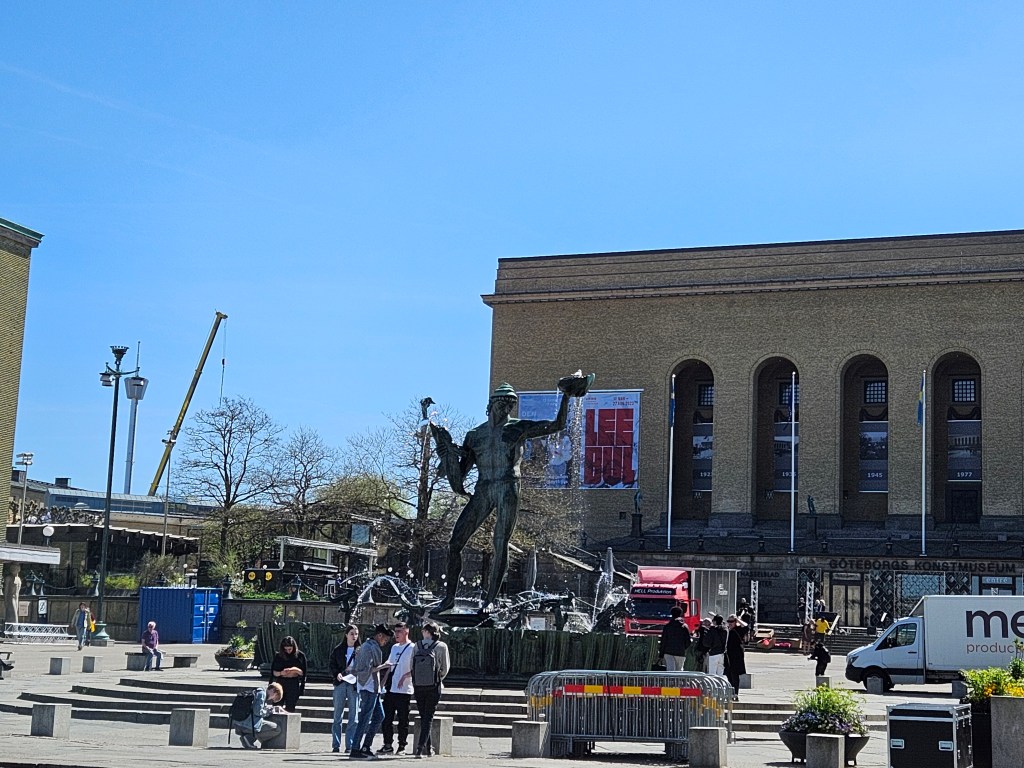
The Poseidon statue is a symbol of Gothenburg. At km 16 in the race, you run around this monument.

Each group has a designated area where the people should gather at a specific time. The organizers take that group of people and bring them to the start when their time to run has come. It is pretty impressive to see that.

Unfortunately, I was seeded by default in the group with a target time of 2:50. The only way to be moved to a faster group was to have a time faster than 1:45 in an official half-marathon ( or similar times in 10k or marathon). Based on my previous results, I wrote to organizers asking to start in the 1:50 group, but they rejected my ask because the rules needed to cover that. My suggestion to organizers is to improve those thresholds ( add more criteria, not just 1:45), as it’s not fun if you want to run with a pace of 5’15″/km to run in a group that has an average speed of 7’30″/km on narrow streets. My friend Bobo was lucky. He had an official time under 1:45 and was placed in the 1:45 group.

Skansen Kronan fortress

It was a hot day on May 13th. The organizers emailed participants the day before, asking people to keep it calm and not target personal records or good times because of the weather. On the positive side, they had water and isotonic drinks every other kilometer. That differs from most races with only 3 or 4 refreshing points on the route.

View from the fortress at km 18 of the race.

Considering these things and that the route had uphills and downhills, I decided to enjoy the sightseeing and do a slow race. To enjoy the run and the show and not care about the time. By the time I started the race, Bobo was about to finish it. There were no events during the race, and I finished at 2:10, less tired than after other races. Bobo had an ambitious race and good result finishing in 1:48. Quite impressive given the circumstances.

I liked that many improvised showers were on the route with cold water. You were supposed to run through them, but one participant in front of me stopped under the water, and I had difficulty avoiding him.

Close to the finish line after 20 km run

Another positive thing was the live singing bands. There were more live bands than kilometers on the way. They played music from classical, marching bands, rock, or PostModern Jukebox style. Generally, you’ll see three or maybe four bands in every half-marathon, but not around 20.

The finish happened inside a stadium, similar to the Malaga half-marathon, and I like this part as a running competition is historically connected with the stadium. A special mention to the wonderful crowd of people that was encouraging the runners all the way in the city. Some people brought chairs and drinks on the street and sat to enjoy the show.

Happy to have finished a difficult race

I am delighted that I had the chance to run all the races I planned last year and even one more (Malaga). That means five half-marathons in 9 months. In the meantime, I also ran 1000 km from that moment, and now I passed the 9400 km mark.

This time I will not make plans like the previous year, but I would like to run in the Bucharest half-marathon on October 15th as it would be a symbolic cross of the 10000 km run in a race that was my first half-marathon run back in 2015.

Paris half-marathon 2023

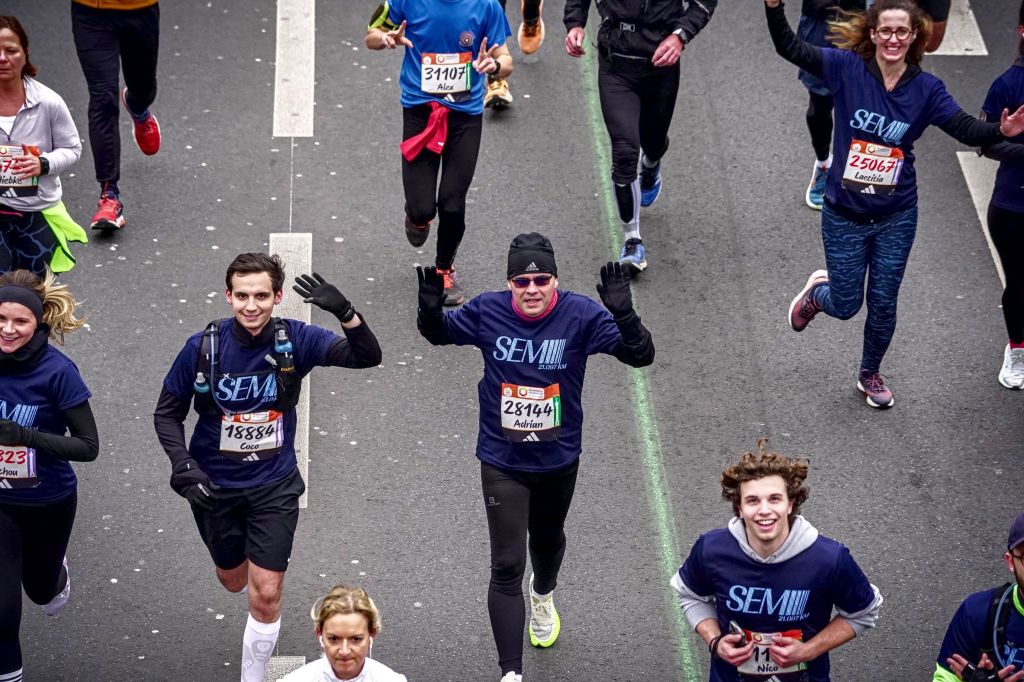
Last weekend, on March 5th, I ran the half marathon in Paris. Harmonie Mutuelle Semi was the best organized half marathon of the ones that I participated in. With over 45000 finishers, this was also the biggest running event I had ever attended.

Here are some highlights of this event for people interested in participating in the following editions. The 45k runners are leaving in groups based on the target time to finish. You know when to go at the start line. Around 200 people start every minute, then the next group follows. The time is measured from the moment you cross the start line. The route is not through the center of Paris; therefore, only a few people will try to cross the street in front of you. You can have a personalized T-shirt with your name on it. This was helpful as many people on the road encouraged the runners by their names when reading them on the T-shirt. There are lots of entertaining points during the course. Over the last kilometer, thousands of people strongly encouraged the runners, which was quite spectacular. You get an SMS with your official time once you cross the finish time. The organizers take pictures of the runners during the race, which you can pay for and download later.

I don’t know the general statistics of half marathons, but 37% of Paris participants were women, which looks great.

Suppose you want to run in France or Italy half marathons (or marathons) distance in official events. In that case, you need to obtain a certificate from sports or general medicine that you are healthy to run for such an event. A runner should get the certificate less than one year before the event. The doctor who gave me the certificate told me they conducted a study in Italy and observed that people who participated in long-distance running without proper training had a higher incidence of a heart attack after the race. Second, there were no isotonic beverages, only water or fruits at refreshments points at km 6, 12, and 17. It was the first time during a half marathon that I saw no isotonic drinks provided to runners. Isotonic drinks are absorbed faster and help you keep hydrated without decreasing performance.

The Harmonie Mutulle Semi de Paris was sold out six weeks before the race day. Keep that in mind if you want to register for next year. If they kept the registration open, there were probably 50k runners at the start.

Enthusiasm in the first part of the race

It was a cold morning in Paris last Sunday, about 5 degrees Celsius, but it was ok for a run. Runners were admitted at the start based on their Bib numbers. Trainers on platforms above the crowd were helping the participants to warm up before going into the race.

Usually, I have no aim for a particular time, but this time I made an exception. I wanted to finish in less than 1:53 to apply for the 1:49-1:53 group at the Gothenburg half marathon in May. In Malaga, I finished at 1:53:10, so I needed a better time.

I planned to take two gels and drink isotonic at the refreshments places. I took one gel after 9 km but chose not to drink water (because there was no isotonic available). In my case, drinking water slows me down until the liquid is absorbed. Because of the lack of beverages, I chose not to take the second gel.

I went a little faster than planned for the first part of the race, and things were ok until the 18th km with an average time of 5’15” per km. For the next 2 km, I struggled at a 5’48” pace. Then something happened when it seemed that I would not achieve my goal. On the last kilometer, the thousands of people strongly encouraging us created an extraordinary atmosphere for runners. That helped me regain my strength and finish with a 5’10” on that km for an official time of 1:52:40, thus achieving my goal at the last moment. I was placed 20k from 45.3k finishers.

Closer to the finish

Although it was a race with a happy ending, I’ve learned from my mistake. Next time I will drink water if isotonic is unavailable and take the second gel.

My friend Bobo had a great race finishing in 1:52:02, a fantastic time given that he was not at his full potential and was still recovering after some health issues the month before.

With Bobo before the race

The last achievement was that I passed the 9200 km run threshold in this race, and I hope to pass the 10k km later this year.

As usual, many thanks to my coach Stefan Oprina who continued to train me remotely all this time!

The Paris Half Marathon starts on the small island on the Seine river, continues on the Seine shores, and then goes around Bois de Vincennes to return on the other side of the Seine and finish on Place de la Bastille. This route reminded me of a song of Barbara: “Bien sûr nous, nous avons la Seine, Et puis notre bois de Vincennes…”. “Göttingen” is a famous song that started the rebuilding of French and Germans friendship after World War II. War is still going on, and we should hope for better times.

Barbara – Göttingen

Recommendations for half-marathon runners

Statistics say that in 2018 there were 2.1 million finishers in half marathons. This distance is becoming more popular because of its benefit for people’s health. The tips provided here are for people who aim at finishing a half marathon in the range of 1:40-2:10, which is a time that covers the majority of runners. Some recommendations apply to any runner, regardless of speed or distance.

I’ve run around 20 official half-marathons, with 5 races in 2022. My times range from 1:46 to 2:10. Here, I want to share my experiences; maybe some people will find them helpful. Of course, I made mistakes during my races and learned from them, but I made good progress in preparing for the race.

Many thanks to my coach, Stefan Oprina, who reviewed the initial form of this article and made valuable suggestions added to the text below. He has a lot of experience in running marathons and half-marathons.

This post will cover three moments: before, during, and after the race.

  1. Before the race
    • Equipment
      • Shoes
        • Try the shoes before buying them. Don’t buy them online just because you read excellent reviews or because they look nice.
        • Buy shoes with 1/2 or 1 number in size more than what you usually wear. During the race, your feet will swallow. Having more oversized shoes will help with that.
        • Don’t lace your shoes tight for the same reason as above.
        • Buy good shoes even if they are more expensive. Otherwise, you risk injuries and pay the doctors the money. I have an upper weight limit of 210-215 g per shoe. If you get injuries or black nails because of the shoe, you should stop using them. For example, I have Adidas Adizero Takumi Sen 8 and Nike ZoomX Vaporfly Next 2%. Both are under 200 g. A light shoe has a good impact on your running time.
        • Make sure your laces will stay intact during the race. Lace your shoes with a double knot and slide the tip of the laces under the lace. If, during the race, your shoes untie when you bend to lace them back, you’ll become instantly dizzy because of the blood pumping through your body. You don’t want that to happen.
      • Shorts/pants
        • Use synthetic shorts. I’ve tried many types, and so far, Nike shorts are the best for me.
        • Buy shorts that have pockets and zippers. If you have to carry a key with you, don’t risk losing it. Also, if you take a phone, gels, etc., it’s good to have more pockets to avoid your pants sliding down.
        • In the case of winter running, I prefer leggings from Salomon.
      • T-Shirts
        • Use synthetic T-Shirts. You get T-Shirts from any competition organizer.
        • Wear the T-Shirt over the shorts. When running, the shorts slide easier on the T-shirt than on the skin.
        • I put a blouse over the T-shirt if the weather is under 10 Celsius for the whole race. If you start at 8 Celsius but finish at 15 Celsius, I wouldn’t add clothes over the T-Shirt. It is better to endure cold at the start than to sweat hard during the race.
      • Other
        • Lately, I am running with a belt around the waist where I carry gels or a phone protected with a zipper.
        • You can use a cardio belt to accurately measure the pulse during the run. That is good if you follow and set your pace according to your heart rate.
        • You can add a foot pod or other devices.
    • Nutrition
      • Everyone knows about the party pasta before the race. Pasta is good because it contains carbohydrates, and the energy is released over an extended period.
      • In the morning before the race, you can get proteins.
      • Don’t drink too much coffee, especially on a sunny day.
    • Warm-up
      • Come to the start 45-60 minutes before the beginning of the race.
      • Begin with a 2 km slow run in 13-14 minutes
      • Do a stretching session for 5-10 minutes.
      • Do special runs to warm the body and prepare it for the race.
      • Run at full speed for 50-60 meters, then walk back to the starting point. Repeat this 6-8 times.
  2. During the race
    • Nutrition
      • It is possible to run a half-marathon without drinking any liquid; I have done that in the past. Now I am drinking once or twice but not more.
      • In all the races, you’ll see volunteers providing the runners’ with water and isotonic drinks every 4-5 kilometers. Drink isotonic and don’t drink water. I’ve tried both options water only made things harder for me. You are already low on minerals, and water only dilutes them.
      • It is possible to run 21.1 km without taking a gel. Before 2022 I didn’t use any gel during races. However, if you take gels, you will suffer much less during the run. Lately, I took one gel at km 9 and one at km 16. I’ve read that most people recommend one single gel after 45 minutes in the race. You need to read the contents of the gel carefully, as you are taking that at your own risk. I have limited experience with gels and can’t make a strong recommendation on this topic.
      • Don’t try any gel or something else during the race you did not experience before. I tried GU gel and Maurten jelly, and both were ok. Maurten and GU have different options with caffeine or without. You can choose whatever works for you. Keep in mind that one cup of coffee has 100mg of caffeine.
    • Strategy
      • Before each race, I make a table with intended times at 5, 10, 15, 20, and 21.1 km. I do this to ensure I run smoothly during the first part of the race. This exercise reduces the pressure on me and ensures I start slowly.
      • Human nature is to run fast for the first part of the race (you feel strong, adrenaline is high, many people around) and slow for the second part. My advice above helps you avoid this.
      • Ideally, you should start slowly and increase the pace as you go. Otherwise, for every minute you run faster in the first part of the race, you lose 2 minutes in the second part. Running fast at the beginning is a bad strategy. However, if you feel you are well-trained for a certain pace, you can start with that pace throughout the race.
      • In the most favorable scenario, you should run as fast as possible during the last few kilometers. If you have a muscular fever after the race, it means you had a good race.
      • If you feel you can’t keep up that pace, slow down. If you continue, you’ll end up in an ambulance in an optimistic scenario. In every race with more than 1000 runners, I’ve seen people lying down under medical assistance or taken to the ambulance. Some competitive people find it hard to know they are running out of steam.
      • You can follow some pacers aiming your desired time. Most races have pacemakers for 1:30, 1:40, 1:45, 1:50, 1:55, 2:00, 2:10, etc. I only used pacers to see where I was, compared to a targeted time but did not run with them.
    • Control
      • You can control your pace based on your watch. Most runners do that.
      • You can set a limit for your heart rate, and if you pass over that heart rate, you slow down.
      • You can set the desired time to finish on your watch, and the clock will tell you how you’re doing. I don’t recommend it as it adds more pressure on you to see that you are lagging N minutes.
  3. After the race
    • It is good to run 2 km at a slow pace to recover after the race, but in reality, it is less likely to be able to do that because of the crowded finishing lines.
    • If it’s your first race, you need to get some rest.
    • Otherwise, you need to drink some water and don’t stay under the sun’s heat. If it’s cold, change your clothes.
    • Celebrate, take pictures!

The purpose of this article is not to cover training for half marathons. That is a much more complex topic, and I should have covered other topics like cadence, posture, nutrition, etc.

Remember Emil Zatopek, the great runner, if all the things written here seem complicated and you lack motivation. He said: “If you want to run, run a mile. If you want to experience a different life, run a marathon.” We’re talking only about half of that here.

Malaga half-marathon 2022

We did not plan to participate in another marathon this year, but the experience of running in Copenhagen was fun, and we decided to repeat it sooner. Malaga was a good option as the weather is good for running there, even in winter.

It was the 31st edition of the Malaga half-marathon. There are many things I liked about this event. They have an official 4* hotel, and the price to stay there is 90 Eur/night alone in a room with breakfast included. This is an excellent discount of about 40 Eur/night on booking.com for the same hotel. On the day of the race, you have late check-out until 4PM to allow runners to take a shower and recover after the race before leaving for home. The organizers take pictures of the participants during the race, and you can buy all the photos later for 19 Eur if you want. Finishing inside a stadium is lovely, with people cheering from the tribune. The course is flat, with just 6 meters difference between the race’s lowest and highest points.

“to run where the braves dare not go” – Man of La Mancha

I did not like that you turn 90 degrees left immediately after the start, and people had to stop there because of a bottleneck. You start running and immediately stop because of that. As a result, I ran my first km in 6 minutes, compared with an average of 5’20″/km for the whole race. It was also hot weather that day, November 13th.

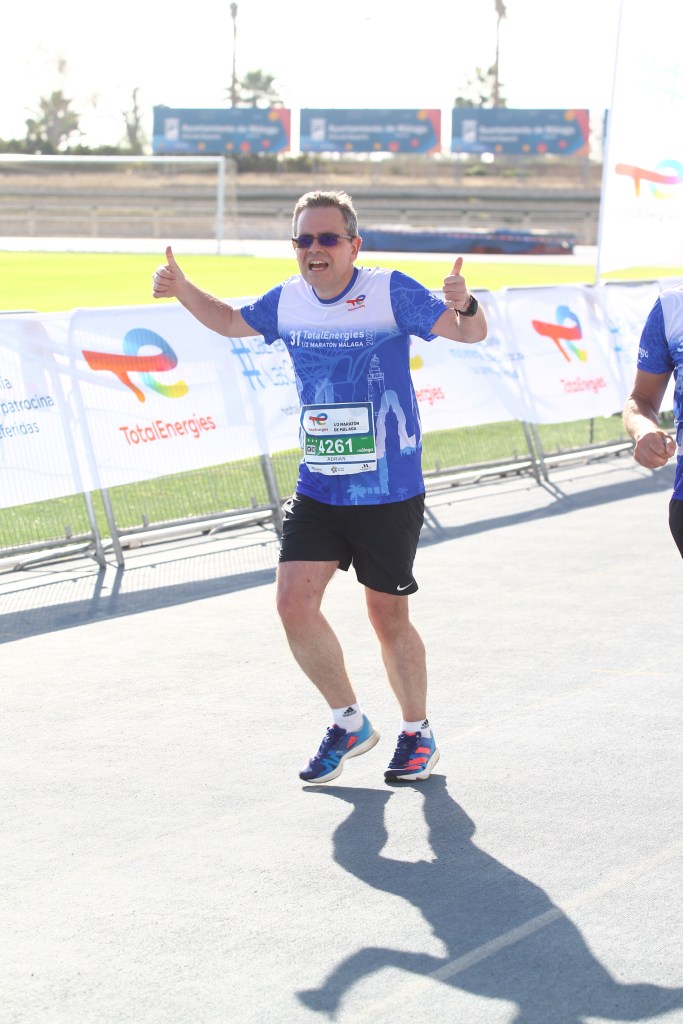
Although the pictures show something else, I did not run with my thumbs up for the whole race 🙂

The race was perfect for me despite the first kilometer and the need to recover that lost time. I was hoping for my best time this year, below 1:54, but I knew that I couldn’t do much better because of the injury that limited my training. I did not put pressure on myself, just enjoyed the run. This race went according to my plan, with a slower start and constantly increasing speed throughout the distance.

Palm trees are on both sides of the street for the whole distance.

The start and finish are close to the airport. The participants run on the street next to the beach towards the city center for 10-11 km and then return. It is a race on asphalt but near the beach. You enjoy the sea breeze and see the waves. Because it’s a flat race, the elite runners finish it in 1 hour or even less. Also, 50% of the finishers had a time better than 1:52:30, which makes it a speedy race.

Unfortunately, a 58-year-old runner died after finishing the race, as I read later that day the news. It was the first time since I ran half marathons that such a tragic event happened in a race where I ran. Statistics say that in marathon races, 1 runner dies for every 150000 finishers, while for half-marathon, the death rate is 40% lower. The advantages that running brings to one’s health are worth taking this minimal risk.

Inside the stadium at the finish line

This was my 5th half-marathon in 2022 and the one where I got my best result in 1:53:10. The rest were in 1:54 except for Krakow, where being injured, I had to stay with 2:00. I learned my lesson after the mistake I made when preparing for Krakow half-marathon. I took a break for a week before preparing for Malaga, which was a good idea. This time, the Voltaren and Nurofen were enough for a race without pain before the start. My focus was not on time but on reducing the pain and enjoying the race.

In long-distance running, you must learn from your mistakes to avoid suffering.

With Bobo after finishing the race

As always, many thanks to my coach Stefan Oprina who provided me training programs remotely and discussed the plans and strategy for each run! He has done that for the past 5 years. A coach is vital for people who intend to run many long-distance races.

I am happy that I could finish five half-marathon races this year, and I hope that by the end of 2023 to run at least one half-marathon in less than 1:50. I know what training needs to be done to reach that level as I had run 3 times half marathons in less than 1:50 in 2018 and 2019.

Krakow half-marathon 2022

For people interested in running, the Krakow half marathon offers great city center views and an excellent organization. The city hall organizes the event. During this race, you will run next to the world’s oldest mall, from the XIII century that is still open, churches 1000 years old, the Wawel castle, and finish inside the biggest arena in Poland, the Tauron Arena.

I like that they offer the best pictures for runners, the race course is very well-guarded, and the pedestrians don’t get in front of runners like in other races. The transport in the city is free for runners that day. You also get an SMS with your time once you finish the race.

The race course is not flat as Copenhagen, and this can be seen in finishing times. One useful metric is the time of the runners at the middle of the ranking. For example, that average was 1:55 in Copenhagen and 1:58 in Krakow. The number of runners is also lower, with a limit of 7000 runners this year. Last year the maximum allowed number of participants was 5000. They could increase this limit to at least 10000 runners. There are pacemakers for all types of people from 1:25 to 2:30. Although only a few runners can keep up with 1:25 or even 1:30; for example, in Bucharest this year, precisely one person was running with the 1:30 pacemakers. As I mentioned in Bucharest, the week before this race was MIB with 1700 runners in the half marathon race with an average time of 2:04. MIB’s average time was slow as the route is flatter than in Krakow.

Usually, I don’t run with the official T-Shirt, but this one I liked

The weather was perfect on October 16, in the range of 15-19 Celsius. Many people encouraged the runners along the way, which was a positive attitude during the race. However, what surprised me was the considerable number of people injured that needed medical assistance during the running. In every half marathon I have run until now, I saw 2-3 people fall injured during the race. I saw maybe seven people lying down on the last kilometers of this run, and I don’t know why.

After 8 km, everything was ok.

Another thing that impressed me was a blind runner tied up to another runner. The other runner was also guiding him. Blind runners for long distances are rare (or I haven’t seen them). I am used to blind chess players, which is quite common in tournaments. Blind chess players can rely on their opponents to make the moves, and it’s easy. Blind runners need someone to be able or willing to run a half marathon at their speed. Training for a long-distance race might be difficult, too.

Smile though your back is aching

The October half marathon has a special meaning for me. In October 2015, I ran my first half-marathon race in Bucharest. Since then, I ran every year a half marathon distance in October. Even when injured (like this year) and even in 2020 when there was no official race because of Covid. Since 2015 I have run more than 8500 km and around 20 half marathons. It is never too late to make a change in life.

Smile even though it’s breaking

I was under an injury after Copenhagen when I started preparing for the Krakow half marathon. When you run only 12 km long runs and then you participate in a half marathon, there is a risk that you will get injured during or after the race. The reason is that the difference between 12 to 21 km run is hard to be absorbed by the body. That is why when increasing the running volume, you should do that by 10-20% every week, but not more. You run 12 km, then 14, 16, and 18, and only then are you ready for the half marathon. I knew that, but I hoped that I would be fine. It wasn’t the case. I got a muscle injury in the back area of the left kidney. After three half marathons in 1:54 this year, I wanted to finish one at a better time and pushed the limits. I made a mistake and learned from it. On a positive note, since Copenhagen, I have lost three kilograms by reducing sweets. They say that if you drop five kilograms, you could improve the half-marathon result by 10 minutes. That works until you reach the ideal weight, then the time to finish increases if you continue to lose weight.

When there are clouds in the sky, you’ll get by.

On the morning of the race, I took Nurofen, used Voltaren, and hoped for the best. Things were ok until the 16th kilometer. At that time, the race predictor estimated I would finish in 1:56. Unfortunately, the pain in my back started to grow. I decreased the pace directly proportional to the increasing pain. Around 18km, I thought to walk instead of running. From a speed of 5’20” -5’30” per km up to that point, I had to drop to 6’30″/km. At km 20, somehow, the pain was gone, but I chose not to push my luck. There was not much to do anyway. The official time was 2:00:16. Ranked 3377 from 6605 people who finished the race.

Fun section. My running club is called in Romanian “Trupa lui Fane”. In English, that translates to Fane’s group or Fane’s team. But in Polish, this reads as “Lui Fane’s corpse”. In Romanian, “trup” means body, but in Polish means dead body. The word has Slavic origin in both languages, but the meaning evolved differently. The word “trupa” is a genitive form of “trup”. All the other runners could see my club on the registrations page. In Polish, “Trupa lui Fane” sounds more like a club for pirates than for runners.

I want to thank Stefan Oprina for training me remotely this year!

Copenhagen Half Marathon 2022

As mentioned previously, I wanted to participate in Copenhagen Half Marathon. It was my third race for this distance in 2022. It was also the race with the most participants I ever ran. The maximum number of participants was 25000, and the race was sold-out more than a week before the run.

This time I ran with Bobo and Cristi, my colleagues from “Trupa lui Fane”. That Sunday, it was perfect weather for a run. The temperature was about 12-13 Celsius, but not windy nor raining.

Obviously, at the start of the race, it was an immense crowd of people and it wasn’t easy to move. I did not like that friends or relatives of runners who were not running themselves stayed in the runners’ area despite officials asking them to leave. In all the other half marathons, only people who had bib numbers were allowed at the start zone. It was so crowded that it took us more than 12 minutes to pass the start line from when the officials gave the start. By the time we passed the start line, the first runners had already run more than 4km! This is not a problem because you are evaluated by the times you cross the start and finish line.

With my colleagues after the race

The race was excellent, with many people on the streets encouraging the runners. The race is flat and is suitable for speed. In 2019 a runner beat the world record in the half marathon on this route. There is no pollution in the city as people travel primarily by bike in Copenhagen.

I started with a pace of 5’30” for the first 10km, then went a little faster. I was tired after km 18 but recovered at the last km. In the final straight line, I started to run fast, but many people ahead were running slowly. There were so many people that it was impossible to run around them. For example, Bobo finished less than one minute ahead of me. Yet, in that minute, more than 500 people crossed the finish line. My time was 1:54:45. It was my 3rd half marathon this year, and every time I finished in one hour and 54 minutes.

However, I am happy with my time, as I was targeting 1:56. The reason is that I was not prepared well for the race, and I had no long runs over 13km in the last two months. In this situation, starting at a slower pace and increasing the speed in the second part of the race was expected.

Happy after the race

The event was well organized and transmitted live on Eurosport 2. There was a mobile app that gave you all the needed info, and I received an SMS with my time once I passed the finish line. There were discounts on urban transport that day for runners and Hydration points at every 3 km during the race.

It happened by a rare coincidence that my sister’s family was visiting Copenhagen at the same time as we did. The day before the race, I had the chance to see her and my niece after more than one year.
I liked Copenhagen, and this half marathon is a race I recommend.

Poland Business Run

Every year in Krakow, on the first Sunday of September it is organized a major running competition for companies, Poland Business Run. This event aims to help people with muscle and bone disabilities using money from sponsors and registration fees.

Each participating company could enlist one or more teams of 5 people who run a 4 km course in relay format. For example, we had five such teams. The limit was for 2000 teams meaning 10000 runners. Besides the on-site teams, there was the possibility of registering teams of people that would run remotely. We also had one such group.

My experience with relay running was minimal, with only one race in 4x400m at an indoor championship in 2020. The context was that one team from “Trupa lui Fane” was short of a team member. They insisted on not letting them down, and eventually, I accepted, although I had no idea how to run a 400m race.

The experience was painful because to run 400m, you need to train a different set of muscles than for a long run. During that race, the competing teams consisted of people who ran 400m in 50 seconds. I still remember the speed they had when passing next to me. I have never before and since seen something similar. Although I was running as fast as I could, the feeling was that I wasn’t moving when they sped next to me.

On the other hand, the Business Run was not a typical relay race. Standard relays in athletics are 4X100m or 4x400m. There is also the Bacanic relay with 4 distances progressive 100m, 200m, 400m, and 800m. You can see this relay at the Balcanic athletics championships.

Last year I was in Bucharest running a half marathon during the Business Run. They allowed runners remote, and I wrote about my experience participating in two competitions simultaneously in a previous post.

At the start of the race

This year I was starting in a team of five with four other colleagues. Each team member was waiting for their turn in a designated area. Then we took the baton from the previous colleague, ran 4 km, and passed it to the next colleague. My average time was 4’49” per km, which is ok. I am slowly improving my running times each week.

My only complaint to organizers would be on how the exchange of the baton happened. Although we stayed in a specific area, too many people were waiting there, and it was very crowded. You did not know when your team member was going to show up. I’ve seen people who reached the area and shout for his following exchange to pick the baton.

Crowded relay exchange areas

I wrote this post because such an event could be organized in many cities worldwide. Companies pay for registration, and relay running is a team-building activity. People run and improve their health. In the end, everybody wins.

…and the race starts!
Small video with the event organized today